



WATER CANNON | Chinese Coast Guard Stops Philippines From Resupplying Troops On BRP Sierra Madre
This was not the first time China used water cannons to prevent the Philippines from delivering supplies to BRP Sierra Madre on Ayungin Shoal.
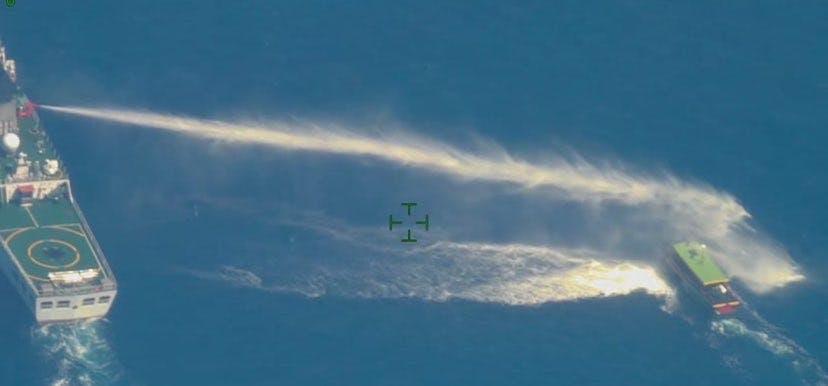
A Chinese coast guard vessel had stopped a Philippine wooden boat from bringing food, fuel, water and other supplies to troops stationed at a rusting ship in the West Philippine Sea, a military spokesman said on Sunday, Aug. 6.
Col. Medel Aguilar said the Chinese coast guard trained its powerful water cannon on a boat hired by the military to bring supplies to Marines deployed on BRP Sierra Madre which ran aground on Second Thomas Shoal or Ayungin Shoal on Saturday morning, Aug. 5.
“Because of the Chinese Coast Guard’s dangerous maneuvers, the second supply boat was not able to unload the supplies and could not complete the resupply mission,” Aguilar said in a statement.
This was not the first time China used water cannons to prevent the Philippines from delivering supplies to BRP Sierra Madre on Ayungin Shoal.
In June, Chinese militia vessels also tried to block two Philippine Coast Guard (PCG) vessels, which were escorting two resupply wooden boats, to go near Ayungin shoal.
There was even a near collision between the PCG vessel and a Chinese coast guard ship which shadowed the local ships.
Both the Armed Forces of the Philippines and the PCG condemned the latest actions of the Chinese Coast Guard.
“Armed Forces of the Philippines strongly condemns and expresses grave concern over the China Coast Guard’s (CCG’s) excessive and offensive actions against Philippine vessels near Ayungin Shoal,” Aguilar said.
“One of our chartered supply boat was blocked and water cannoned by a CCG vessel…(on) August 5, while en route to Ayungin Shoal for a routine troop rotation and resupply mission, in wanton disregard of the safety of the people on board and in violation of international law, particularly the 1982 United Nations Convention on the Law of the Sea (UNCLOS) and the 2016 Arbitral Award.”
For its part, the PCG said: “The Philippine Coast Guard (PCG) strongly condemns the China Coast Guard's (CCG's) dangerous maneuvers and illegal use of water cannons against the PCG vessels escorting the indigenous boats chartered by the Armed Forces of the Philippines (AFP) yesterday, 5 August 2023.”
“Such actions by the CCG not only disregarded the safety of the PCG crew and the supply boats but also violated international law, including the 1982 United Nations Convention on the Law of the Sea (UNCLOS), the 1972 Convention on the International Regulations for Preventing Collisions at Sea (COLREGS), and the 2016 Arbitral Award,” the PCG statement added.
Both the military and coast guard called on China to act responsibly as a member of the international community.
“We call on the China Coast Guard and the Central Military Commission to act with prudence and be responsible in their actions to prevent miscalculations and accidents that will endanger peoples' lives,” Aguilar said.
For its part, the PCG called on the China Coast Guard “to restrain its forces, respect the sovereign rights of the Philippines in its exclusive economic zone and continental shelf, refrain from hampering freedom of navigation, and take appropriate actions against the individuals involved in this unlawful incident.”
“We ask that China Coast Guard, as an organization with a responsibility to observe state obligations under UNCLOS, COLREGs, and other relevant instruments of international maritime safety and security, to cease all illegal activities within the maritime zones of the Philippines,” it said.
China claims almost the entire South China Sea, a strategic waterway where $3 trillion worth of seaborne goods pass every year.
Brunei, Malaysia, the Philippines, Taiwan and Vietnam also have conflicting claims in the sea believed to have rich deposits of energy resources.
China and the ten member countries of the Association of Southeast Asian Nations have been negotiating to adopt a formal Code of Conduct to ease tensions in one of the flashpoints in this part of the world.


