



‘Vague And Unconstitutional’: Here’s Why Four Petitions Seek SC Junking Of The Anti-Terrorism Act
The petitioners cite several reasons for asking the Supreme Court to nullify the Anti-Terrorism Act. These are just some of highlights of their petitions against the allegedly vague and unconstitutional measure.
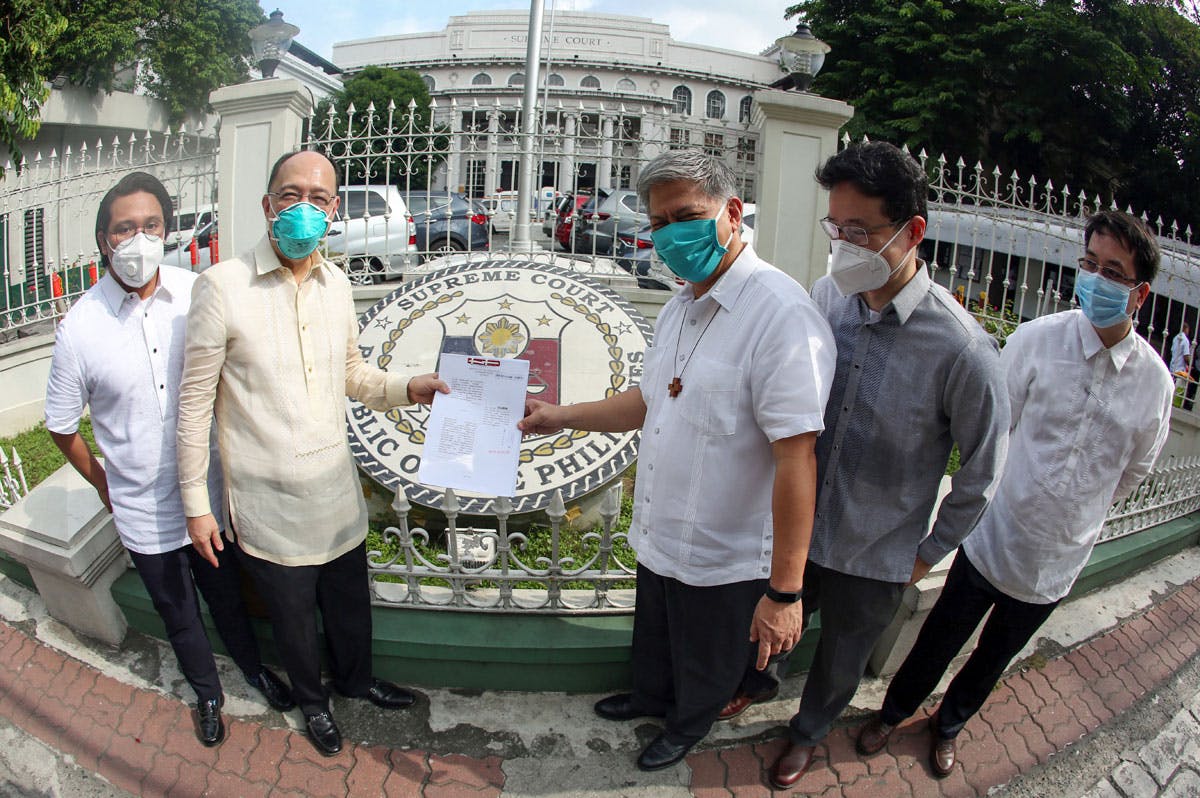
Four petitions were swiftly filed on the first weekday following the enactment of the Anti-Terrorism Act – bringing to the Supreme Court the battle against a law that opponents condemn for what they describe as its vague provisions and violations of human rights and principles enshrined by the Constitution.
The focus now turns to the highest tribunal in the land, which had cited procedural grounds in dismissing challenges to the constitutionality of the Human Security Act in the Oct. 5, 2010 decision on Southern Hemisphere Engagement Network Inc. versus Anti-Terrorism Council and the Sept. 24, 2013 decision on Republic versus Roque. The petitioner in Republic v. Roque was former human rights lawyer and now presidential spokesman Harry Roque.
According to Roque, the new Anti-Terrorism Law or Republic Act No. 11479 would take effect – and repeal the Human Security Act of 2007 (RA 9372) – on July 18, 15 days after President Duterte signed it into law on Friday, July 3.
Roque considered the uploading of the bill in the Official Gazette website to fulfill the requirement of Section 58 for the law to take effect 15 days “after its complete publication in the Official Gazette or in at least two newspapers of general circulation.” Sources in the National Printing Office said the law had not been forwarded for inclusion in the print version.
Even before the Anti-Terrorism Act took effect, lawyer Howard Calleja led the electronical filing of their petition on July 4, a Saturday. They then filed a physical copy on Monday, July 6, the first workday that also saw other groups of petitioners flock to the SC for its intervention.
Calleja’s co-petitioners are lawyer Joseph Peter Calleja, University of the Philippines professor Christopher John Lao, De La Salle Brothers Inc. (represented by former education secretary Armin Luistro), Reynaldo Echavez, Napoleon Siongco and Raeyan Reposar.
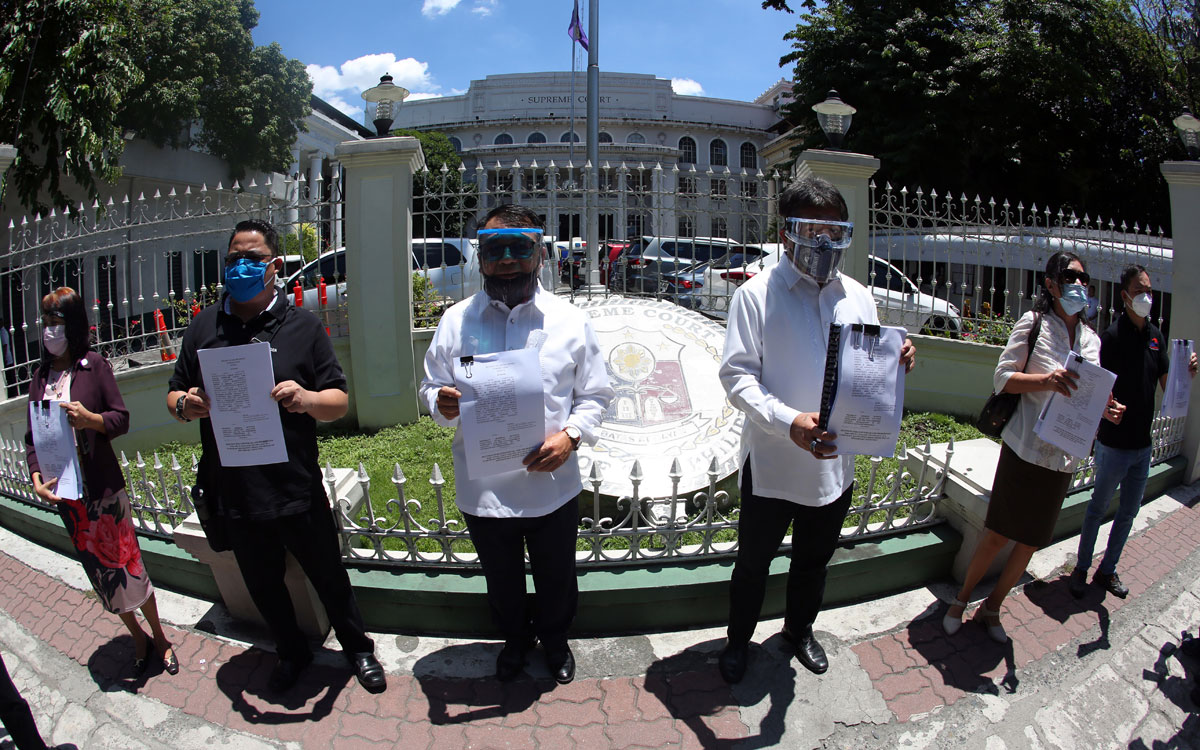
The filing of the three other petitions was led by Albay 1st District Rep. Edcel Lagman, Far Eastern University (FEU) Institute of Law dean (and host of One PH public affairs show Relasyon) Melencio Sta. Maria, and members of the Makabayan party-list bloc.
Lagman filed the petition on his own. Sta. Maria was joined by Eirene Jhone Aguila, Gideon Peña, Michael Tiu Jr., Francis Euston Acero, Paul Cornelius Castillo and Eugene Kaw, who are faculty members of FEU Law and other law schools.
Makabayan’s incumbent House members are Bayan Muna party-list Rep. Carlos Isagani Zarate, Ferdinand Gaite and Eufemia Cullamat, Gabriela Women’s party Rep. Arlene Brosas, ACT Teachers Party-list Rep. France Castro, and Kabataan party-list Rep. Sarah Jane Elago. Party officials who joined the petition were Bayan Muna president Saturnino Ocampo and chairperson Neri Colmenares, Makabayan co-chair Liza Maza and secretary-general Nathanael Santiago, ACT Teachers party-list president Antonio Tinio, and Anakpawis party-list vice president Ariel Casilao.
All the petitioners filed for certiorari and prohibition with a prayer for temporary restraining order and writ of preliminary injunction against Anti-Terrorism Council (ATC) chairperson Executive Secretary Salvador Medialdea and its members.
It was only the Makabayan bloc that added Duterte in its list of respondents. Lagman included as respondents the Senate represented by Senate President Vicente Sotto III, and the House of Representatives represented by Speaker Alan Peter Cayetano.
Lagman and the Makabayan bloc both prayed that the SC, after due proceedings, nullify the Anti-Terrorism Act of for being replete with constitutional infirmities.
Lagman asked that a writ of prohibition be issued against Medialdea, the ATC and the Anti-Money Laundering Council to prohibit them from enforcing the new law.
The Makabayan bloc requested the SC to restrain and enjoin the respondents from implementing RA 11479 and from promulgating the implementing rules and regulation (IRR) while their petition is pending.
Other petitioners only asked that some sections of the new law be declared null and void.
Procedural grounds
For the petitioners to mount a challenge to the constitutionality of the Anti-Terrorism Law, they would have to succeed in pushing procedural arguments – or hope that the SC would see the “transcendental importance” of the issues.
Lagman said it should not matter that the law was not yet in effect, as he noted that the SC still ruled on the constitutionality of the Responsible Parenthood and Reproductive Health Act even though the petition was filed only 12 days after it was signed into law.
The Calleja petition said there was no need for “an actual case or controversy” to occur before the act could be assailed. It said the law could be subjected to a “facial challenge” since the vague and overbroad text of the law encroaches on the freedom of speech.
It argued that the law’s provisions are so vague and overbroad that they cause a “chilling effect” on people in exercising their freedom of speech, instilling fear that authorities could use loopholes to arrest and detain them.
Similarly, the Sta. Maria petition argued that the act would affect the “academic freedom of institutions of higher learning.”
Although the definition of terrorism under Section 4 of the Anti-Terrorism Act states that it “shall not include advocacy, protest, dissent, stoppage of work, industrial or mass action, and other similar exercises,” the Sta. Maria petition said this would “not adequately protect against this unconstitutional incursion into the most sacrosanct of our rights.”
It zoomed in on the caveat that the dissident actions should be “not intended to cause death or serious physical harm… or to create a serious risk to public safety.”
Lagman also raised the same argument, and added that the “facial challenge” should also be extended to the Anti-Terrorism Act provisions that would affect “other civil liberties and fundamental freedoms.”
All groups of petitioners invoked their standing as citizens and taxpayers, with Lagman and the Makabayan bloc meeting the criterion of being legislators to argue the transcendental importance of the case.
The Makabayan bloc claimed to be “immediately in danger of sustaining some direct injury.” It cited the official statements posted in the Facebook page of the National Task Force to End Local Communist Armed Conflict, which “tagged” the petitioners and their party-list as “terrorists.”
‘Vague’ definition of terrorism
The Calleja petition argues that the vagueness of the definition of terrorism in the new law violates substantive due process because “men of common intelligence would necessarily guess as to their meaning and differ as to their application.”
The definition of terrorism under the Human Security Act used to specify “predicate crimes” such as piracy, rebellion or insurrection, coup d’etat, murder, kidnapping, arson, hijacking, highway robbery, illegal possession and manufacture of firearms and explosives, and violations of the laws regulating toxic substances and nuclear wastes and atomic energy.
This was replaced by some criteria that opponents deemed vague, such as engaging in acts “intended to cause death or serious bodily injury to any person, or endangers a person’s life,” acts “intended to cause extensive damage or destruction to a government or public facility, public place or private property,” and acts “intended to cause extensive interference with, damage or destruction to critical infrastructure.”
Makabayan noted that “anything and everything is susceptible of being considered as – terrorist, whether punished as criminal under existing laws or not punished – in other words, innocent.”
The key word of the definition is “intention”; Section 4 even considers certain acts to be terrorism “regardless of the stage of execution.”
The Sta. Maria petition noted that the wording of Section 4 provided for a “more apparent-than-real” definition of terrorism.
“Section 4 suggests that anyone can be pointed to as suspect of terrorism even if the person is not engaged in any illegal activity,” the Calleja petition pointed out. It added that there was no definition of the terms and concepts used to describe terrorism.
Makabayan stresed that the definition was “so broadly framed as to sweep any speech and any act which would otherwise be protected.” It could even include “internal acts,” which Makabayan argued are “beyond the sphere of criminal law.”
As an example, a rally or strike could now be misconstrued as being “intended to cause” injury to persons, damage to property or interference with infrastructure, the group noted.
Makabayan cited the statement of National Security Adviser Hermogenes Esperon Jr. on July 4, the day after the President signed the bill into law: “Ngayon, kung sino ang nagsasabing ito ay para sa kanila at tahimik naman sila eh huwag silang mababahala (Now, whoever says it is aimed at them and they are quiet, eh, they should not worry).”
Makabayan noted that even the phrase “endangers a person’s life” would be “nebulous,” considering the recent arrests of quarantine violators, relief workers and protesters “during the COVID-19 quarantine period, ostensibly because they ‘endanger’ the health and lives of others.”
“This discriminatory enforcement is a real possibility due to the very imprecise, ambiguous manner of defining terrorism,” its petition read.
Section 4 also states that the purpose of intimidating the general public, creating an atmosphere of fear, provoking the government or seriously destabilizing the structures of the country can be determined by the “nature and context” of acts constituting terrorism.
Makabayan pointed out that there is no definition for the phrase “nature and context” in the Anti-Terrorism Law, the Revised Penal Code, special penal laws and even international law.
“The implementors of the law, who have actually called (petitioners) and their organizations, as well as other dissenters, terrorists, will have unbridled discretion to select the targets of the new terror law including those from among critics and the opposition,” the petition read.
Lagman pointed out that “there is no certainty as to what the law actually seeks to proscribe,” especially since the new law deleted the Human Security Act’s requirement for a “political motive,” or the coercion of the government to “give in to an unlawful demand,” to be established.
Warrantless arrest on suspicion
Section 29 is also one of the most controversial provisions of the new law. It allows authorities to arrest and detain persons “suspected” of committing terrorist acts even without a warrant from the court, as long as they have the authorization of the ATC.
The ATC is not part of the judiciary. It is a nine-member body chaired by the executive secretary and composed of Cabinet officials as well as the executive director of the Anti-Money Laundering Council.
The Makabayan petition emphasized that Section 29 violates the principle of the separation of powers. It cited Article 3, Section 2 of the Constitution, which states that “no… warrant of arrest shall issue except upon probable cause to be determined personally by the judge.”
It said allowing warrantless arrests based on the ATC’s authorization would effectively “usurp such function textually committed by the constitution to a judge.”
The Makabayan and Sta. Maria petitions also assailed the provision for allowing authorities to take suspects into custody “without probable cause.”
Section 29 does not state the requirement of the existence of “probable cause” for arrests to be made, despite it being mandated by the Constitution. Instead, it merely states that persons could be taken into custody even if they are merely “suspected of committing any of the acts defined and penalized” by the law.
“Mere suspicion cannot be the basis of a warrantless arrest,” the Sta. Maria petition emphasized. It said the word “suspected” could only be interpreted according to its ordinary meaning, because it was not even defined anywhere in the law. This could only be understood according to its dictionary definition: “suspecting something wrong without proof or on slight evidence.”
The Sta. Maria petition said this was contrary to the SC’s 2014 decision on Pestilos versus Generoso, which stated that warrantless arrests should be “based on probable cause to be determined by the arresting officer based on his personal knowledge of facts and circumstances that the person to be arrested has committed a criminal offense.”
Meanwhile, Lagman said Section 29’s provision for a maximum of 24 days in detention without being charged in court “exceedingly infringes on a person’s personal liberty and his right against warrantless arrests or detention.”
He said this is “conducive to the person detained being tortured or coerced into involuntary confession by law enforcers, notwithstanding motherhood declarations of safeguards.”
The Sta. Maria petition underscored that 24 days would be nearly as long as imprisonment for a crime punishable by arresto menor – “a deprivation of liberty that can only be imposed upon a judgment based on a finding of guilt without reasonable doubt.”
The Makabayan petition noted that this would be inconsistent with the Constitution, because Article 7, Section 18 limited the detention of persons without charges to a maximum period of three days during the suspension of the privilege of the writ of habeas corpus. – With Evelyn Macairan


