



Symbolic 8 Billionth Baby Born In Manila
The Commission on Population and Development expressed hope that Baby Vinice will be a symbol of development in the future, and that more meaningful programs will be launched for newborns like her.
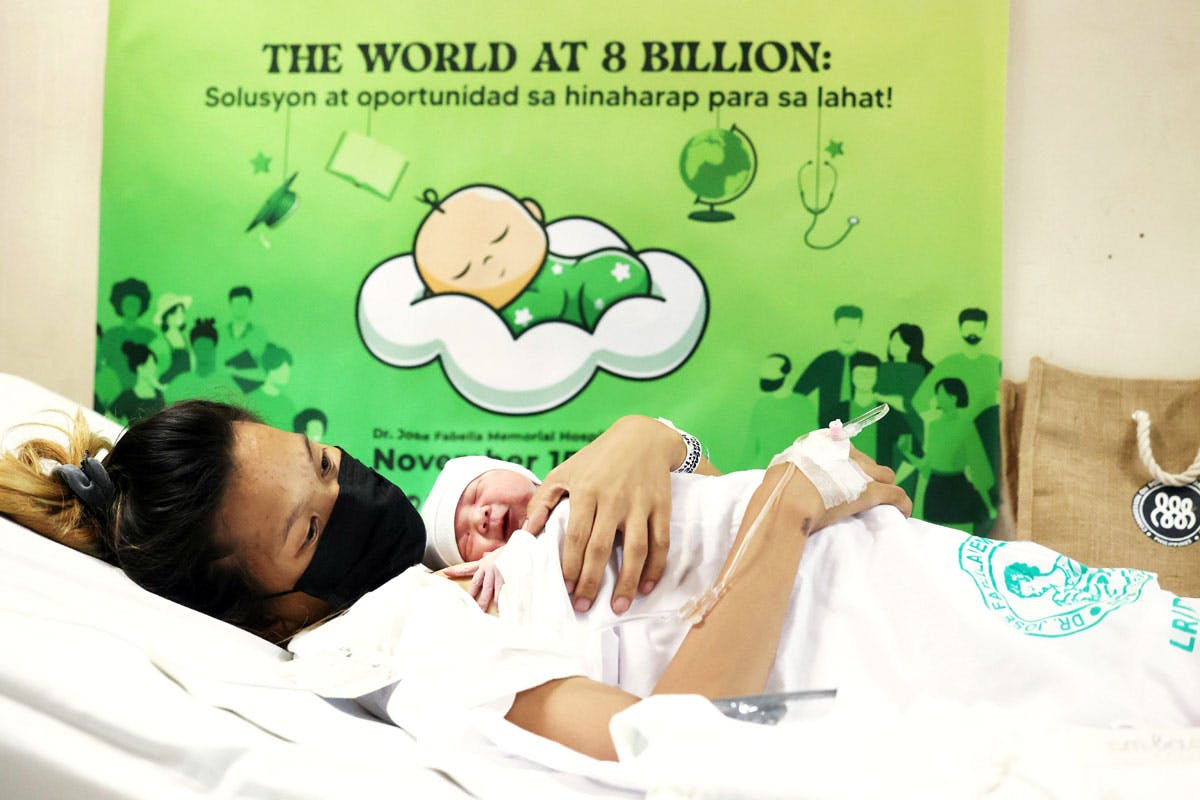
A baby girl born in a Manila hospital on Tuesday, Nov. 14, was chosen to mark the eight billionth person in the world.
Weighing 5.82 pounds, Baby Vinice was born at the Dr. Jose Fabella Memorial Hospital at 1:29 a.m.
According to the hospital’s chief medical professional staff, Dr. Romeo Bituin, Baby Vinice was born through normal delivery.
“We just witnessed the world’s eight billionth baby in the Philippines. We waited around two hours starting at 11 p.m. on Monday (Nov. 14) and the baby was delivered at around 1:29 a.m.,” Bituin said.
“This can somehow serve as an inspiration for the hospital to further improve our guidelines and procedures in taking care of pregnant patients and their babies,” he added.
The baby’s mother, 27-year-old Maria Margarita Eugenio Villorente, said she is happy that her daughter is considered as the world’s eight billionth baby.
Villorente said she just wants her baby to grow up healthy.
The Commission on Population and Development (PopCom) expressed hope that Baby Vinice will be a symbol of development in the future, and that more meaningful programs will be launched for newborns like her.
On Monday, the PopCom said the total fertility rate of Filipino women aged 15 to 49 stands at 1.9 children, from 2.7 children in 2017.
Citing data from the National Democratic Health Survey (NDHS), the PopCom said the country has reached the replacement fertility level of 2.1 children.
Replacement fertility level refers to the fertility rate at which women give birth to enough babies to sustain population levels.
The PopCom said the updated NDHS validates the Philippine Statistic Authority’s findings last February that the Philippines is now in a “demographic transition,” characterized by a situation when a country has a low level of fertility and mortality.
With the world now having eight billion people, the Philippines is among eight countries where more than half of the projected increase in global population up to 2050 will be concentrated.
According to the World Population Prospects 2022, India is projected to surpass China as the world’s most populous country in 2023.
More than half of the projected increase in the global population up to 2050 will be concentrated in eight countries: the Democratic Republic of the Congo, Egypt, Ethiopia, India, Nigeria, Pakistan, the Philippines and the United Republic of Tanzania.
The global population is growing at its slowest rate since 1950, having fallen under one percent in 2020.
The latest projections by the UN suggest that the world’s population could grow to around 8.5 billion in 2030 and 9.7 billion in 2050.
It is projected to reach a peak of around 10.4 billion people during the 2080s and to remain at that level until 2100.
While it took the global population 12 years to grow from seven to eight billion, it will take approximately 15 years or until 2037 for it to reach nine billion, a sign that the overall growth rate of the global population is slowing.
World Population Prospects 2022 also states that fertility has fallen in recent decades for many countries.
Today, two-thirds of the global population lives in a country or area where lifetime fertility is below 2.1 births per woman, roughly the level required for zero growth in the long run for a population with low mortality.
The populations of 61 countries are projected to decrease by one percent or more between 2022 and 2050, owing to sustained low levels of fertility and, in some cases, elevated rates of emigration.
Global life expectancy at birth reached 72.8 years in 2019, an improvement of almost nine years since 1990. Further reductions in mortality are projected to result in an average global longevity of around 77.2 years in 2050. In 2021, life expectancy for the least developed countries lagged seven years behind the global average. – With Pia Lee-Brago


