Some Siargao Residents Saved By Mangrove Forest From Odette
Siargao Island’s largest mangrove forest in located in the municipality of Del Carmen, which was able to protect residents hit by a storm surge during the onslaught of Typhoon Odette on Dec. 16.
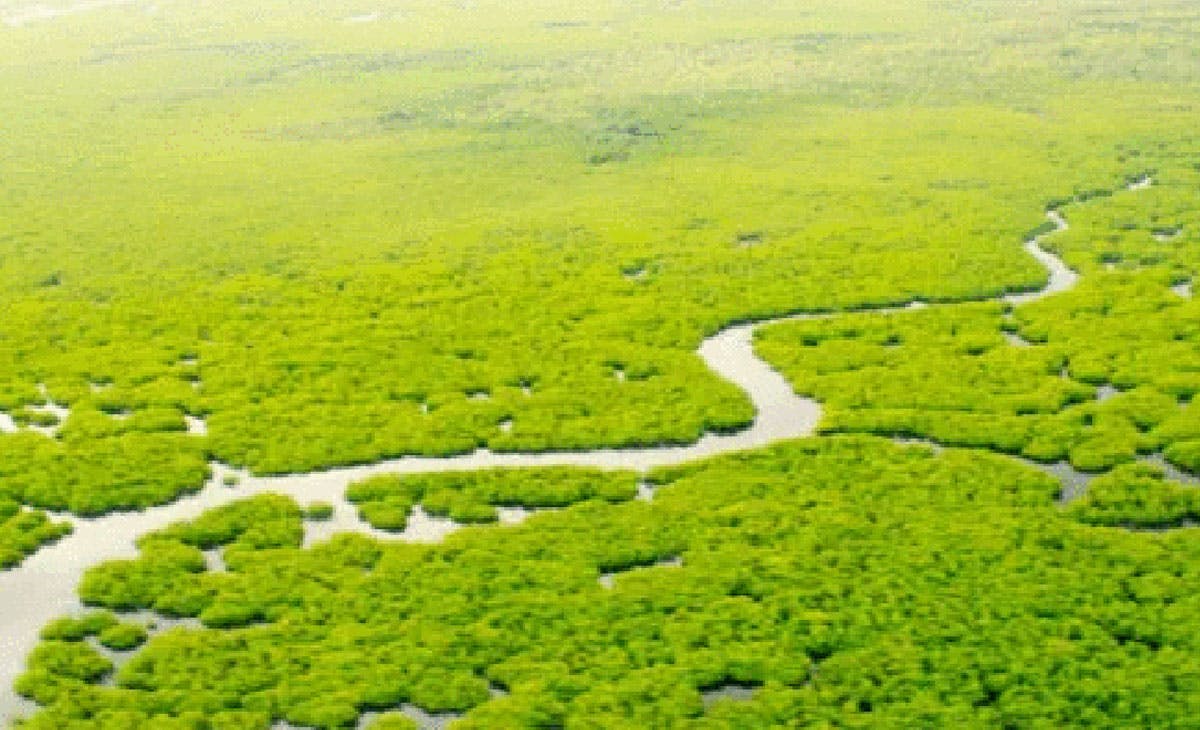
Residents of few small islands in Siargao were saved by the mangrove forest in the municipality of Del Carmen as Typhoon Odette wreaked on the province last Dec. 16.
Presidential Communications Operations Office (PCOO) Secretary Martin Andanar told One PH's “SaTotoo Lang” on Tuesday, Dec. 21, a tsunami was recorded in two to three islands in Siargao and residents were safe because of the massive mangrove reforestation there. Andanar used the word tsunami instead of storm surge.
Andanar gave credit to MVP Group chairman Manuel V. Pangilinan for being the major sponsor of the mangrove reforestation in Siargao.
“Na-save po ‘yung mga kababayan natin doon dahil sa mangrove forest,” Andanar said.
He added there’s no illegal logging in Siargao and an “angel” like Pangilinan helped in reforestration projects.
“Buti na lang ay natural reserve ‘yung Siargao, walang illegal logging. Meron tayong anghel tulad ni MVP na tumutulong sa mga reforestation projects,” he added.
Siargao Island is the largest protected area under the National Integrated Protected Area System Act due to its mangrove forests, which cover an area of 8,620 hectares.
The largest mangrove forest in the Philippines – consisting of 4,871 hectares as of 2018 – is found in the municipality of Del Carmen, one of the oldest settlements founded by the Spanish.
This mangrove forest is the habitat of rare and endangered species of flora and fauna both in marine, wetland and terrestrial areas. This ecosystem helps maintain the island’s ecological balance by providing rich breeding grounds to aquatic life.
It was Del Carmen Vice Mayor Alfredo Coro II who started the town’s mangrove conservation in 2010.
Recently, Del Carmen was named Caraga Region’s grand winner in the Malinis and Masaganang Karagatan (MMK) program of the Department of Agriculture-Bureau of Fisheries and Aquatic Resources (DA-BFAR), which recognizes the most outstanding coastal communities across the archipelago.
The town was hailed for its exemplary efforts in protecting and conserving their marine environment set by the BFAR.
The MMK program’s five general criteria include absence of illegal fishing, observance of closed fishing season, establishment of marine protected areas, clean coastal waters without domestic and industrial wastes, and effective mangrove protection and rehabilitation program.
In an article posted on Del Carmen’s website, Coro said “the town’s healthy environment was key in their economic sustainability during the imposition of the lockdown in the early months of the COVID-19 pandemic.”
“The investments in the protection of the marine protected areas and mangrove forest gave us enough fish to feed the many despite a sudden increase in fisherfolks and resulting in lowering of the cost of fisheries for the consuming public,” he noted.
Due to the displacement of workers from other sectors, Coro noted that its marginal fishermen increased by 1,500, which its ecosystem was able to absorb.
“Protection of our mountains and watershed also allowed [a] good source of water for irrigation which when several people started to grow their food, was enough to support the farms. The non-disturbance of the forest trees also attracted good rain that was enough to toil our farms,” he added.
The local government has also partnered with Metro Pacific Investment Corp. chaired by Pangilinan for its multi-awarded corporate social responsibility program, “Shore it Up,” which seeks to establish a nationwide network of local governments for the conservation of marine and coastal ecosystems.
Under a local version called, “Siargao It Up,” it has undertaken underwater cleanup by MPIC volunteer scuba divers, Run for the Mangroves International Marathon, strengthening of the Bantay Dagat units, Junior Environmental Scouts for elementary students, and ecotourism tours around the mangrove forest and Sugba Lagoon, among others.
The town also hosts the Mangrove Propagation and Information Center, the first of its kind in southern Philippines, which promotes an integrated community approach on education, mangrove reforestation, sustainable tourism, and livelihood.
Last May, the local government of Del Carmen and the Wellife Corporation, a home care products company, also signed a memorandum of agreement for the company’s extension of regular support for the conservation of 10 hectares of the municipality’s mangrove forest.
The company gave an initial cash grant amounting to P150,000 to the Siargao Islands Wildlife Conservation Foundation, the local non-government organization implementing partner.
‘What are we going to do better next time?’
Meanwhile, Yolanda “Yoly” Crisanto, Globe senior vice president and chief sustainability officer told her fellow industry leaders that the “challenge” for them now is to think about they’re going to do “better the next time” so that the country will “never get to be in this position again” after Odette caused massive devastation.
According to Crisanto, the recent typhoon is a “test for resiliency.”
“Think about it this way, remove everything again, reset everything again. So humans, what are you going to do to make things better?” Crisanto asked in an online webinar hosted by the non-government organization Tzu Chi Philippines on Dec. 23.
“I think that is the challenge of our time. And the challenge is for us to respond to build things better the next time. And that is exactly what we have been doing,” she added.
Crisanto said on the part of Globe, it built better cell sites after their existing ones were destroyed by Super Typhoon Yolanda back in 2013.
“We were struck by 275 kilometers per hour winds. Our cell sites at that time were only equipped to withstand 175 to 200 kilometers per hour winds. And so we saw… the whole cell towers were twisted metal. And that is how 275 kilometers per hour winds can do to metal,” she said, noting the devastation caused by Yolanda.
“So what did we do? We built cell sites that can withstand 275 to 300 kilometers per hour winds. And all of this comes in the form of how we are investing and using our money,” she added.
Odette – the 15th tropical cyclone and the fiercest to enter the Philippine area of responsibility this year – pummeled the southern Philippines with nine landfalls on Dec. 16 and 17.
Aside from deaths, Odette also cut power and telecommunication services in Visayas, Mindanao and even Palawan – with some areas still having poor reception even days after the typhoon.
Set aside time
Crisanto said while companies are doing their very best to do relief operations to help those affected by the typhoon, it is also important to set aside time to prepare for climate disaster, as well as to mitigate future risks.
“Let’s also set aside time so that we can start changing the path in terms of, are we going to see more and more of this in the future when climate change strikes us?” she said.
Prepare architects, engineers
Meanwhile, Marco Santos, Mapua University representative, said that future architects and engineers can be equipped with knowledge on resilient structures against future calamities.
“I strongly believe that there’s a big gap (between) the skills that you learn in school and the skills that you need in the real world, especially after this pandemic, it heightened the need for people to think outside the box and make sure that those graduates are already prepared for the job,” he said.
“Mapua has been known for its good engineers, whatever works, if there’s anything they can do, they will do it,” he added.