



Sans NCAP, P1,000 Fine Imposed For ‘Speeding’ On Roxas Boulevard
With no timely warning to the public, the Metropolitan Manila Development Authority has started apprehending motorists for violating a 60-kilometer per hour speed that was announced in April 2019, but which was hardly enforced.
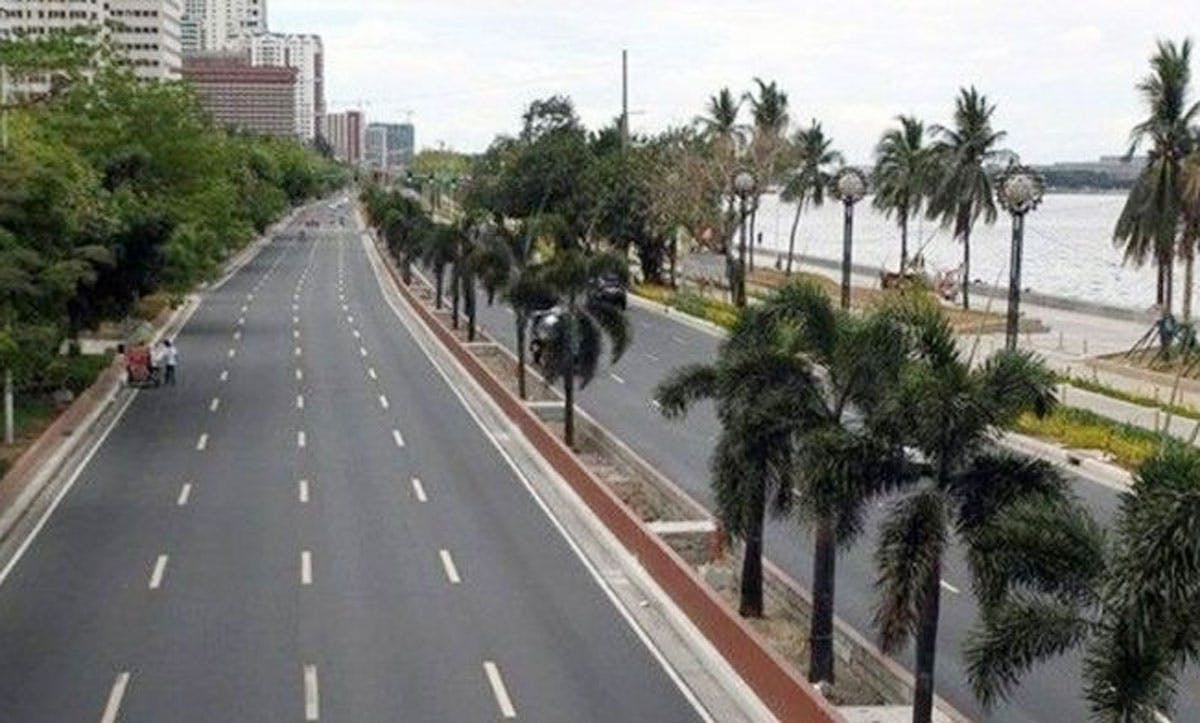
Along Roxas Boulevard, there are no road signs reminding motorists that there is a speed limit of 60 kilometers per hour.
But with no timely warning to the public, the Metropolitan Manila Development Authority (MMDA) has started apprehending motorists for violating a 60-kph speed that was announced in April 2019, but which was hardly enforced, and was put on hold by the pandemic lockdowns beginning in March 2020.
The fine: P1,000. A traffic citation ticket is given, and the fine can be paid through Bayad Centers. Drivers who challenge the apprehension are told that their speed was registered in a radar speed gun.
Apprehensions for driving faster than 60 kph have increased following the Supreme Court’s order suspending the controversial no-contact apprehension program (NCAP), under which the MMDA and several local government units in Metro Manila collected hefty fines even for minor or unclear traffic infractions.
Several motorists have complained that after over two years of non-implementation of the speed limit, the MMDA should first conduct a public information campaign and install road signs that are prominently displayed along the stretch of Roxas Boulevard before fully reviving the scheme.
A speed limit of 60 kph is imposed along Macapagal Boulevard, which runs parallel to Roxas Boulevard. But since the rule went into force in 2019, Macapagal Boulevard has been dotted with large signs announcing the 60-kph speed limit.
Similar signs are also prominently displayed along Commonwealth Avenue in Quezon City, where the speed limit has always been strictly enforced because of its reputation as the Philippines’ “Killer Highway” where speeding is common and deaths from road accidents are a regular occurrence.
On April 5, 2019, the MMDA announced that it would implement a 60-kph speed limit along major roads in Metro Manila, following its approval on March 26 by the Metro Manila Council. Buses and trucks must abide by a speed limit of 50 kph.
MMDA Regulation No. 19-001, which took effect on April 9, 2019, imposed a fine of P1,000 for violating the speed limit.
At the time, the MMDA announced that the rule covered circumferential roads Recto, President Quirino, Araneta and CP Garcia Avenues as well as EDSA and the Southeast Metro Manila Expressway.
Also covered were radial roads Roxas Boulevard, Taft Avenue, South Luzon Expressway, Shaw Boulevard, Ortigas Avenue, Magsaysay Boulevard/Aurora Boulevard, Quezon Avenue/Commonwealth Avenue, A. Bonifacio Avenue, Rizal Avenue, Delpan/Marcos Highway/McArthur Highway.
With the pandemic lockdowns, motorists noted that enforcement of speed limits except along Commonwealth and EDSA was largely put on hold.
What was implemented after COVID mobility restrictions were lifted was the NCAP. But the program was suspended by the Supreme Court amid complaints about arbitrary fines of up to P5,000 imposed even for unclear violations, vague traffic rules and the lack of clear road signs.
Questions have also been raised about the constitutionality of outsourcing law enforcement including the imposition and collection of fines to a private firm, QPax Traffic Systems Inc.
Qpax, whose managing director is Dodoo Ona, gets 70 percent of the fees, with only 30 percent going to the local government units. The company has been engaged for NCAP by the local governments of Manila, Caloocan, Parañaque, Quezon City, San Juan and Valenzuela.
The MMDA has its own NCAP system, which has lower fines and is not outsourced to any private firm.
But the MMDA has also come under fire for disabling traffic countdown timers on stoplights, which has turned yellow traffic junction boxes into virtual NCAP traps.