



Phl Seeks Membership In UN Security Council
President Marcos trumpeted the peace process in the Bangsamoro Autonomous Region in Muslim Mindanao in seeking support for the country's bid for a non-permanent seat in the United Nations Security Council.
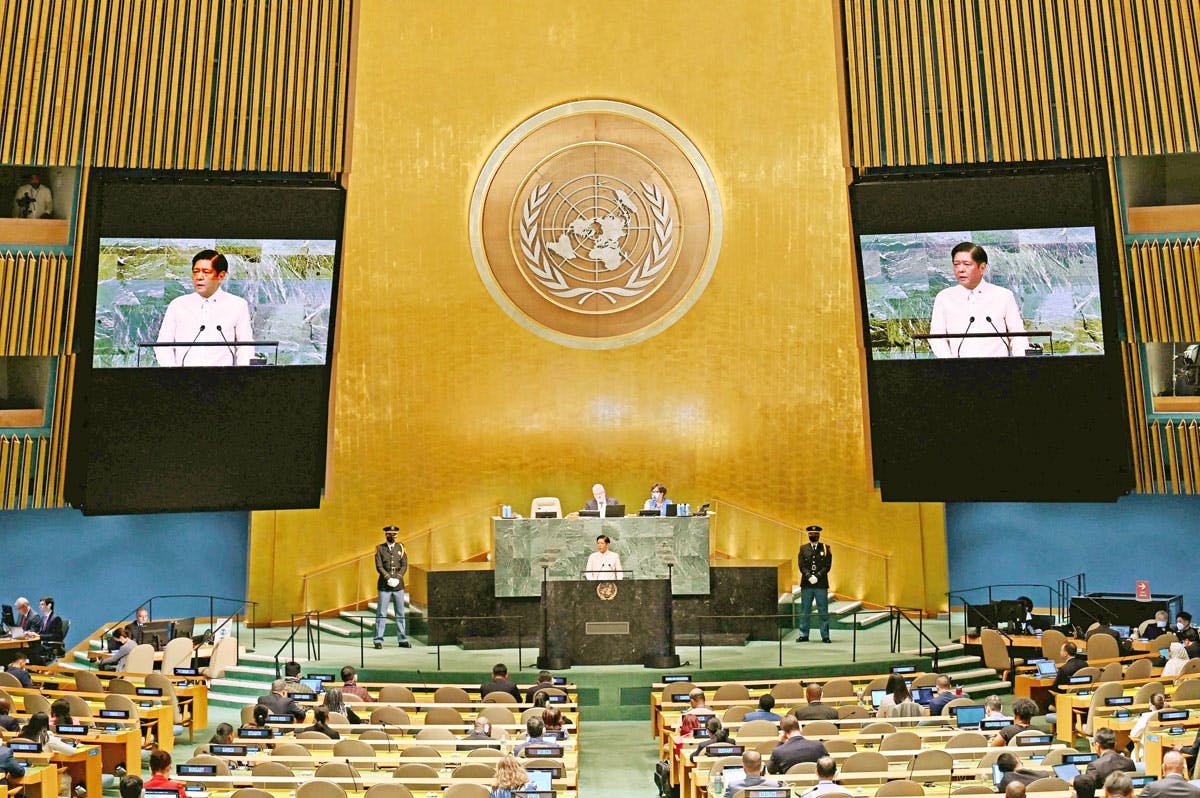
UNITED NATIONS – President Marcos urged United Nations member-states to support the Philippines’ bid for a non-permanent seat in the Security Council, citing the country’s experience in Mindanao and the partnerships it forged with regional stakeholders.
“My country’s experience in building peace and forging new paths of cooperation can enrich the work of the Security Council. And to this end I appeal for the valuable support of all UN member-states for the Philippines’ candidature to the Security Council for the term of 2027-2028,” Marcos said during a session of the 77th United Nations General Assembly on Tuesday, Sept. 20, (Wednesday, Sept. 21 in Manila).
Marcos trumpeted the peace process in the Bangsamoro Autonomous Region in Muslim Mindanao, saying the peace forged after decades of conflict among warring factions and clans “demonstrates that unity is possible even in the most trying circumstances.”
The Muslim separatist rebellion in the southern Philippines intensified during the presidency of Marcos’ father and namesake.
“Inclusive dialogue involving all stakeholders, including women, the youth, faith leaders and civil society, conducted with patience and good faith, has produced a credible and solid foundation for self-government that paves the way for lasting peace and sustainable development,” Marcos said.
He said the Philippines has adopted the same approach in Asia by forming peace and development partnerships through dialogue, especially through the Association of Southeast Asian Nations.
“In the face of great diversity, we believe that partnerships form the bridge to unite all of us in promoting peace and stability in the Asia Pacific region,” the President said.
Marcos also cited the Philippines-United Nations Joint Program on Human Rights, which he described as “an example of a constructive approach that puts our people, not our politics, at the center of this work.”
The Philippines’ continued solidarity with the UN would also benefit from “a reformed and more inclusive” Security Council and an empowered General Assembly that can hold the Council to account, he said.
“At the same time, the United Nations must forge ahead with its flagship tradition of global peacekeeping,” Marcos added.
The UN Security Council is tasked to maintain international peace and security. It has five permanent members – China, France, Russia, the United Kingdom and the US – and 10 non-permanent members elected for two-year terms by the General Assembly. The present non-permanent members of the council are Albania, Brazil, Gabon, Ghana, India, Ireland, Kenya, Mexico, Norway and the United Arab Emirates.
The Philippines was a non-permanent member of the council in 1957, in 1963, from 1980 to 1981 and from 2004 to 2005.
Last year, former president Rodrigo Duterte criticized the Security Council, saying it was “neither democratic nor transparent in its presentation and processes.”
Enemy to none
In the same speech, Marcos echoed his predecessor’s stance on the Philippines being “a friend to all and an enemy to none” and emphasized the importance of resolving disputes peacefully through international law.
He said the Philippines has made “solid contributions” to the cause of peace and justice by shepherding the Manila Declaration of 1982, a framework on peaceful settlement of international disputes.
“We helped affirm that differences should only be resolved through peaceful means. By reinforcing the predictability and stability of international law, particularly the 1982 United Nations Convention on the Law of the Sea (UNCLOS), we provided an example of how states should resolve their differences: through reason and through right,” Marcos said.
The President said an open, inclusive and rules-based international order governed by international law and informed by the principles of equity and of justice “stabilizes our common vessel” amid the “challenging global tides.”
“As I have underscored, the Philippines shall continue to be a friend to all and an enemy of none,” he said.
In 2020, then president Duterte affirmed the Philippines’ commitment in the South China Sea in accordance with UNCLOS and the 2016 arbitral award. The 2016 arbitral award voided Beijing’s maritime claim in the area and affirmed Manila’s sovereign rights over its exclusive economic zone.


