



Philippine Nurses’ Dilemma: Stay Or Leave?
According to the Organization for Economic Cooperation and Development countries, 277,266 Philippine-born nurses were working in OECD countries in 2020 and 2021 – a 147-percent increase since 2000 and 2001.
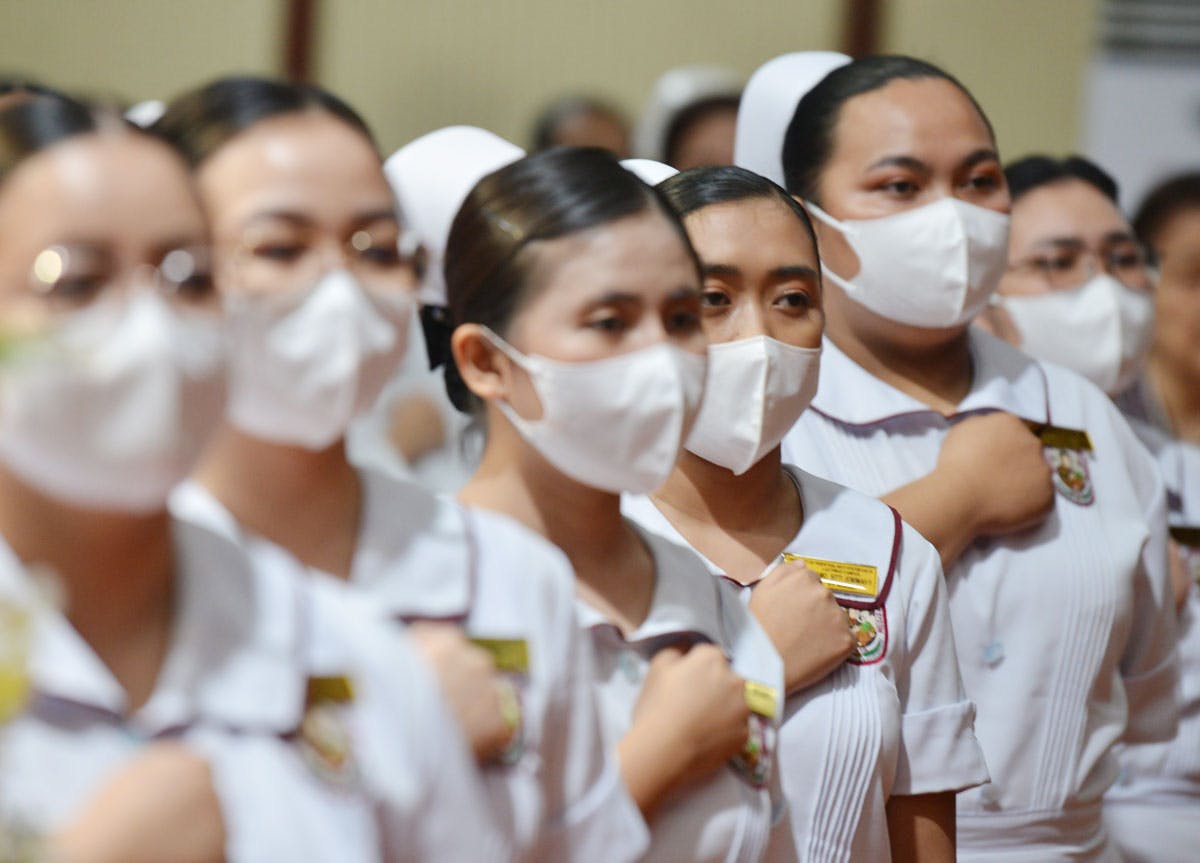
A Metro Manila nurse who once stood on the brink of migration is choosing to stay in one of the world’s leading exporters of nurses – a decision that is becoming increasingly rare.
For many Filipino nurses, the financial incentive to work overseas is difficult to ignore.
A newly registered nurse in New Zealand can earn more than six times the starting salary for a government nurse in the Philippines.
“The difference is significant, and it’s understandable why many Filipino nurses are drawn to opportunities overseas,” said Regie Legaspi, a nurse of 16 years and associate director at St. Luke’s Medical Center.
“Some leave to provide a better future for their families, while others seek professional growth and better working conditions,” he said. “At the same time, there are nurses who choose to stay because they believe in serving their fellow Filipinos.”
Legaspi understands both perspectives.
In his tenth year as a nurse, he was preparing to migrate to the United Kingdom in search of new professional challenges.
Just months before he was due to leave, however, he was offered a director position in a private hospital, with a competitive compensation package and the opportunity to pursue a doctorate through a scholarship.
“It was an opportunity that aligned with my personal and professional goals, so I chose to stay. Looking back, I have no regrets,” Legaspi said.
His story stands in contrast to a broader trend.
The Philippines has become the world’s largest source of migrant nurses among Organization for Economic Cooperation and Development countries.
According to the OECD, 277,266 Philippine-born nurses were working in OECD countries in 2020 and 2021 – a 147-percent increase since 2000 and 2001.
The OECD’s 2025 report found that around 37 percent of Filipino nurses work abroad based on 2020 and 2021 data.
Many of those leaving head to countries such as New Zealand, which had a population of 5.36 million in 2024 and continues to face growing demand for nurses.
Starting afresh
For nurses such as Charissa Escobia, the decision to migrate was driven by a combination of professional and personal factors.
She is a registered midwife nurse in the Philippines who worked in a state hospital for more than 12 years and now works in a private nursing home in New Zealand.
Escobia is among many Filipino nurses who have taken the long path of requalifying and starting afresh in a first-world country.
She emigrated with her husband and son, but said it has been difficult leaving her family and everything familiar behind to settle in the North Island in August 2023.
“Since moving here, I’ve noticed a significant improvement in my standard of living. Life here feels quieter, safer and more balanced,” said the Taranaki-based nurse. “My hands still care for patients, but I no longer burn out doing it.”
Escobia said better pay, a fairer workload, better nurse-to-patient ratios and more career opportunities were also reasons.
“There are still staffing pressures here in New Zealand, but here, safe staffing is recognized as a right, not a luxury,” she said. “In the Philippines, the nursing shortage is a constant. Short-staffing and overtime happen almost every day, hence burnout is unavoidable.”
Although the cost of living is comparatively higher, Escobia said she is still able to support her family back home and save.
She believes the overall lifestyle outweighs the difference.
If salaries and conditions in the Philippines were comparable to New Zealand, Escobia said she would have chosen to stay.
“Not because the Philippines is easier, but because home is where my heart is,” she said.
Internationally trained nurses now make up more than one-third of New Zealand’s nursing workforce, with Filipinos representing one of the largest ethnic groups in the profession.
The Nursing Council of New Zealand said they accounted for around 14 percent of the country’s 80,000 nurses that held an annual practicing certificate during the 2024 to 2025 registration year.
Improvised health care?
Bicol Regional Hospital and Medical Center nurse supervisor Angela Opeña said working in a public or government hospital was challenging.
“Everything you need is not provided automatically,” said Opeña, a nurse of 10 years.
"In the government hospital, you will learn how to improvise things just to provide something for your patient,” she added.
Opeña works in the hospital’s pediatric intensive care unit, which has a capacity of 10 beds.
“We are short-staffed every day because the manpower of ICU is supposed to be one to one, but currently with my staffing today it is one nurse to three patients,” she said.
The pressure and low compensation had made Opeña say she has considered working overseas. “But I still have a reason to stay.”
“I still feel the satisfaction of caring for the needy, especially in a state hospital. I still want to provide them the care that they deserve even if they have nothing,” she said.
Opeña said many of her colleagues had left to work overseas, while others were considering doing the same.
For Legaspi, while many of his friends, colleagues and former classmates have built successful careers overseas, the answer is not simply convincing nurses to stay.
“It is about building a health care system where our nurses feel valued, respected and proud to build their future here in the Philippines,” he said.


