



OCTA: NCR Gradual Reopening ‘Reasonable’; DOH Eyes Stricter Border Controls For Travelers From Middle East
While keeping the NCR Plus bubble intact is ideal, experts say a gradual and calibrated reopening is reasonable in Metro Manila.
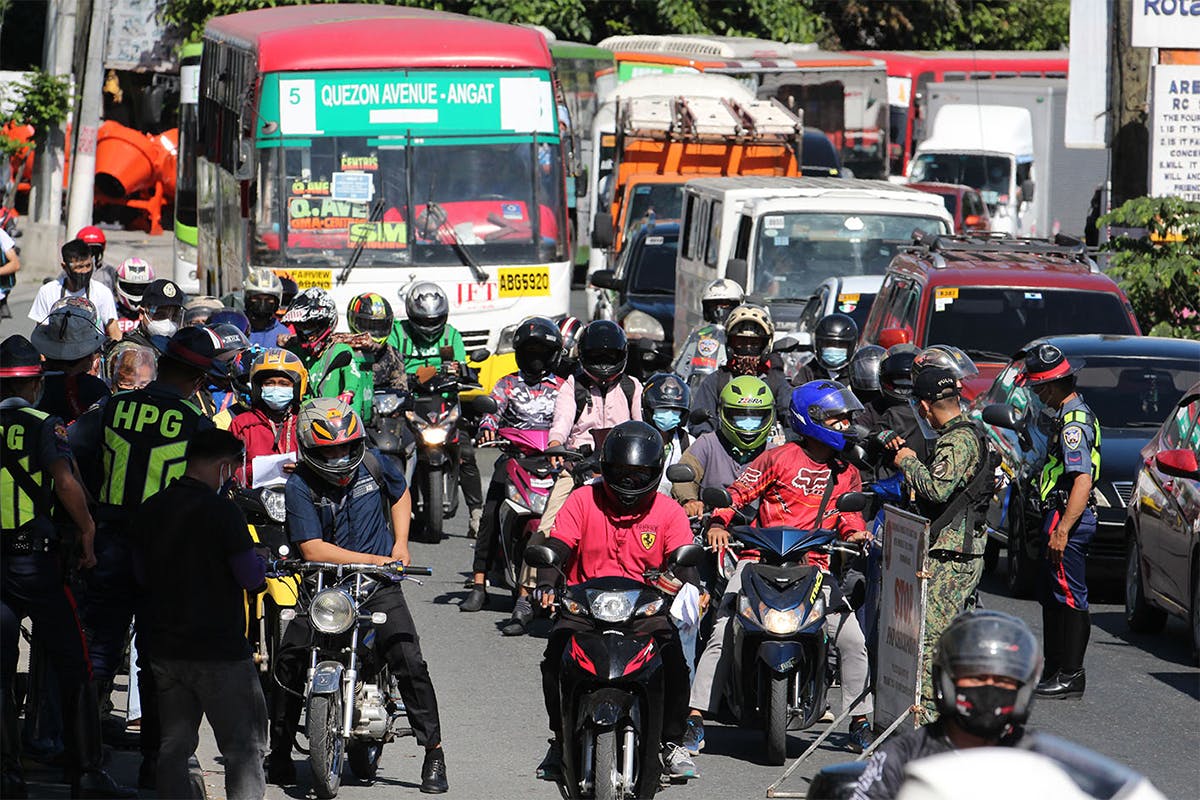
While keeping the National Capital Region, Bulacan, Laguna, Cavite or NCR Plus bubble intact is ideal, a gradual and calibrated reopening of Metro Manila is reasonable provided that the government is ready to respond should a variant-driven surge occur, according to the OCTA Research group.
In an interview with “The Chiefs” on One News / TV 5 on Tuesday night, OCTA fellow and molecular biologist Fr. Nicanor Austriaco advised the government to tread carefully on easing restrictions even as he acknowledged that the number of new COVID-19 cases in Metro Manila is on a downward trend.
“Gradual opening up is reasonable. Now the question is, what is gradual? And that is going to be what the government has to calibrate,” he said.
“The danger is if we open up quickly, we underestimate the force of that virus and it explodes… The government needs to be ready to be more aggressive with controlling spikes,” he added.
Austriaco expressed hope that the COVID variant first detected in India will not spread in the country, noting that the two cases recently confirmed by the Department of Health (DOH) arrived at the height of the recent lockdowns.
“The hope and the prayer is that when this (variant) arrived last month, we were in the middle of the ECQ and MECQ and that was enough to suffocate it and starve it before it spread,” he said, referring to the strictest enhanced community quarantine and its modified version.
OCTA fellow Guido David said there is a real threat with the B.1.617 variant that has overwhelmed the health care system of India, but stressed it is still uncertain if it is prevalent in the Philippines.
“It’s possible that it has already entered (the country), but the people are in quarantine so they might not have spread it,” he noted.
Saying he supports keeping the NCR Plus bubble intact, David said any easing of restrictions should be gradual and calibrated.
Austriaco thinks the government will still maintain the MECQ in Metro Manila and the provinces of Bulacan, Cavite, Laguna and Rizal which comprise NCR Plus after May 15, but will continue to ease restrictions.
“We keep arguing about the name but at the end of the day, (what comes with the) name is changing every two weeks,” he said, noting increased mobility despite the supposed strict quarantine classification.
“The vaccines aren’t going to help us until the third or fourth quarter, so either we’re going to stay this way for the next six months or we are gradually going to open up and test our current system,” he added.
Stricter border controls
Following the detection of the B.1.617 variant from two Filipinos seafarers who arrived from Oman and United Arab Emirates (UAE) last month, Health Secretary Francisco Duque III said he will recommend stricter border controls for travelers coming from the Middle East.
Duque did not provide specific details but said in an interview with ABS-CBN News Channel that he will certainly make the recommendation.
He said he is currently in touch with World Health Organization country representative Rabindra Abeyasinghe regarding the matter, stressing that COVID-19 variants are a cause for concern that should be dealt with accordingly.
“That is why it is important that we keep track of them, so this will now help us make the necessary adjustments in terms of our five strategic pandemic response pillars,” he added, referring to massive prevention campaign, early detection, active case finding and contact tracing, aggressive isolation and quarantine and treating patients.
The DOH on Tuesday, May 11, announced that the B.1.617 variant were detected from a 37-year old male seafarer who flew from Oman and a 58-year old male who came from UAE.
Duque said there is not enough data on the Indian variant in terms of “virulence and gravity of infection” but stressed that their response will always be “intensified compliance with minimum public health standards.”
“It might be too presumptuous of me to say that what’s happening in India will not happen to us. We have to be really extra careful knowing what is happening there. This is really something that all countries must learn from,” he added.
Surge in Zamboanga
While cases in Metro Manila is on a downward trend, OCTA said Zamboanga City has recorded a surge in new cases over the past week, the highest among local government units (LGUs) outside Metro Manila.
Zamboanga City recorded an average of 151 new cases daily over the past week, 47 percent higher than the preceding week.
It was followed by Baguio City with an average of 78 new cases per day (up one percent); Calamba, Laguna with 73 (down five percent); Tuguegarao, Cagayan with 70 (down five prevent) and Antipolo, Rizal with 67 (down 55 percent).
Other LGUs that have recorded increases include Cagayan de Oro with an average of 62 new cases per day (up 13 percent), Puerto Princesa in Palawan with 60 (up 35 percent) and Batangas City with 57 (up 15 percent).
The reproduction number in Metro Manila, which indicates the number of persons a positive individual can infect, continued to go down to 0.62 over the past seven days.
The average number of new cases in the region from May 5 to 11 is at 1,855, significantly lower than the more than 5,500 new cases recorded per day during the peak last March 29 to April 4.


