



‘No Homework’ Policy: What The Research Shows
Amid all the fuss about the ‘no homework’ bills in Congress that are pitting teachers, the Department of Education and parents against each other, what does actual empirical research say about the matter?

Three bills that aim to limit, if not totally ban, homework in schools are currently pending in Congress, eliciting mixed reactions from parents, students and teachers alike this past week.
The first measure, Senate Bill No. 966, authored by Sen. Grace Poe aims to limit homework of students from Kinder to Grade 12 to weekdays. It also states that homework should be minimal and should take only four hours to complete.
In her explanatory note for the bill, Poe cited a 2009 study by the Organization for Economic Cooperation and Development titled “Does Homework Perpetuate Inequities in Education?” The study examined the number of hours students spent on homework in 38 countries and their performance in OECD’s Program for International Student Assessment or PISA tests.
The results of the study showed that while students who spent longer hours on homework did perform better in PISA tests, there were diminishing marginal returns in terms of test scores after four hours of homework.
The study also showed that there wasn’t much of a correlation between the number of hours students spent on homework and their PISA test scores. It cited Finland as an example, where students spend only three hours a week on homework but scored sixth highest in the world in reading and 12th highest in math in PISA tests.

Poe’s bill will institutionalize and expand the Department
of Education (DepEd) Memorandum Circular No. 392 in 2010, which discourages
teachers from giving homework during weekends so that students can spend more
time with their families.
Quezon City Second District Rep. Alfred Vargas also proposes to limit homework to weekdays in his House Bill (HB) No. 3883.
The bill raised eyebrows this past week after a provision in the bill proposed penalties on teachers who will give homework on weekends with a P50,000 fine and jail time of one to two years. Vargas later apologized for the provision, stating that it was a clerical error and withdrew it.
Nevertheless, Vargas, in his explanatory note for the bill, cites a number of scientific studies to justify his proposal.
Among those cited are the 2011 study by Boston University developmental psychologist Janine Bempechat, et al. on low-income students’ perception of homework, the 2006 book The Homework Myth by independent researcher Alfie Kohn, and the 2000 book The End of Homework by University of Arizona professor Etta Kralovec and author John Buell.

Both The Homework Myth and The End of Homework contend that assigning children homework puts them in greater stress and results in conflict within the family.
Kohn argues in The Homework Myth that homework negatively impacts students’ natural tendency for curiosity, while Kralovec and Buell argue in The End of Homework that there is no correlation between homework and student achievement, and that homework time is better spent on play, extra-curricular activities or family time.
Also cited are studies on the impact of homework on families such as the 2003 study by Boston College professor Curt Dudley-Marling and the 1998 study by Mississippi State University professor Xu Jianzhong and Columbia University professor Lyn Corno.
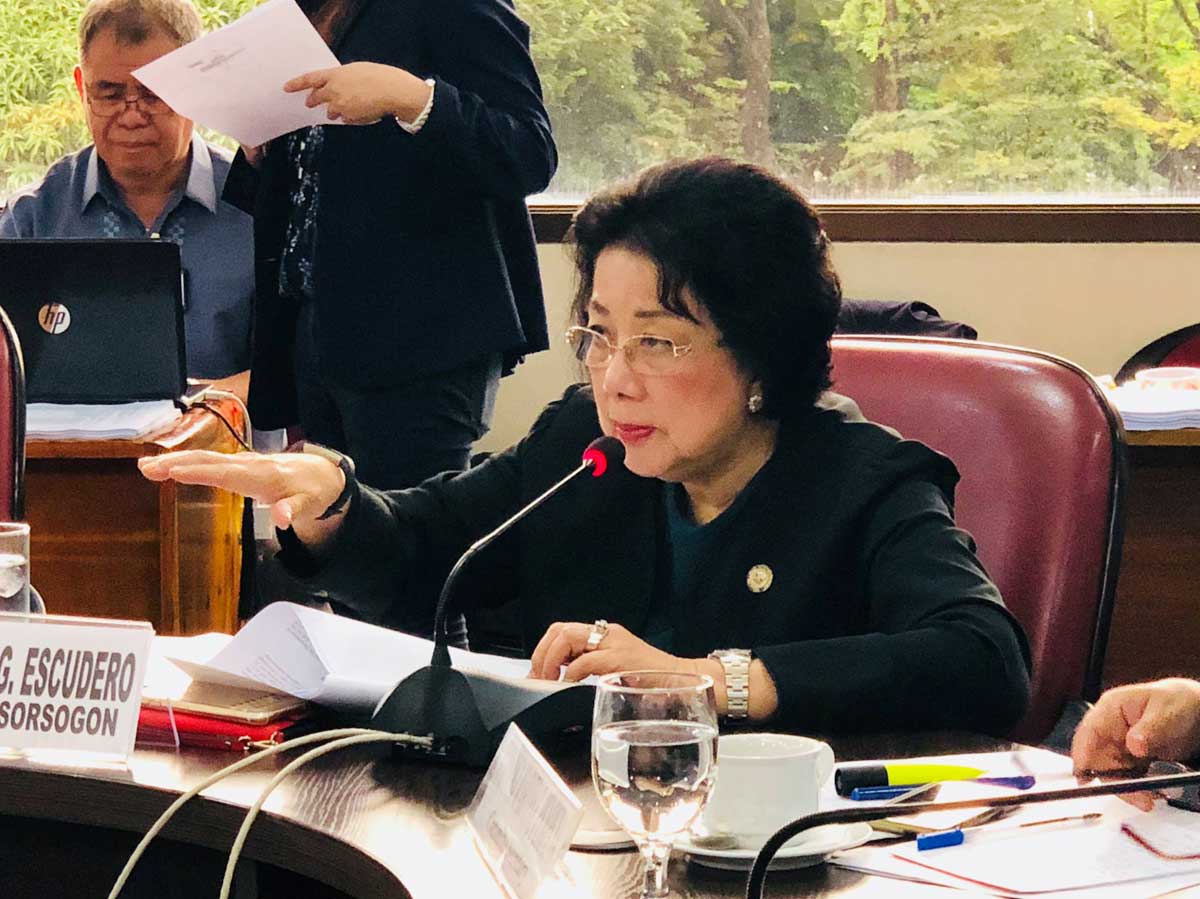
Sorsogon First District Rep. Evelina Escudero has a proposal that’s a notch higher than that of Poe and Vargas. In her HB 3611, Escudero proposes a total ban on homework from Kinder to Grade 12 and conducting all learning activities within school premises for both public and private schools.
To accomplish that, she proposes that all textbooks be deposited and left in school after classes so that students would not be burdened with bringing the heavy books to school every day. The bill also requires private and public schools to provide lockers where the books can be deposited.
However, Escudero’s proposal to totally ban homework and conduct all learning activities in school is not supported by research. In her explanatory note for the bill, Escudero did not cite existing researches or studies proving that a total ban on homework is beneficial to students.
In a 2006 study, researchers at Duke University in Durham, North Carolina, led by prominent psychologist Dr. Harris Cooper, experimented with two sets of average students — one group was given homework on a subject matter, the other was not. In a standardized test on the subject matter, the students who were given homework scored 23 percentile points higher than those who weren’t given homework.
Nevertheless, Cooper and his colleagues also recognized that children do experience burnout when too much homework is given. He proposes a 10-minute rule wherein a Kindergarten student is given an assignment that takes 10 minutes to accomplish, and as a student progresses in each grade level, another 10 minutes will be added to the time needed to accomplish the homework.
Vargas cites this same study in his explanatory note for HB 3883, as well as a 2016 study by Australian researchers Colin Carmichael and Amy MacDonald on the effectiveness of parental involvement in accomplishing homework.
Likewise, Dr. Jennifer Davis Bowman, an adjunct professor of education and psychology at the University of Cincinnati in Ohio, agrees that homework can be beneficial if teachers properly administer it to students.
In an article for the Teachers.net Gazette, Bowman advises teachers to limit the time it takes to accomplish homework and make sure that students understand its purpose in relation to their learning. She also highlighted the importance of parental involvement in accomplishing homework, the giving of feedback after the homework has been accomplished and graded, and the inclusion in standardized tests of knowledge and insights gained from homework.


