



NEWS IN CONTEXT | Is The 1898 Paris Treaty The Strongest Case For WPS Claims?
Former Supreme Court senior associate justice Antonio Carpio says treaties are more binding than China’s “historical claims.” Otherwise, the Italians can claim Europe, the Greeks have a right over Egypt, and the Mongolians still own China.
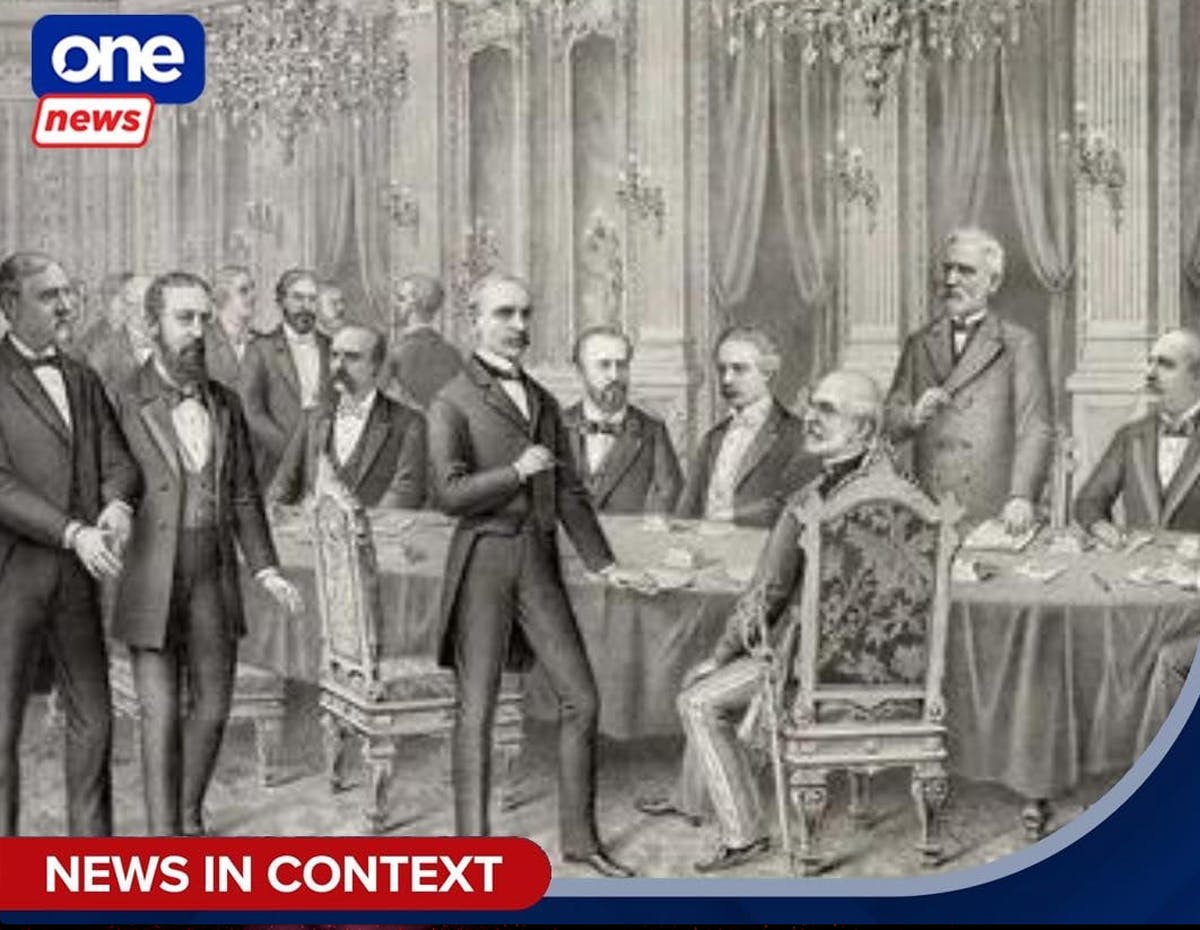
In his keynote at the Shangri-La Dialogue in Singapore, President Ferdinand Marcos Jr. mentioned the Treaty of Paris.
The significance and meaning eluded most.
However, former Supreme Court senior associate justice Antonio Carpio
calls it “one of the most significant events that happened lately.”
Speaking before the gathering of diplomats and defense officials,
Marcos Jr. said, “The Treaty of Paris between the United States and
Spain crystallized our islands into a cohesive home. The Treaty of
Washington clarified the extent of our sovereignty and patrimony in the
lines set by international powers.”
It was apparently the first
time a Philippine president has invoked these treaties in the context
of Philippine claims on the West Philippine Sea.
These two
treaties, in which Spain sold the Philippines to the United States,
indicate that the Spratly islands and Scarborough Shoal have been part
of Philippine archipelago since Spanish times.
Carpio breaks it down for us in an interview with One News last week.
First, the 1898 Treaty of Paris. From this alone, the Spratlys and
Scarborough Shoal are outside the treaty lines. But it caused problems
when Spanish garrisons in Cagayan de Sulu and Sibutu in Tawi-Tawi
refused to withdraw, claiming they were outside the treaty lines.
The Americans and Spaniards renegotiated. For an additional $100,000
(on top of the $20 million paid under the Treaty of Paris), Spain and
the US signed a second treaty that had one line in it: “Treaty between
the United States and Spain for the Cession to the United States of any
and all islands of the Philippine archipelago lying outside the lines
described in Article III of the Treaty of Peace of December 10, 1898.”
This is the Treaty of Washington, signed only two years after the Paris Treaty.
The second treaty resolved the problem of holdover Spanish garrisons.
It basically said that all Spanish possessions outside the treaty line
were now owned by the US.
“So, the question is, what are the islands of the Philippine archipelago outside the lines,” Carpio said.
Carpio goes to three maps.
First is the 1734 Murillo-Velarde map that already includes the Spratly Islands, then known as Bajo de Paragua.
The second is the 1808 official Spanish map that shows Scarborough Shoal or Bajo de Masinloc as part of Philippine territory.
The third and most significant is the 1875 Carta General de Archipelago
Filipino. Both the Spratlys and Scarborough Shoal are part of it.
“When the Americans came here they did not have a map of the
Philippines,” Carpio said. “They adopted en toto the 1875 Carta General
because it was a complete map. You can see Scarborough and you can see
the entire Spratlys.”
The 1875 Carta General is especially
significant. It suggests that Philippine claim on the Spratlys is not a
recent claim, and is much older than the 1945 claim of China.
The 1875 Carta had details of the ocean floor in Scarborough that Spanish mapmakers made for navigation.
Officially, the Spratlys claim only goes back to 1978, when then
president Ferdinand Marcos, father and namesake of the current Chief
Executive, issued Presidential Decree No. 1596, declaring the Kalayaan
Island Group as part of Philippine territory.
Officially, too, Scarborough Shoal is not within Philippine territorial waters. But the 1875 Carta indicates it is.
The mention of the Paris and Washington treaties in Marcos Jr.’s
Shangri-La speech signals that a narrative familiar only to history and
legal geeks like Carpio is becoming an official line.
As Marcos
Jr. himself said, the Washington treaty “clarified” the treaty signed
in Paris. In effect, he was saying Scarborough is not just EEZ but
territory and the claim on the Spratlys predates his father’s decree.
Carpio pointed out that even China has unwittingly invoked these
treaties. Although it did not participate in the arbitration at the
Hague, China submitted a position paper, stating Philippine territory
was bound by the Treaty of Paris and Treaty of Washington.
“So,
they (China) admit our territory is regulated by the Treaty of
Washington and that binds them,” Carpio said. “They did not read the
text of the Treaty of Washington.”
The confusion lies in an
original treaty that sets limits to Philippine territory, and a second
treaty that corrects those limits. Both are legally binding, and one
cannot be invoked without the other.
Carpio says treaties are more binding than China’s “historical claims.”
Otherwise, the Italians can claim Europe, the Greeks have a right over Egypt, and the Mongolians still own China.


