NEWS IN CONTEXT | Escalation in Ayungin: Will Phl Invoke The MDT?
For now, there appears to be deafening silence from Malacañang, while policymakers scramble to decide whether invoking the 1951 Mutual Defense Treaty between the United States and the Philippines will be for the better or for the worse.
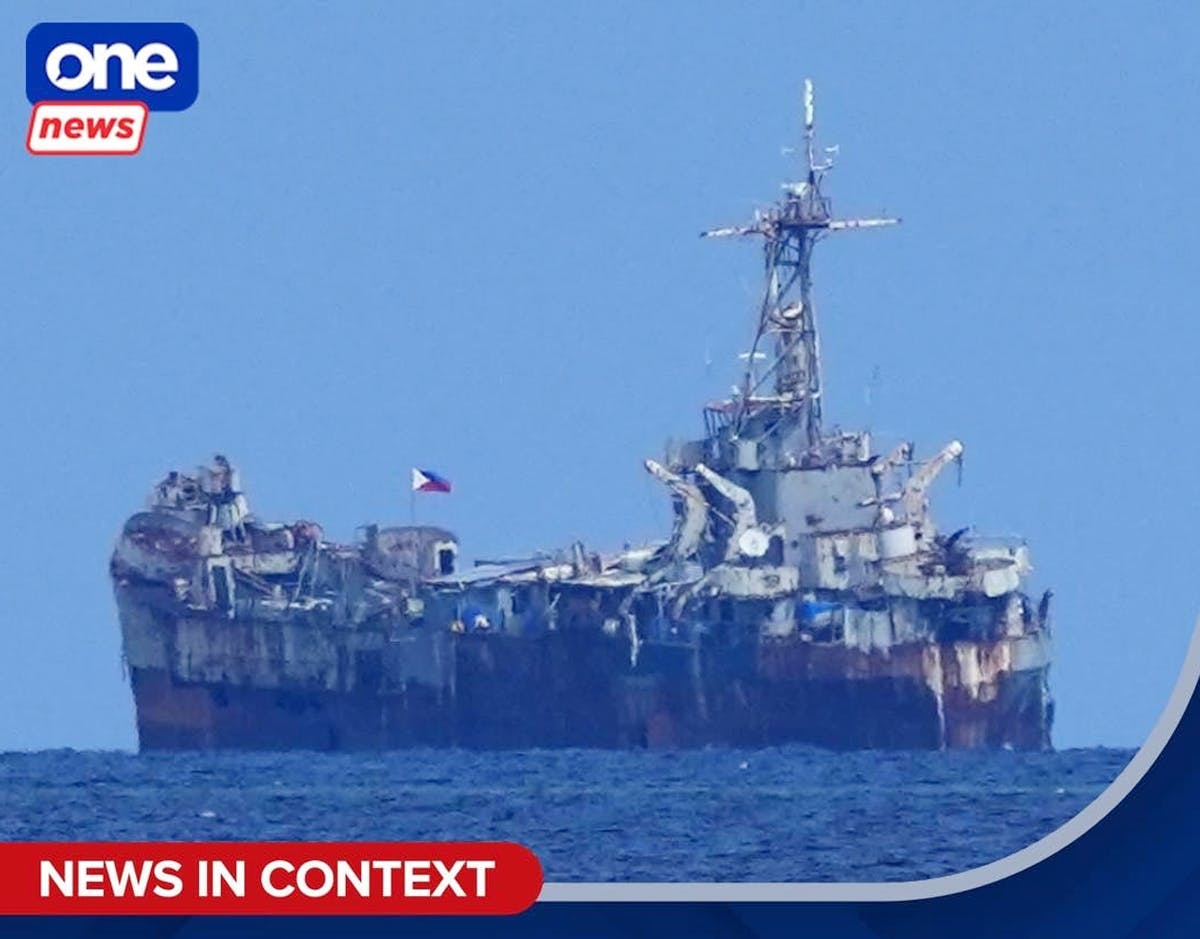
There is so much more to the June 17 incident between the Chinese coast guard and Philippine Navy than a mere collision of vessels.
For the first time, Philippine officials will need to seriously consider if they would want to invoke the 1951 Mutual Defense Treaty (MDT) between the Philippines and the United States that would bring the US into the fray.
The June 17 incident is an alarming escalation in many ways. In previous well-publicized incidents, the China Coast Guard (CCG) has rammed and bombarded Philippine Coast Guard ships and chartered civilian resupply vessels with water cannons.
But in the early morning of June 17, CCG members rammed at least one Philippine Navy vessel, boarded it, overpowered the crew, and confiscated their firearms before puncturing the Navy boat to render it useless.
Official details from the Philippine side have been scant, but the local news website Palawan News provides much more detail.
Palawan News reports that a member of the Philippine Naval Special Operations Command (NAVSOCOM), the Philippine version of the US Navy SEALs, was severely injured in the melee when the CCG boarded their ship and overpowered the crew. Several other members of the crew were reported injured as well.
The CCG then carted off at least eight weapons of the crew before disabling the Philippine Navy vessel by puncturing it.
There were also reports that at least one Philippine Navy boat was towed away by the CCG.
Professor Renato de Castro of De La Salle University says this is a marked escalation in the Ayungin Shoal. De Castro says naval vessels typically have what he calls sovereign immunity from boarding because they are extensions of the territory of a state. To forcibly board a naval vessel and overpower a crew is, in many ways, the crossing of a red line.
So can the Philippines invoke the 1951 MDT?
We also need to be realistic as to what the MDT brings to the table.
The common misconception is that if we invoke the MDT, America goes to war with us. That is not the case.
Section 4 of the MDT only provides that in the event of an armed attack, both countries will act together in accordance with their own constitutional processes.
Each party recognizes that an armed attack in the Pacific area on either of the parties would be dangerous to its own peace and safety and declares that it would act to meet the common dangers in accordance with its constitutional processes.
This means the two countries resolve the issue together, not necessarily go to war together. This gives both countries leeway for gradations of their response to a crisis.
Also note the proviso that the two countries will act according to their own constitutional processes.
In part, this means that the Mutual Defense Board will have to convene first for meetings once the MDT is invoked.
On the part of the US, also note that it is the US Congress that has the authority to declare a war. The last time it did that was in December 1941 after the bombing of Pearl Harbor.
The US President has the authority to take military action, if he wants to, under the War Powers Act. This has been the way America has gone to war from Korea to Vietnam to Iraq and to Afghanistan.
The other important question is whether the June 17 incident already constitutes an armed attack under the MDT. This has been a grey area for years.
But in October 2023, the US Indo-Pacific Command, the military command with jurisdiction over the Pacific, published a legal policy guidance that seems to expand the definition of "armed attack."
And interestingly, the police guidance was specifically written by the command's lawyers in the context of the US commitments under the MDT in the event of an escalation over the BRP Sierra Madre.
Under this policy, an armed attack under the MDT already includes any illegal use of force on public vessels under the MDT. And more interestingly, the paper states that the illegal use of force “is not limited by law to a kinetic armed attack, but could also include non-kinetic attacks that result in death, injury, damage or destruction of persons or objects.”
Kinetic attacks refer to attacks using military munitions.
In other words, the definition of armed attack under the MDT now includes illegal use of force that do not involve firearms or weapons.
Professor de Castro says the implications are clear: The June 17 incident where CCG members forcibly boarded a Philippine Navy boat, overpowered the crew, took their firearms, and disabled their boat, could be used to invoke the MDT.
The next question now is if the Philippines would want to invoke the MDT over this incident, considering that doing so may mean a further escalation.
On the other hand, China may also be closely observing how both the Philippines and the US will react to its more recent attack.
For now, there appears to be deafening silence from Malacañang, while policymakers scramble to decide whether invoking the MDT will be for the better or for the worse.