



Move On? Historian Says Younger Generations Must Learn About Martial Law
A history professor said martial law could not be treated like a “love life” that could be forgotten after getting hurt, so government officials should not simply ask Filipinos to move from the past.
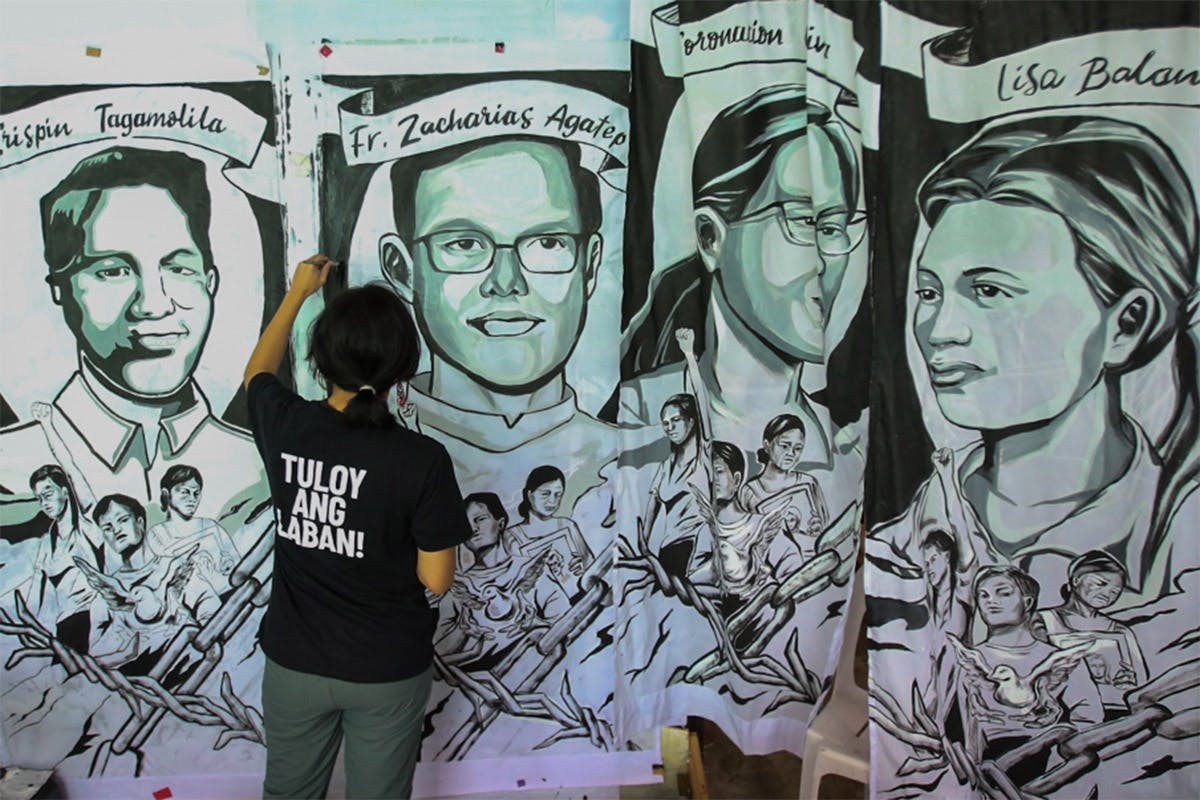
A historian has expressed belief that government officials must be careful in asking Filipinos to “move on” when talking about martial law and the abuses committed during such period.
Jose Victor Torres, professor at the history department of the De La Salle University in Manila, said the military rule that was enforced by the late dictator Ferdinand Marcos was not a simple matter as it involved “abuse of power.”
Torres said the issue could not be treated like a “love life” that people could just forget after getting hurt. “It's not that way,” Torres added.
He also stressed that martial law would always be part of the country’s history and that a lot of people were affected when martial law was imposed.
“Maraming tao ang madamay at hindi ganun kasimple kapag sinabi lang na kalimutan ang lahat,” Torres said in an interview with “Sa Totoo Lang” on One News as the country marked the 50th anniversary of the declaration of martial law on Wednesday, Sept. 21.
He was reacting to the statements of pro-administration Senators Jinggoy Estrada and Robin Padilla that Filipinos should now move on from the past.
Estrada said the country could progress amid serious challenges if people would move on as he pointed out that the late dictator’s son and namesake, Ferdinand Marcos Jr., was elected president last May with 31 million votes.
Estrada claimed Filipinos do not believe Marcos Jr. was complicit in the human rights and other abuses attributed to his father.
“We must be united as one. At the end, if the President succeeds, the whole nation succeeds,” Estrada said.
Sen. Robin Padilla also urged Filipinos to move on now that the son of the late strongman is now the President.
“Let’s move on children. If former president Marcos committed sins, those are not of the son,” Padilla told reporters in Filipino.
He said both in Islam and Catholic religions teach that sins of the father should not be pinned on their sons.
“‘Pag hindi tayo nakaalis diyan sa Marcos issue at martial law issue, kailan pa tayo mag-grow (When will we grow if we cannot move on from the Marcos issue and the martial law issue)?” he asked.
Sen. Imee Marcos, daughter of the late dictator, said her brother’s victory in the elections was a clear judgment of the Filipinos who do not care about martial law.
Younger generations must know
Torres lamented that martial law was a “dark period” in the history of the Philippines but the Filipino people “got too overjoyed with the return of the democratic principles” after the 1968 Edsa people power revolution that “we forgot to teach the next generations” about it.
“We always consider 1986 as the return to democracy, then all of a sudden, after 1986, we got freedom of the press back, and of course, the freedom of the media, the freedom of expression was always there, but then again, what happened after that?” Torres told “The Big Story” on One News on Wednesday.
Torres described it “tragic” for the Filipinos to forget history. He said young people “know only little about” the country’s past.
On Sept. 21, 1972, Marcos Sr. signed Proclamation No. 1081 placing the Philippines under martial law. The military rule lasted until 1981.
Human rights group Amnesty International documented “extensive human rights violations,” which it said clearly showed “a pattern of widespread arrests and detention, enforced disappearances, killings and torture of people that were critical of the government or perceived as political opponents” during martial law.
Cracks of martial law
While martial law made the Philippines “conducive” for business, Torres noted that it only lasted for three years as crony capitalism led to the distrust of many foreign countries.
“From 1972 to 1975 gumanda ang ekonomiya, ‘yun ang sinasabi nila, ‘di ba golden years, pero after 1975, the cracks of martial law were beginning to show,” he pointed out.
The historian also emphasized that the Marcoses should acknowledge that they were part of the dark history of the Philippines because “apology sometimes will not repair everything.”
“I think it's the acknowledgement that they play a large part in what has become, they say the dark days of our history,” Torres said.
The developments that occurred after 1986 showed “we are a forgiving people,” he added.
Correct the distortions of truth
For Etta Rosales, a martial law victim and former chairperson of the Commission of Human Rights, organizing events and teaching martial law to the young Filipinos have been their way of moving on from the past.
“We’re moving on, but it depends on how you move on,” Rosales told Sa Totoo Lang in Filipino also on Wednesday. “Sa kasalukuyan ang ginagawa namin, maraming kabataan na nag-oorganisa at nabibigyan ng pag-aaral tungkol sa katotohanan.”
“That's moving on, that's progress… We have to correct the past. We have to correct the distortions of truth,” she underscored.
Justice still “elusive” for many victims
Meanwhile, activist group Bagong Alyansang Makabaya (Bayan) reminded the President on Tuesday, Sept. 20, that the issues hounding the Marcoses “cannot be avoided wherever he may be in the world.”
Marcos is currently in the United States where he spoke at the 77th United Nations General Assembly, among other activities.
“On the 50th anniversary of martial law, we vow to fight all forms of disinformation and historical distortion about the dictatorship. We vow to fight for justice for the victims of martial law and for the Filipino people suffering under a second Marcos regime,” Bayan secretary general Renato Reyes said in a statement.
According to Reyes, justice remained “elusive for many of the victims of Marcos and for the Filipino people as a whole.”
“Bayan honors all the brave and patriotic citizens who fought the atrocities and unbridled corruption of the US-backed Marcos dictatorship,” he said.
Reyes added, “We expect Mr. Marcos to make a grand pitch to foreign investors and hype the state of the Philippines, even if our economy is mired in crisis and the regime has offered no real solutions.”
Commemoration
In a Facebook post captioned “Minority,” Senate Minority Leader Aquilino “Koko” Pimentel III shared a photo of him with deputy minority leader, Sen. Risa Hontiveros, and their staff members wearing black on the day of martial law declaration’s 50th anniversary.
Hontiveros said it is not enough to only commemorate the event because Filipinos are still suffering from the deep wounds “brought by the countless deaths, abuses and injustices during those dark years.”
“We cry out ‘NEVER FORGET’ because our various media forms have become avenues of shameless lies and propaganda, infecting the very fabric of our institutions and collective identity,” the opposition senator posted on her social media account.
Barry Gutierrez, former spokesperson of former vice president Leni Robredo, tweeted, “I want him (Marcos Jr.) to do well. Too many will suffer otherwise. But whatever good he does now does not erase the need to account for past crimes. Especially when they still continue to deny, while benefiting from, those crimes. Without justice we cannot move on.”
The Economic Journalists Association of the Philippines, the official press corps of Filipino journalists covering the economy, also said, “We will never forget the economic decline. We will never forget the malnutrition of children. We will never forget the debt burden that took the country decades to settle. We will never forget the state cronyism that diminished free enterprise.”
“And above all, we will never forget the lives and sacrifices of our fellow journalists who went after the truth, even when it cost them their life. We will remember as we must,” the group added.
Albay 1st District Rep. Edcel Lagman also said on Wednesday that the anniversary of the martial law declaration was not a golden jubilee but a “recollection of infamy, repression, corruption and economic despoliation.”
Lagman told his fellow lawmakers at the House of Representatives not to forget “the tragic and horrific past” where friends and relatives suffered torture, extra-judicial killings and enforced disappearances for their “convictions and heroism.”
“We must always remember the years of state terrorism by a dictator as we firmly resolve never to allow this national tragedy to again besiege us,” he added.
The lawmaker also asked the public to resist “all attempts of historical revisionism and self-serving sanitizing in literature and the arts, including cinematography.”
“Lamentably, the sins of the Marcos Sr. dictatorship – the grievous human rights violations, unrestrained cronyism, the plunder of the economy, the negative economic growth are barely taught in educational institutions specially in the basic education level,” he said.
This is despite the provision under Republic Act No. 10358 or the “Human Rights Victims Reparation and Recognition Act” which mandates the Department of Education and Commission on Higher Education to “ensure that the teaching of Martial Law atrocities, the lives and sacrifices of human rights violations victims in our history are included in the basic, secondary and tertiary education curricula.”
The lawmaker underscored that commemorating the “horrors of the past instills in us the obligation to guard and be vigilant against its recurrence.”
“Remembering will make it more difficult to normalize violence and injustice. Remembering will help foreclose the propensity of people to turn a blind eye on official corruption and misconduct,” he said.
He stressed that remembering “is essential in demanding accountability.”
Lagman recalled that his brother, Herman Lagman, was the “first lawyer” to disappear on May 11, 1977 or five years after martial law was declared.
“For courageously challenging aboveground the martial law regime and its disastrous consequences on civil liberties and the national economy and for his resolute crusade to promote and protect the rights of workers, Mon was forcibly disappeared by agents of the state and is still missing after 45 years,” he added.
Lagman’s speech was backed by the Makabayan bloc as they also emphasized the need to remember martial law.
According to Kabataan partylist Rep. Raoul Manuel, the country could still feel traces of the “repressive and tyrannical rule “ during martial law five decades after.
“The youth of today will not forget and will continue to study the lessons that have been imparted to us by past generations who fought for democracy in our country, and who tried to push for the rise of our people so that these are protected from any types of threats or attacks,” Manuel said.
For her part, Gabriela partylist Arlene Brosas pointed out that Filipino people could never forget those who were killed and jailed under the Marcos dictatorship.
Brosas added the fight continues for justice to be served for the victims of martial law.
France Castro, of ACT Teacher partylist, had pushed for the swift passage of House Bill No. 207, mandating the inclusion of Philippine History as a subject in high school curriculum.
Castro also asked the lower chamber to investigate the proliferation of disinformation and red-tagging.
"It has been 50 years since former president and dictator Marcos first declared Martial law. Another Marcos is now president, basic human rights continue to be violated, freedom of the press continues to be curtailed, legitimate demands of the people are being terrorized, there is still widespread corruption, and the government continues to hinder the people from their right to free speech by blocking rallies and threatening those who criticize the anti-people policies of the government," she said.
Castro added it is important to “bring back Philippine History as a separate subject” in high school to “ensure that the Filipino people do not forget the lessons of the past and not let the sins of those in office in the past against the people will not be repeated.”
On Tuesday, hundreds of anti-Marcos activists marched the streets of New York City from the Philippine Consul General on Fifth Avenue towards the United Nations where the President spoke at the UNGA.
A documentary film about the survivors of martial law also premiered on Wednesday at the University of the Philippines Film Institute and at the Bantayog ng mga Bayani to commemorate the anniversary of the martial law declaration. – With Sheila Crisostomo, Paolo Romero