



Marcos Signs P5.268-Trillion National Budget For 2023
The President said the quick passage of the 2023 General Appropriations Act shows that the roadmap proposed by the executive is fully supported by the legislature.
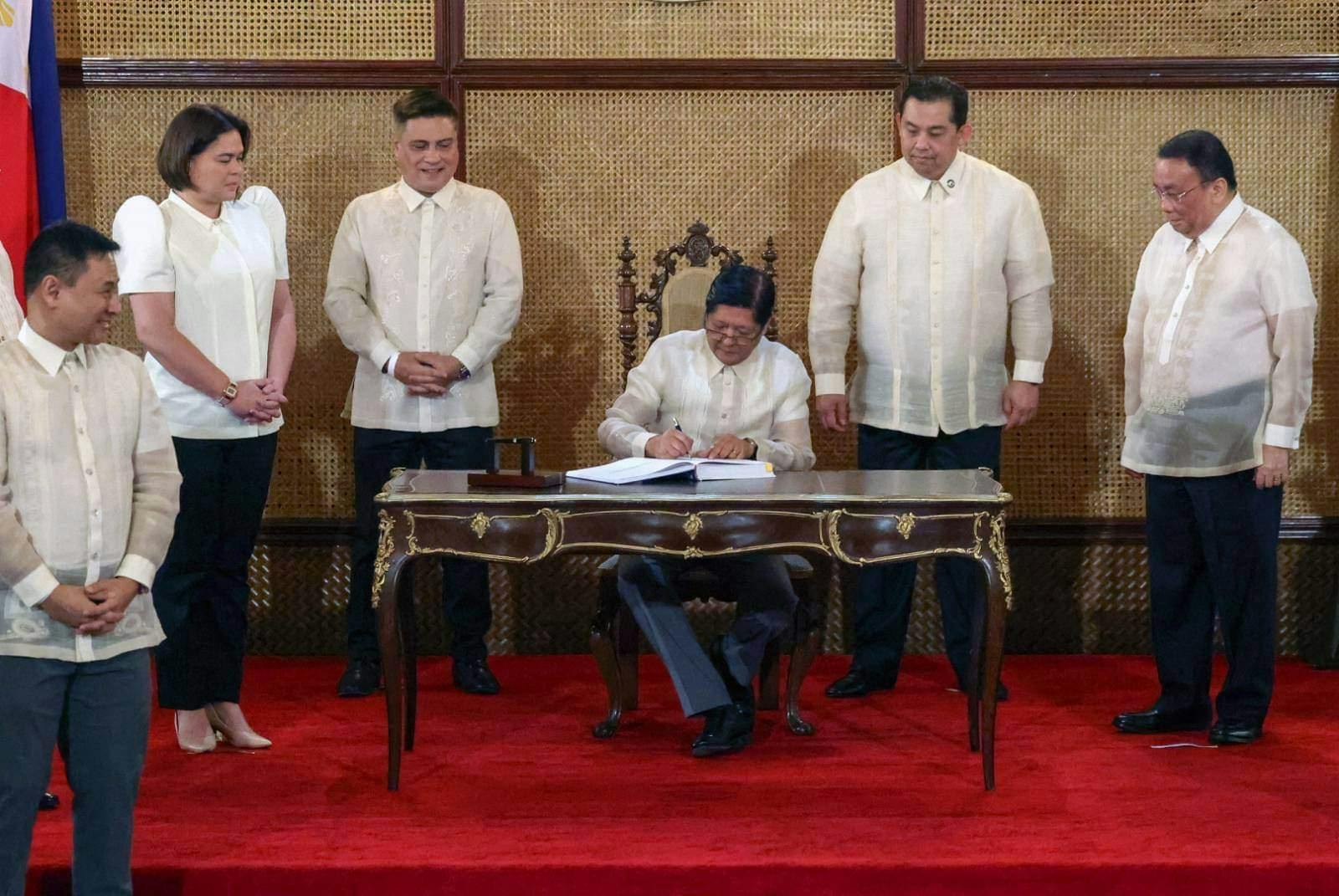
President Marcos signed into law on Friday, Dec. 16, the P5.268-trillion General Appropriations Act (GAA) for 2023, the earliest enacted budget program in the country’s history, designed – according to administration officials – to usher in prosperity in the post-pandemic era.
In his speech, Marcos described the signing of the 2023 GAA as a “historic moment” and a “fine Christmas gift” to any president from the legislature. This was the first national budget of the Marcos administration.
“I cannot overstate the significance of the fact that as Speaker Martin (Romualdez) continually reminds me, this is the quickest and the fastest – and the SP (Senate President Juan Miguel Zubiri) – the fastest passage of the national budget that we have seen so far,” the President said.
“And why is that important? Well, it is important because the budget is essentially the roadmap that we are going – that essentially defines and gives muscle to the roadmap of what we intend to do for the next year,” Marcos said.
With the President during the budget signing at Malacañang were Vice President Sara Duterte, Zubiri, Romualdez, members of the Cabinet, members of the Senate led by finance committee chairman Sen. Sonny Angara, members of the diplomatic corps, officials of the Union of Local Authorities of the Philippines and representatives from the business sector.
Marcos said the quick passage of the 2023 GAA shows that the roadmap proposed by the executive is fully supported by the legislature.
“And that is very, very important indeed. Because it is what is essentially or sometimes regarded as a long, difficult, long drawn-out process has been shown to still be able to express that kind of support, that kind of solidarity with the executive,” he said.
“And that bodes well for us, seeing as we have many, many plans. There are many things that we need to do. There are many things that we would like to do. And we are slowly moving in that direction. We are doing all the structural changes that we need,” the Chief Executive said.
Marcos also hailed the legislators for being “very cooperative” in making necessary amendments to the law.
“All of these elements that are important for us to position ourselves in the new – I nearly said new society – in the new economy after the pandemic,” the President said.
“So again, it bodes well for our future, for the next year at the very least. We know that we are all together and that we will be moving in a very, on the way to transformation of our economy, and we will be moving in the same direction, following the same plan, following the same – with the understanding that this is the best path to progress, this is the best path to prosperity,” Marcos said.
The President, meanwhile, also approved the government’s six-year development plan aimed at boosting the Philippines’ economic and social transformation and make it more inclusive and resilient to unexpected shocks
The National Economic and Development Authority (NEDA) board presented the Philippine Development Plan (PDP) 2023-2028 to Marcos during a meeting at Malacañang yesterday
With Marcos’ approval, the development plan will be ready for immediate implementation in 2023, according to the Office of the Press Secretary.
“This will facilitate the coordination and the alignment of all departments and all agencies in government to a single plan so that we are all working in the same direction,” Marcos said.
Grateful
The President expressed his gratitude to the Senate and the House, as well as to the Department of Budget and Management, for working very hard to ensure the fast enactment of the spending law.
“And what we have achieved here in terms of the fact that we have been able to put into place the budgeting requirements for all that we plan to do and that we did it in record time, that is a significant, significant achievement. And for that, I can only thank you all,” the Chief Executive said.
“It is the most important and potent tool the President, his economic team and the entire government can use to accomplish the goals of the prosperity roadmap,” Romualdez said.
“The money needed to sustain our economic expansion momentum and keep the country on the high-growth path should be out on Jan. 1. Agencies should be ready to keep up with their programs, activities and projects, while observing transparency and accountability,” Romualdez added.
House Majority Leader Manuel Jose Dalipe said the “record-breaking” enactment of the national budget is “proof of the Marcos administration’s unparalleled commitment to quickly set into motion all the programs needed to revive the economy.”
Angara said targeted financial assistance to sectors hardest-hit by the pandemic would continue under the approved budget program.
“While there were disagreements on some issues during the bicameral conference committee meetings, both panels found common ground in the need to ensure that assistance is given to those who require it the most and to keep the momentum going in the country’s move towards economic recovery,” Angara said.
“As stated by President Ferdinand Marcos Jr., this budget is anchored on an agenda for prosperity. We are no longer at a point where we are catching up and reacting to the developments just like the past two years,” he said.
“Now we can lay the foundation for the country to build on towards sustaining economic growth and providing more opportunities for our people,” he added.
“This GAA provides for items that would sustain the growth we are enjoying, continue generating investments and jobs for our constituents and increase incomes of Filipino families,” House appropriations committee chairman and Elizaldy Co maintained.
Fastest
In a statement, the DBM said the passage of the 2023 national budget is historically the fastest for the country. The 2023 GAA is 4.9 percent higher than this year’s budget.
The bicameral conference committee – composed of representatives from the Senate and the House of Representatives – approved the 2023 budget bill last Dec. 5.
The Marcos administration aims to achieve the following economic objectives outlined in its Medium-Term Fiscal Framework (MTFF): 6.5 to 7.5 percent real gross domestic product growth in 2022 and 6.5 to eight percent real GDP growth annually between 2023 and 2028; nine percent or single digit poverty rate by 2028; three percent national government (NG) deficit-to-GDP ratio by 2028; less than 60 percent NG debt-to-GDP ratio by 2025 and the attainment of upper-middle-income status for Filipinos.
Meanwhile, the eight-point socioeconomic agenda under the MTFF is focused on food security, improved transportation, affordable and clean energy, health care, social services, education, bureaucratic efficiency and sound fiscal management.
“When we submitted the NEP (National Expenditure Program) to the Congress, we only asked for one thing – hopefully, if they introduce amendments, it is in sync with the MTFF and the eight-point socioeconomic agenda. We are grateful that both houses have adopted,” Budget Secretary Amenah Pangandaman said.
“This is the fruit of all the intense work, sacrifice and strong partnership from all the branches of government. This is truly a timely gift for the Filipino people,” Pangandaman said.
The following are the agencies with the highest appropriations for 2023 based on the final report of Congress: Department of Education (P900.9 billion), Department of Public Works and Highways (P881.9 billion), Department of Health (P334.9 billion), Department of the Interior and Local Government (P255.3 billion), Department of National Defense (P234.9 billion), Department of Social Welfare and Development (P199.5 billion), Department of Agriculture (P178.7 billion), Department of Transportation (P105.9 billion), Department of Justice (P54.9 billion), and Department of Labor and Employment (P44.8 billion). – With additional reports from Sheila Crisostomo, Paolo Romero


