



Incompetence, Negligence Seen In NAIA Shutdown
“We take this as a lesson and we manifest to this honorable committee and fellow Filipinos that we take full responsibility and accountability for what happened,” Civil Aviation Authority of the Philippines Director General Manuel Antonio Tamayo said
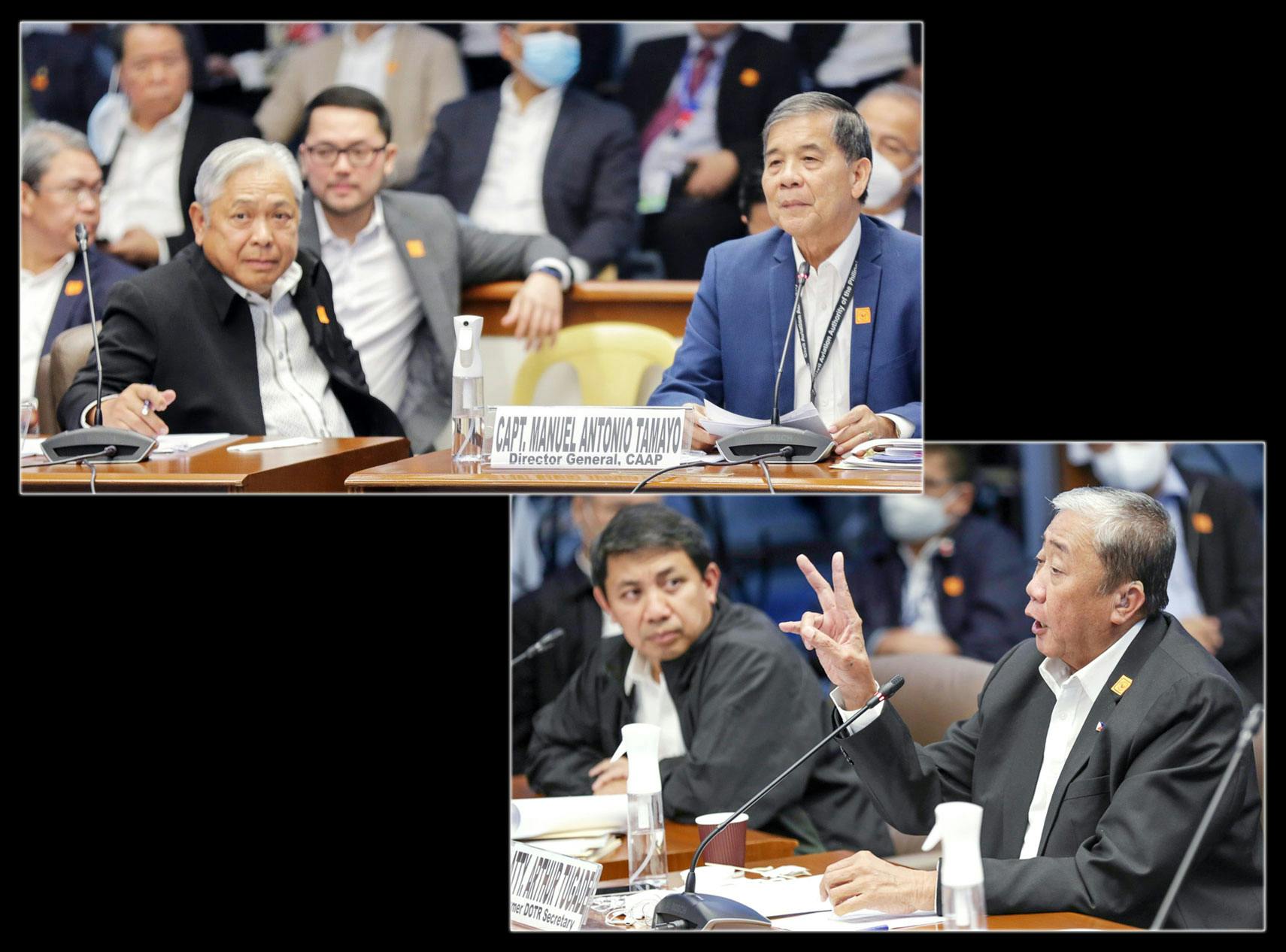
Negligence, incompetence, poor maintenance as well as claims disputes with suppliers apparently were to blame for the New Year’s Day crash of the air traffic management system at the Ninoy Aquino International Airport (NAIA), according to details and testimonies that emerged from the Senate inquiry into the incident on Thursday, Jan. 12.
The breakdown forced the closure of the country’s airspace for over nine hours, disrupted over 300 flights and left 65,000 air travelers stuck at the premier gateway.
The Senate committee on public services, chaired by Sen. Grace Poe, started its probe on the shutdown of NAIA, with senators blasting the explanation of the Civil Aviation Authority of the Philippines (CAAP) that it was a simple failure of a circuit breaker that led to the malfunction of the Communications, Navigation and Surveillance/Air Traffic Management (CNS/ATM).
Also testifying was former transportation secretary Arthur Tugade, who debunked reports that he caused the diversion of CAAP funds for the system even as he disclosed there is an ongoing dispute between the Department of Transportation (DOTr), which supervises the agency, and the suppliers/contractors – Thales and Sumitomo.
CAAP Director General Manuel Tamayo repeated to the committee what he told a parallel inquiry at the House of Representatives on Tuesday, Jan. 10, that a faulty circuit breaker caused the two uninterruptible power supply (UPS) units to stop working, causing a power outage that paralyzed the system.
He offered to take full responsibility for the fiasco. “We take this as a lesson and we manifest to this honorable committee and fellow Filipinos that we take full responsibility and accountability for what happened,” he said.
“We commit to see through this ordeal and remain transparent in all our dealings and of service to the Filipinos in ensuring that our skies are safe,” he added.
Arnold Balucating, CAAP assistant director general for air navigation service, said when technicians were reinitializing the system, they saw sparks and detected burning odor from the circuit breaker, which they realized was the problem and not the UPS as they had thought.
When separately questioned by Senate President Pro Tempore Loren Legarda, Sen. Risa Hontiveros and Poe regarding the circuit breaker, Balucating said there are no answers yet as the piece was sent to experts for forensic examination. He did not give details.
Poe suspended the hearing at around 7:15 p.m. and instructed CAAP officials to submit documents to help them come up with information to prevent a similar incident in the future.
“Despite the lengthy discussion today, you can’t say what happened and can’t determine what happened, so how can we act, we don’t know the beginning and end of why this happened?” Poe said.
Cybercrime probe
Tamayo said the Cybercrime Investigation and Coordinating Center of the Department of Information and Communications Technology conducted a parallel investigation two days after incident.
“The result indicates that the incident is unlikely due to a cyber attack. However, the damaged circuit breaker and power transfer switch were turned over to them for forensic investigation,” Tamayo said.
When asked by Sen. Jinggoy Estrada about its maintenance, Tamayo stressed the circuit breaker required “minimal maintenance” and was good up to 20,000 “trip cycles” or automatic shutdowns during power surges.
“Are you incompetent?” an incredulous Estrada asked Tamayo. Balucating told the panel that CAAP would double its checks on the circuit breaker because of what happened. Hontiveros said there is now a “big mystery about a small part.”
It was also learned that there were no security cameras in the building where the circuit breakers were housed. This worried Senate President Juan Miguel Zubiri, who raised the possibility of sabotage.
Officials also mentioned that an automatic voltage regulator as well as a very-small-aperture terminal or VSAT satellite ground station at NAIA was damaged during the incident.
Poe cited reports that one UPS was not regularly used as its cooling fan was not working properly while a local company tasked to maintain them apparently was not regularly servicing the units.
Legarda noted that the emergency procurement of UPS was not the “answer” to the circuit breaker problem, to which Tamayo responded that the purchase was a preventive measure.
“But would you agree with me if we have a working maintenance checks, this would not have happened?” Senate Majority Leader Joel Villanueva asked, noting that he wanted to know whether the shutdown of the CNS/ATM was an unforeseen event or a disaster waiting to happen.
Tamayo replied: “The chances of it happening will definitely be reduced if we have maintenance checks.”
It was learned during the hearing that the warranty from Sumitomo and Thales expired in 2020 but the DOTr could not continue to tap their services to maintain their equipment. Balucating admitted that critical supplies are now running out.
Tugade said the dispute arose from claims from Thales and Sumitomo totaling P986.6 million, including for price escalation, after the Commission on Audit issued a notice of disallowance on the payments to them in 2011 only to reverse in 2013 that led to delays in the completion of the project funded by loans from the Japan International Cooperation Agency.
Tugade said they had worked to resolve the matter but a DOTr committee then recommended to negotiate on those that are clearly arrears, and not to pay claims with unclear documentation, as they are not loans per se but simply supposed penalties sought by the suppliers due to the delays.
Incumbent officials as well as representatives of Thales and Sumitomo told the panel that they are working to resolve the matter so new service contracts could be entered into for them to maintain the equipment.
No new contract
However, Thales representative Harry Nuske said the company will not enter into service contracts unless the government pays what it owes.
Poe urged airport authorities to tap a third party provider that would regularly check and maintain air traffic equipment to avert a similar fiasco.
She said the CAAP has the funds to engage the services of qualified maintenance providers and must not waste time so as not to “put in jeopardy the safety of passengers.”
Sumitomo’s consultant, lawyer Lloyd Chadwick Lim said CAAP has competent and trained personnel, but added that “having a third party would be beneficial.”
“Knowing what and why it happened and seeking accountability is to our best interest. But at the end of the day, our goal is to make sure that this will not happen again – not only by upgrading the system or replacing the equipment but also making sure that the institutions running these are empowered and capacitated,” Poe said.
Hontiveros said CAAP should not lead the investigation on the New Year’s Day fiasco. She raised the possibility that the Senate consider asking different aviation bodies to be part of the investigation.
“There should be no scapegoats or free passes from liability. If someone became sloppy, they must be held accountable. In all honesty, this seems to be an extraordinary event caused by very basic mistakes. Totally unacceptable,” she said.
“CAAP cannot even get its facts straight. It’s been one and a half weeks since the incident, it should be clear to them what the problem was. And if they don’t know, that’s even worse than what happened. That would make them both negligent and incompetent. The CAAP should not, in any way, attempt to absolve itself of any faults,” she said.
Third party
Hontiveros said a third party should double-check both the equipment log and the manual log of the system error.
“Let’s identify who entered the manual log of the system error. The Senate needs their firsthand account of what they had observed to cross-check CAAP’s statements. The suppliers of the equipment should also check the logs themselves and provide that information to the Senate committee,” she said.
She also said that the CAAP should explain to the Senate how it ruled out cyberattacks within 24 hours as a cause for the NAIA meltdown. The senator added that increased cybersecurity steps should be taken because the meltdown was also a security risk.
“We want to be immensely thorough before we rule out a cyberattack. Let’s get this verified by our other cybersecurity bodies like the DICT. If this is not a cyberattack if our systems are that vulnerable, it means we are exposed to possible attacks from entities that can shut down our major airports so easily,” she said.
“I brought up these same security risks for our national grid, the NGCP. Extensive measures need to be explored and put in place so that there are no sizeable weaknesses in our cybersecurity,” she added.
Undersecretary Alex Ramos, Cybercrime Investigation and Coordinating Center (CICC) executive director, clarified that their report ruling out the cyber attack is not conclusive.
The senator said that if the mistakes leading up to the NAIA mess turned out to be “simple and basic,” then those responsible should be charged with gross negligence.
“This mess could have been much worse. There was a report that the paths of two planes were dangerously close to each other and could have resulted in a mid-air collision that day. This was a tragedy narrowly avoided,” she noted.
Sen. Bong Go warned of “terrorism waiting to happen” with the removal of the X-ray and scanner at the entrance of the airports, a measure which aviation authorities employed to speed up the process in the aftermath of the systems breakdown.
“I have received reports that x-ray machines and scanners at the airport departure entrances were recently removed to accommodate the concerns of passengers to have faster and more convenient travel. Our security is more relaxed to speed up the processes inside the airport,” Go said in his opening statement.
“However, I noticed that the first layer (of security) was removed. The question is, this is an issue of security and convenience. Do not compromise, do not risk the safety of our passengers,” he said. – With Rudy Santos


