Gov’t Downplays Strike As Protesters Say 95% Of Metro Manila Transport Paralyzed
Malacañang said the operation of public utility vehicles remained normal while Manibela president Mar Valbuena declared the first day of the one-week strike was a success.
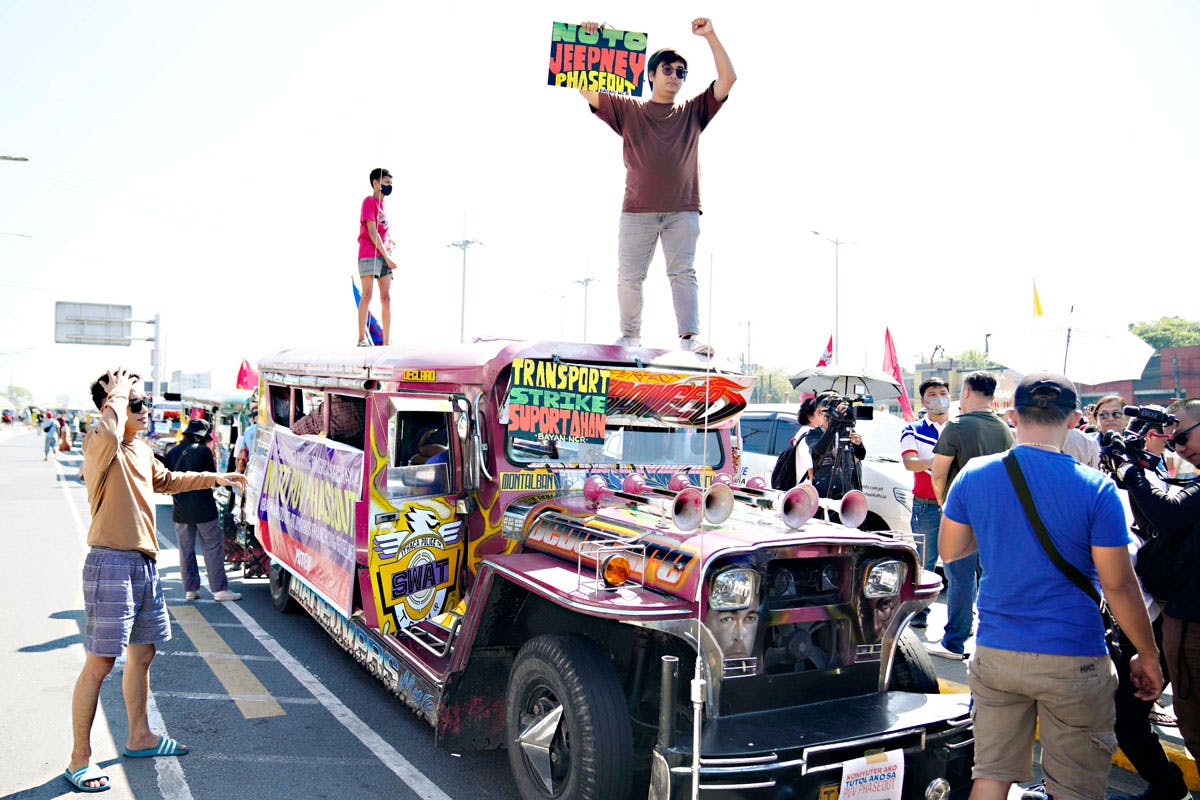
A strike by public utility vehicle (PUV) operators and drivers paralyzed 95 percent of transportation in Metro Manila on Monday, March 6, leaders said as they announced they would push through with the planned weeklong protest.
But Malacañang said on Monday that except for some Metro Manila routes, the operation of PUV remained normal despite the transport strike by some groups.
In an interview with The Philippine STAR, Pinagkaisang Samahan ng mga Tsuper at Operator Nationwide (Piston) president Mody Floranda said that aside from the National Capital Region (NCR), the strike was felt in nearby regions.
“Based on our estimate, the paralyzation was almost 95 percent here in Metro Manila and nearby provinces,” Floranda said, that noting over 100 public utility vehicles (PUVs) joined the caravan from the University of the Philippines in Diliman, Quezon City.
“Our mobilization will continue until President Marcos Jr. issues an executive order junking the modus memorandum order on the modernization program,” he added.
Based on the breakdown of Piston, among the areas totally paralyzed were those plying routes from Cubao to San Juan, Cubao to Divisoria, Malolos, Bulacan to San Fernando, Pampanga, Jollibee Molino, Alabang to Zapote Highway, Zobel Roxas to Paco, Navotas to Divisoria, Recto, Monumento, Malabon, Pateros to Pasig City, Zapote to Paliparan, Marcos Alvarez, and Sangandaan to Pajo to Divisoria.
Piston added that other areas affected by the strike included Marikina to Parang to SSS (70 percent paralyzed), Calumpit to Meycauayan, Bulacan (90 percent), Baclaran Metrobank route (90 percent), E. Rodriguez route including Cubao to Quiapo, Kalaw to Project 2 and 3 (99.9 percent), Novaliches to Blumentritt (80 percent), Pasay (90 percent), Palapala to Imus (70 percent), Los Baños to Calamba (95 percent), Calamba (80 percent), Antipolo to Junction Crossing (90 percent) and Cogeo to Cubao (80 percent paralyzed).
For his part, Manibela president Mar Valbuena said that the first day of the one-week strike was a success. “Aside from Metro Manila, affected by the transport strike include Central Luzon, particularly Bulacan, Pampanga and Bataan and Calabarzon (Calamba, Laguna, Batangas, Rizal and Quezon),” Valbuena told The STAR.
“The effect of the strike was lessened as many decided to cancel the face-to-face classes and companies opt for work-from-home setup,” Valbuena said.
Several schools and local government units have suspended in-person classes and work operations during the weeklong transport strike.
Valbuena said that the mobilization will continue until the government acts on the demands of the transport groups. “Other members of different transport groups joined the strike as the membership of Manibela is only 10 percent. The strike was composed of different affiliations,” he noted.
At the same time, Valbuena said that he was not surprised when the Land Transportation, Franchising and Regulatory Board (LTFRB) did not invite Manibela and Piston in the dialogue on Monday.
“I expect the LTFRB will never invite us. We anticipated that the LTFRB would downplay the strike. What we can say is we were able to stop the (face-to-face) classes and that is already a big achievement,” he added.
On the other hand, Pasang Masda president Obet Martin expressed doubt whether Piston and Manibela will be able to sustain the strike amid reports that the Piston Monumento Chapter will return to normal operation today.
“(On Tuesday, March 7), we expect that the situation will normalize as the jeepney drivers cannot afford their family to suffer,” Martin said.
“In my experience as a driver as I am the oldest here, transport strikes cannot be sustained in one week. Many joined the strike today (Monday) because of the support of militant groups,” he noted.
Where is the President?
Militant group Bagong Alyansang Makabayan (Bayan) slammed the government for not responding to calls opposing the jeepney phaseout.
“Where is the desire to actually address the grievances of the drivers and operators? Are they really numb?” Bayan said in the statement.
“Amid the transport strike, we ask, ‘Nasaan ang pangulo?’ What is his response to the demands to stop the phaseout and scrap the deadline at the end of the year?” it added.
The group also said President Marcos has the authority to revoke the Department of Transportation order, and “the ball is in his court.”
Bayan slammed the statements of some government agencies that the transport strike only accounted for a small number of jeepney drivers and operators. They said that they went from España, Manila to Quezon Avenue and East Avenue on Monday, but only saw one traditional jeepney plying the route.
Only 5% to 10% of PUJs joined
“There is no disruption except in a handful of routes in the National Capital Region amid the ongoing transport group strike,” the Palace said in a statement.
“The strike initiated by some transport groups has failed to disrupt the normal public transport operations particularly in Metro Manila and nearby areas, with the government efficiently responding to serve the commuting public affected by the disturbance on Monday,” Presidential Communications Secretary Cheloy Garafil said in a separate statement.
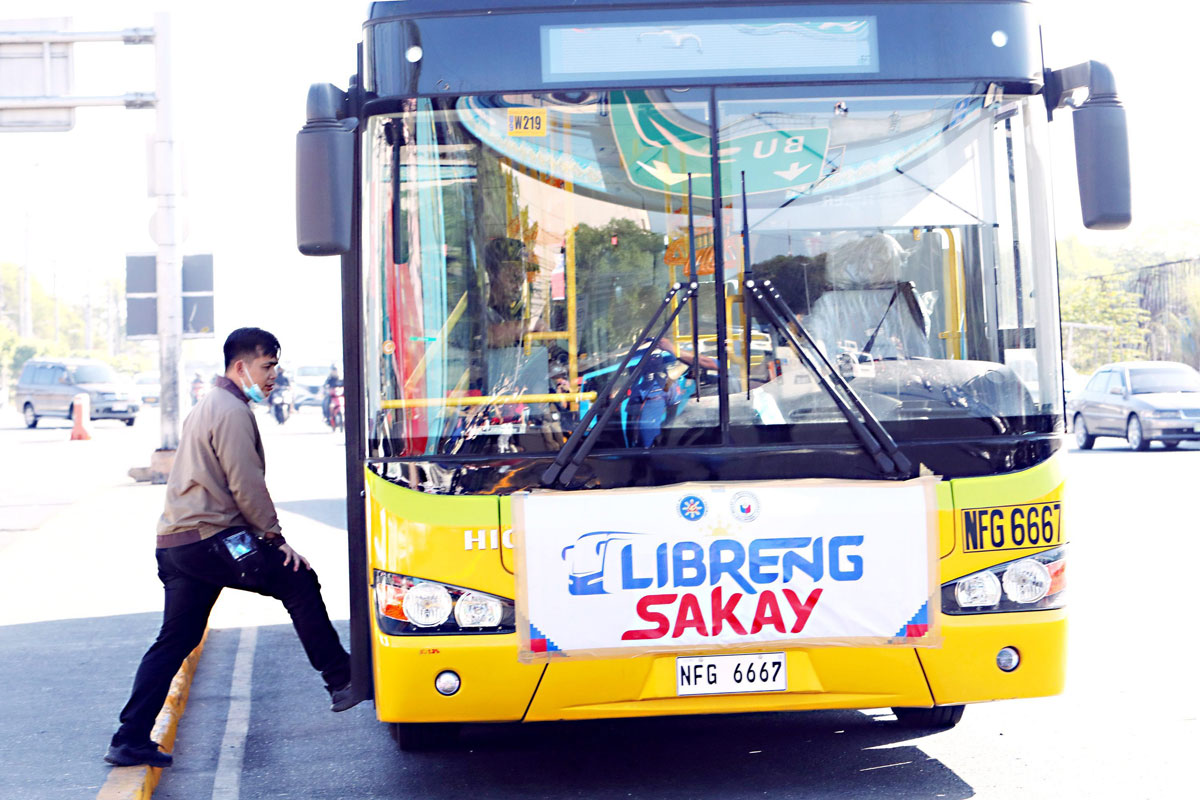
According to Malacañang, the government has enough personnel to assist commuters and has provided free rides to those affected by the strike.
Police personnel have ferried affected passengers from Almar Subdivision in Caloocan to Quezon City. The government has also deployed vehicles to serve passengers in the Dapitan-Baclaran route. Buses offering free rides were also prepositioned in Pasay, Marikina, Caloocan and Quezon City, the Palace said.
At least 11 PUV groups in Metro Manila have said they won’t support the weeklong transport strike led by Manibela.
LTFRB chairman Teofilo Guadiz said only five percent of the total members of various transport groups joined the strike.
“Many buses offered free rides but based on our assessment, there’s no need as based on our monitoring, only five percent all over the country participated in the strike. In Metro Manila, it’s about 10 percent,” Guadiz said, noting that aside from NCR, the strike was only felt in Region IV-A.
Transportation Secretary Jaime Bautista said he expects the weeklong transport strike to inflict little to no damage to the economy, although it has yet to project its impact in the coming days.
Bautista also said the strike failed to paralyze growth areas encircling Metro Manila, particularly Bulacan, Cavite and Laguna.
Around Metro Manila, Transportation Undersecretary Mark Steven Pastor said the strike injured just two routes: Monumento to Malanday and Monumento to Navotas. Some routes, on the other hand, were served by transport assets of both the local and national government.
On the other hand, Bautista said the government is evaluating the creation of bike lanes in areas outside Metro Manila in line with efforts to promote active modes of transport. For 2023, the Department of Transportation has received P700 million for the establishment of bike lanes.
“For the new bike lanes, we secured from the General Appropriations Act around P700 million,” Bautista said. “We are studying different areas not only in Metro Manila, but also in the provinces.”
Generally peaceful
Members of the Inter-Agency Task Force Monitoring Team reported their assessment during the first day of the weeklong transport strike in Makati on Monday.
According to Metro Manila Development Authority (MMDA) acting Chairperson Don Artes, there were three incidents reported on the first day of the weeklong transport strike but was “generally peaceful.”
Artes believes that only a few transport groups joined in the strike, saying that public transport was not paralyzed by the protest. However, the MMDA chair said that they will still put their vehicles on standby.
The MMDA also announced that they will bring back the number coding scheme starting today, after observing heavy traffic on the first day of the jeepney strike.
The first day of the weeklong jeepney strike went generally peaceful in Calabarzon, with five police directors noting that “strike in their respective areas of jurisdiction are generally peaceful and under control.”
In Central Luzon, Brig. Gen. Jose Hidalgo, Police Regional Office-3 director said “no untoward incidents happened the region” as transport groups in Pampanga, Bulacan and Bataan did not join the strike.
The Bulacan Federation of Jeepney Operators and Drivers Association and other jeepney transport groups in the province did not join the one-week nationwide transport strike, the Provincial Public Affairs Office reported.
In Zamboanga City, the Federation of Land Transportation of Zamboanga turned down calls to join the strike, saying it understands the repercussions this will bring to the riding public.
Increased subsidy
Pressured by jeepney drivers and operators, the DOTr will hike the subsidy it extends for the purchase of modern public utility jeepneys (PUJs) to P20,000 for every unit.
“We give out a subsidy of P160,000 per unit, [but] we will increase this amount. We just have to get an additional budget. We will also help them borrow capital from the state-run banks. We will increase it [subsidy] to around P260,000,” Bautista said.
At that rate, the government will cover roughly 10 percent of the cost of a modern PUJ that runs anywhere between P2.2 million and P2.4 million. Bautista said cooperatives can apply for loans from government and private banks for additional capital.
Further, the DOTr wants to talk to the Development Bank of the Philippines and Land Bank of the Philippines in the hopes of extending the period of repayment for the loans.
Bautista added that loans for the purchase of modern PUJs may be taken from private banks, although borrowers have to expect the interest to be higher than from state-run lenders.
Painful interference
For her part, Vice President and Education Secretary Sara Duterte slammed Piston on Monday for pushing through with its nationwide transport strike, which she described as a “painful interference to the Department of Education (DepEd)’s efforts to address the learning gap brought by the COVID-19 pandemic.”
The Vice President likewise slammed other organizations expressing their support to the transport strike, including the Alliance of Concerned Teachers.
Duterte, nonetheless, said the classes will continue amid the weeklong transport strike. The DepEd over the weekend instructed its regional directors and division superintendents to prepare for in-person classes and modular learning setup, depending on the circumstances in their respective localities.
Meanwhile, the Philippine National Police called on drivers and operators joining the transport strike to instead raise their concerns through legal processes.
“They do not have anything to paralyze. So why don’t they just air their grievances to the agency concerned so that it will reach the decision makers, whatever their grievances are?” Azurin said.
In Bulacan, the police provincial office said public transport operation were “normal,” as it bared an “isolated” case of a reported transport strike in Calumpit, where 50 jeepney drivers from the United Calumpit Jitney Driver’s and Operator Association and Manibela Driver’s Association participated.
The group was advised by authorities to conduct their protest actions peacefully without harassing other drivers and have been warned not to violate any law.
The transport strike was also supported by around 30 members of Anakbayan, Kabataan and STAND BulSU.
Tulong Guro
Members of the group Alliance of Concerned Teachers (ACT) extended assistance to jeepney drivers holding a strike to oppose the government’s PUV modernization program.
The group launched its “Tulong Guro” program by distributing food and drinking water in strike centers.
“As teachers, we aim to set a good example for our students on being compassionate, especially to the poor and the downtrodden, as opposed to the arrogance and cold-heartedness that the DepEd secretary has shown in her tirade against the drivers and us, her own employees,” ACT NCR union president Ruby Bernardo said.
Bernardo was apparently referring to Vice President and Education Secretary Sara Duterte who had repeatedly slammed the protesters and the ACT over the supposed “communist-inspired” transport strike.
Duterte even went on linking the ACT and Piston to Communist Party of the Philippines, National Democratic Front and New People’s Army.
“The right to strike is a basic right of all working people, guaranteed by international instruments and our own Constitution. It is the workers’ last resort in the face of unbearable exploitation and oppression, their means to assert and show the indispensability of their labor to the economy and the society,” Bernardo said.
Several transport groups, led by Piston, decided to hold a weeklong strike to oppose the national government’s jeepney modernization program which aims to phase out old jeepney units and consolidate drivers into cooperatives.
PUV operators were initially given until June 30 to form a cooperative. If they fail to do so, their certificate of public convenience will be revoked.
The LTFRB last Wednesday extended the deadline to Dec. 31 but some groups said they will push through with the strike. – With Elijah Felice Rosales, Ed Amoroso, Elizabeth Marcelo, Ric Sapnu, Ramon Efren Lazaro, Roel Pareño, Michelle Zoleta, Mark Ernest Villeza, Mayen Jaymalin