



Flights Delayed As Phl Airspace Briefly Shut Anew
Unlike the New Year fiasco, the Civil Aviation Authority of the Philippines this time shut the Philippine airspace on its own to replace the blowing/cooling fan for the second uninterruptible power supply.
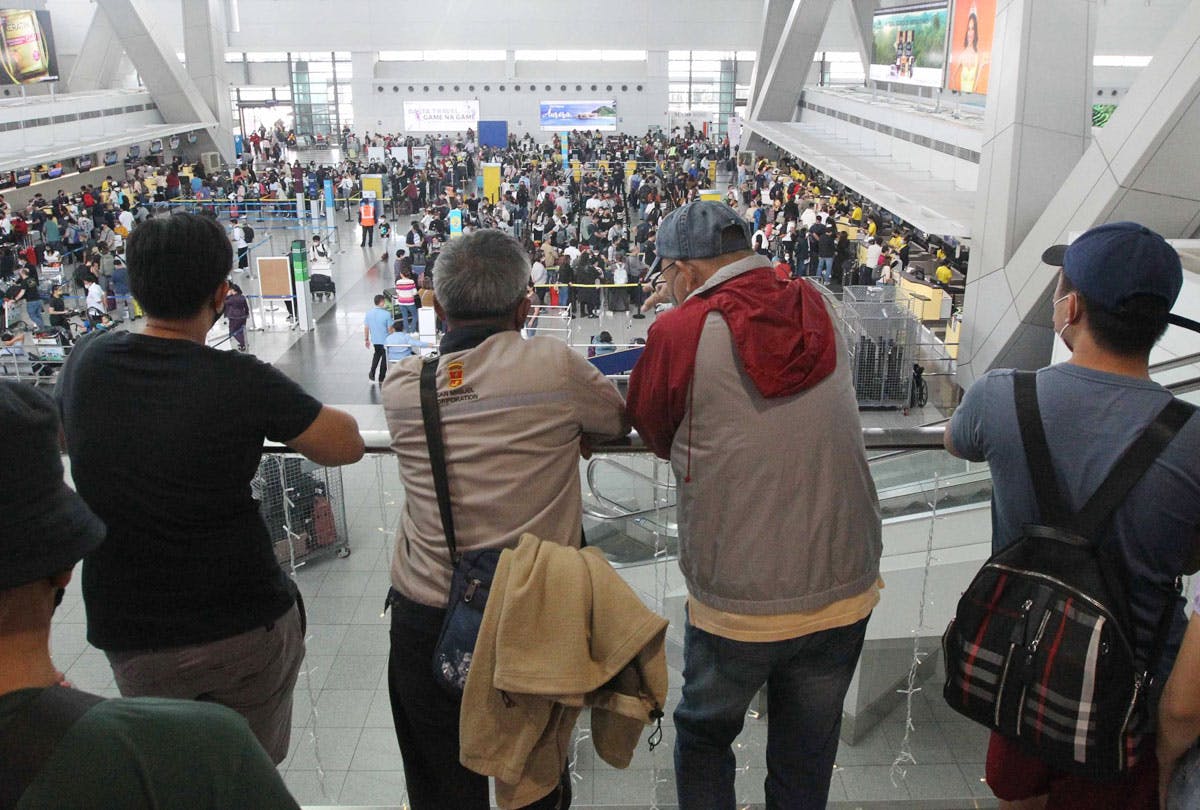
The Civil Aviation Authority of the Philippines (CAAP) shut Manila airspace anew to the rest of the world for nearly two hours on Sunday, Jan. 22, this time to make way for maintenance work on air traffic control.
According to CAAP, the temporary shutdown in its air traffic control delayed at least 47 flights, of which nine were held at the Ninoy Aquino International Airport (NAIA)’s taxiway while another 38 stood by for clearance.
“There were nine affected flights held at NAIA’s taxiway Charlie for departure and 38 flights that had to wait for clearance delivery during the short outage, which was necessary to complete the maintenance activity,” CAAP said.
In an advisory, CAAP said that it issued a notice to airmen (NOTAM) on Saturday, Jan. 21, to inform all of the airlines flying in and out of the Philippines about a temporary closure on air traffic.
Unlike the New Year fiasco, however, CAAP this time shut the Philippine airspace on its own to replace the blowing/cooling fan for the second uninterruptible power supply (UPS).
CAAP said the cooling fan had to be changed to ensure the workability of the second UPS. The UPS is being used by the agency to operate the communication, navigation and surveillance/air traffic management (CNS/ATM) system at the Air Traffic Management Center (ATMC).
Based on the NOTAM, CAAP said that the maintenance activity scheduled for Jan. 22 would start at 4:20 a.m. and end about an hour later. However, the replacement lasted for almost two hours.
“After the scheduled maintenance activity which was undertaken by CAAP’s engineers and the equipment’s service provider, operations at the ATMC returned to normal at 6:09 a.m., with the NOTAM subsequently being cancelled at 6:16 a.m.,” CAAP said.
On New Year’s Day, CAAP suffered a power outage that drove all aircraft away from Philippine airspace. As the CNS/ATM system experienced a loss of communication and electricity, airlines then were forced to cancel, delay or divert around 300 flights of more than 56,000 travelers both here and abroad.
The Department of Transportation has launched an investigation on the cause of the incident to determine what reforms should be made and whose heads must roll. CAAP has also asked the government for funding to modernize the CNS/ATM system, saying it must be upgraded to meet the demands of the aviation industry in the future.
Likewise, Transportation Undersecretary Roberto Lim said the agency is looking at the option of privatizing the CNS/ATM system to secure enough funds for its upgrade and pre-vent a repeat of the airspace shutdown.
Another option for the government is to put up a separate agency from the CAAP with the sole purpose of operating and maintaining air traffic control.
‘Divert 50% of NAIA flights to Clark’
The leader of the official opposition bloc in the House of Representatives offered a sensible solution to perennial problems plaguing NAIA by transferring half of its total flights to Clark until 2025.
“Assuming all flights are divided evenly between NAIA and Clark by 2025, only half of all flights would be cancelled, diverted or delayed in the event of a sudden emergency in either gateway,” House Minority Leader Marcelino Libanan proposed on Sunday.
“For instance, if NAIA has another air traffic system glitch, or if a large aircraft suddenly has a runway excursion there, only 50 percent of all flights would be disrupted once the other 50 percent is already operating out of Clark,” the 4Ps party-list congressman said.
“We have no choice but to fully harness Clark, which has been up and running for years. Clark is capable of operating more flights, offers good connectivity to Metro Manila via modern expressways, and is only 90 kilometers away from Quezon City,” Libanan added.
The opposition leader pointed out that “If we do not take full advantage of Clark as alternate gateway, there will be chaos at NAIA once global air travel explodes” and that privatizing NAIA will definitely “not solve the airport’s congestion.”
“NAIA’s problem is lack of land for expansion. No new parallel runway can be built there because the area around the airport is already highly urbanized,” the veteran lawyer-legislator stressed.
The International Air Transport Association sees international traveler numbers reaching 82 percent of pre-pandemic level this year, 92 percent in 2024 and 101 percent in 2025.
Libanan said the government, through the state-run Bases Conversion and Development Authority (BCDA), had invested P10 billion to fully develop Clark as an alternate gateway “precisely to alleviate congestion at NAIA and accommodate growing passenger traffic.”
“In fact, on top of the BCDA’s investment, the Department of Transportation also spent billions of pesos to modernize Clark,” the former immigration commissioner during the time of former president Gloria Macapagal Arroyo said.
Only immediate solution
Long before the pandemic, a study by the International Finance Corp. (IFC) had declared that “Clark is the only immediate solution to address congestion in NAIA and expand air-port capacity serving the Greater Capital Region (comprising Metro Manila, Southern Tagalog and Central Luzon).”
“NAIA is running over its design passenger and airside capacity, respectively. The current situation is unsustainable and can significantly undermine the Philippines’ competitive-ness and economic growth,” according to the IFC study.
“Currently, flight delays and cancellations have become commonplace, as well as negative passenger experience. Having to fly through NAIA adds roughly four hours more to passenger travel time, having to pass through the highly congested roads of Metro Manila,” the study pointed out.
Outside of NAIA and Clark, Libanan said it would take 10 to 15 years to build another major aviation hub serving the Greater Capital Region – whether in Bulacan or Cavite. – With Ralph Edwin Villanueva, Rudy Santos, Delon Porcalla


