



FACT CHECK: Cory Aquino’s Phone Call Scene In The Movie ‘Maid In Malacañang’ Needs Context
The late former Supreme Court magistrate Cecilia Muñoz Palma said then elected Corazon Aquino wanted to grant the request of the Marcoses to stay for two days in Ilocos Norte during the EDSA revolution in 1986, but her allies opposed this.
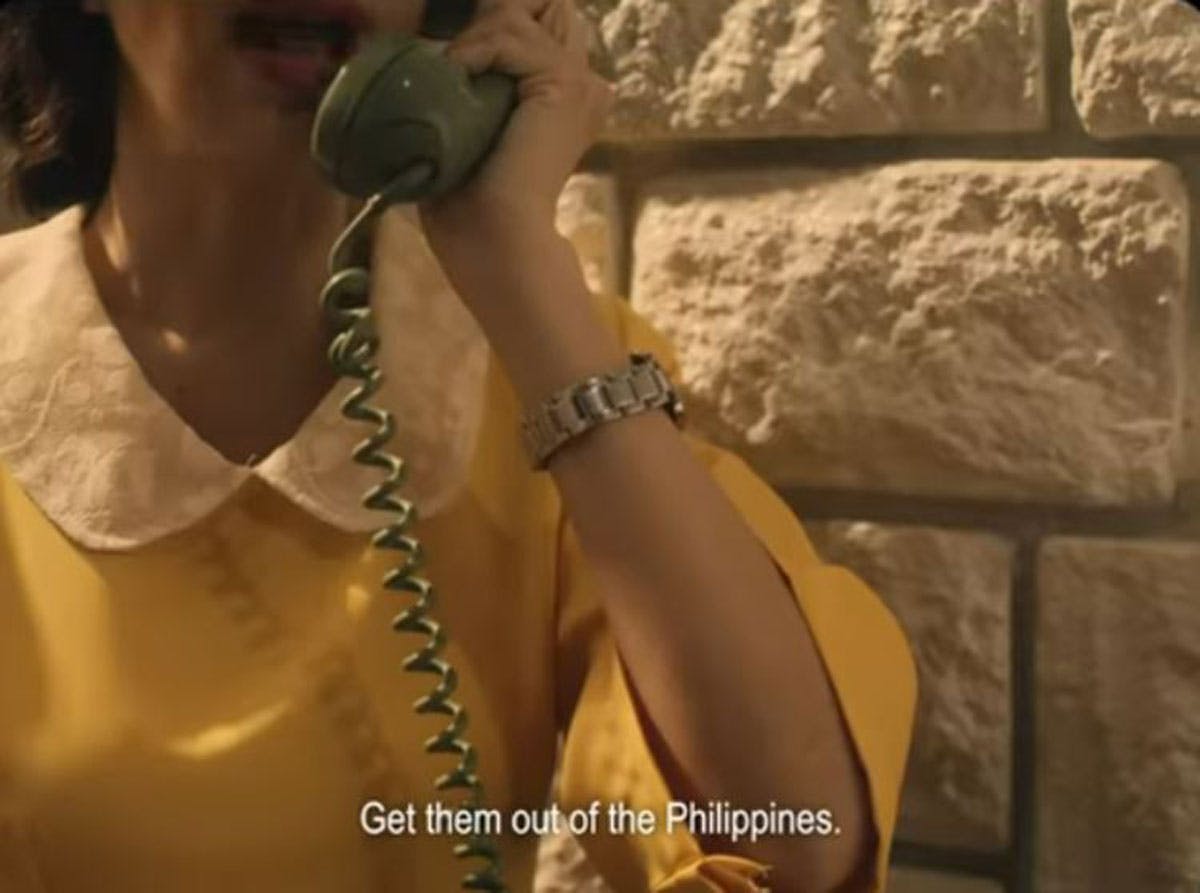
A TikTok user claimed that the controversial scene featuring the late former president Corazon “Cory” Aquino in the movie “Maid in Malacañang” is historically accurate.
Produced by Viva Films and directed by internet personality Darryl Yap, the movie depicted the democracy icon in her emblematic yellow blouse, telling someone over the phone to “Get them (Marcoses) out of the Philippines.”
Aquino was referring to the late dictator Ferdinand Marcos Sr. and his family following the events of the 1986 EDSA people power revolution, which ended Marcos Sr.’s 21-year regime and also swept her into the presidency.
A screenshot of the scene was uploaded on Facebook by entertainment page Cinema Bravo that showed the former president playing a game of mahjong with the Carmelite nuns after the phone call. This is false because Aquino made the phone call when she was already in Metro Manila.
Aquino spent time with the members of the Carmelite Monastery in Cebu City while observing a civil disobedience campaign due to reports of massive fraud involving the 1986 snap elections. The nation commemorated her 13th death anniversary last Aug. 1. She died of colon cancer in 2009.
Rating: Needs Context
Facts: The claim made by the Tiktok user needs to be put into the proper context of historical events that led to the downfall of the Marcoses and the restoration of democracy in the country during that turbulent period.
In defending the scene, the TikToker cited the 1986 subcommittee report of the US Congress titled “Investigation of the Costs Involved in Moving Former President Marcos and His Party from Manila to Hawaii.”
To prove that Aquino booted the Marcoses out of the Philippines, the TikTok user lifted this portion from the document: “The (Marcos) party arrived at Clark after sunset, making it impossible to leave for the Laoag Airport in Ilocos Norte because that airport did not have runway lights.”
“The plan was to leave for Laoag at 10:00 the next morning, February 26. However, after the party arrived at Clark Air Force Base, the new President, Corazon Aquino, advised Ambassador Bosworth that she wanted former President Marcos out of the Philippines,” the report added.
A full copy of the document is uploaded in the non-profit digital library Hathi Trust. It was referring to the Marcoses’ escape from Malacañang at the height of people power after they lost support from the United States.
The diplomat referred to in the report was then US ambassador to the Philippines Stephen Bosworth, credited as the White House envoy, who told Marcos Sr. to step down and give way to the new government in order to prevent bloodshed.
The TikTok user overlooked the whole point of the document, which actually detailed the expenses incurred by the US government in helping the Marcoses flee the Philippines upon the orders of then US President Ronald Reagan.
The report listed the
expenses as follows: $183,539 for “air lift (military air command);”
$60,375 in “operation and maintenance;” and $206,899 “for the
convenience and acquisition of personal items for Marcos’ party.”
The personal expenses incurred by the Marcoses – during their stopover at the Andersen Air Force Base in Guam and their five-day stay at the Hickam Air Force Base in Hawaii – were deemed “excessive,” according to the report.
The report also included “$20,000 in long distance phone calls, $16,000 in meals, and $11,000 in health and beauty aids,” which the subcommittee wanted the Marcoses to pay back to the US government with the State Department acting as the collecting authority.
“President Reagan offered safety and medical care to former President Marcos, his family and associates. He did not offer housing, meals, clothing and other personal conveniences,” the report read.
“Reasonable amounts would be acceptable in support of the former President (Marcos) because he was a guest of the (US) President,” it added.
Back to Aquino’s phone call, the TikTok user also cited a Facebook post by former Marcos defense minister Juan Ponce Enrile dated Sept. 23, 2021. In that post, Enrile recounted a visit to Aquino at the house of her sister Josephine Reyes in Wack-Wack Subdivision, Mandaluyong.
Present in that meeting were, among others, opposition figures Rene Saguisag, Ramon Mitra, Joker Arroyo, Jejomar Binay and retired Supreme Court associate justice Cecilia Muñoz Palma. Enrile said he told Aquino about an earlier call he had with Bosworth regarding the evacuation of the Marcoses.
“While I was talking, all those around President Aquino looked at me sullenly, as though they did not believe what I was telling them. President Aquino asked someone to call Ambassador Bosworth, and she talked to him,” Enrile wrote.
“All of a sudden, I heard her (Aquino) loudly exclaimed of ABC, 'No! I do not want him here. I want him out of the country!' I was certain, her remarks meant (then president) Marcos. She did not want him to remain in the country,” he claimed further.
The TikTok user said this must have been the basis for the scene in the film. But Enrile’s version was countered by a much earlier account from Palma, a staunch Marcos critic, who served as the country’s first female magistrate and later member of parliament.
Muñoz Palma was interviewed about that meeting in the book “People Power: The Philippine Revolution of 1986 (An Eyewitness History),” published in the same year by the James B. Reuter, S.J. Foundation. The book is a compilation of personal accounts of people who were part of the uprising.
According to Muñoz Palma, Aquino decided not to grant the request of the Marcoses to be allowed to stay for two days in Paoay, Ilocos Norte on the advice of people with her in that meeting, for fear of the late dictator gathering forces to reclaim Malacañang.
“Cory’s initial reaction was: ‘Poor man, let us give him (Marcos) two days.’ But we did not agree with that idea. We thought that given the chance, Marcos may regroup his forces or extend his stay indefinitely,” she recalled.
“Cory then called Ambassador Bosworth to say that she could not grant the request. Marcos should just leave the country. When Ambassador Bosworth called her back, it was to say that Marcos had left,” Muñoz Palma added.
Aquino also maintained a “cool” demeanor during that conversation with Bosworth, contrary to the account of Enrile, according to the former associate justice.
“Cool as always, Cory turned to us after she put the phone down. She said simply: ‘Marcos has left.’ She said it as if it was the most ordinary thing. We all shouted jubilantly. She did not,” Muñoz Palma remembered.
Enrile had been accused of revising the country’s history with martial law, of which he was the main architect as Marcos Sr.’s defense minister, before he defected and led the military and people power uprising.
On the eve of the anniversary of the martial law declaration in 2018, Enrile appeared in a video with former senator and now President Ferdinand “Bongbong” Marcos, Jr. himself to deny that arrests based on political beliefs and massacres happened during his father’s regime. Enrile’s claim has been factchecked by numerous media outlets as false.
Enrile’s has been appointed as Marcos’ chief presidential legal counsel.
The fears of Aquino and her supporters that Marcos Sr. could regroup his forces also proved true, after the late dictator’s planned invasion of the Philippines from his exile in Hawaii was revealed during a US House subcommittee hearing on July 9, 1987.
In that hearing, lawyer Richard Hirschfeld and business consultant Robert Chastain played before the committee a tape they recorded of a conversation with Marcos Sr. about the latter’s plan to invade the Philippines and take Aquino hostage. The two Americans posed as an arms dealer to Marcos Sr. during a visit in Hawaii.
Why it matters: The events of the people power Revolution have to be put in its right historical context, amid relentless attempts by pro-Marcos influencers and agents to sanitize the Marcoses’ roles in history.
The Facebook posts of Cinema Bravo and Enrile also remain uploaded to this day, generating thousands of reactions, comments and shares.
The EDSA revolution was described by multiple reliable sources both here and abroad as a peaceful uprising of people, who knelt down and prayed before tanks and soldiers while bearing rosaries and carrying Marian images.
A chronology of the civilian-led revolt from Feb. 22-25, 1986 can be read at edsarevolution.com, where an online copy of Angela Stuart-Santiago’s “Chronology of a Revolution, 1986” is available.
To counter the film "Maid in Malacañang," Vince Tañada's critically-acclaimed film "Katips," which depicted the torture endured by activists during MarcosSr.’s regime also premiered on Aug. 3, the same date as Yap's pro-Marcos movie.
REFERENCES
Gottlieb, Henry. “Former Philippine President Marcos Reveals Plan to Invade Homeland.” AP NEWS, Associated Press, 10 July 1987, https://apnews.com/article/1b750440d5a491184f5b2a91533774c1
Mayol, Ador Vincent. “The Day the Carmelite Nuns Hid Cory.” Cebu Daily News, 21 Feb. 2016, https://cebudailynews.inquirer.net/86832/86832
Ocampo, Ambeth R. “The Marcoses' Expenses in Exile.” INQUIRER.net, 22 June 2018, https://opinion.inquirer.net/114099/marcoses-expenses-exile
Roberts, Sam. “Stephen W. Bosworth, U.S. Diplomat Who Helped Oust Ferdinand Marcos, Dies at 76.” The New York Times, 8 Jan. 2016, https://www.nytimes.com/2016/01/09/world/americas/stephen-w-bosworth-us-diplomat-who-helped-oust-ferdinand-marcos-dies-at-76.html
OneNews.PH is part of #FactsFirstPH, which brings together various sectors that are committed to promoting truth in the public space, and exacting accountability on those who harm it with lies. For those interested to join the initiative, email [email protected] and [email protected].


