Diesel Up By P13.15, Gasoline By P7.10; Transport Strike Set Today As Fuel Prices Projected To Hit P90/Liter
Energy Undersecretary Gerardo Erquiza Jr. told the Senate committee on energy that if the price of oil hits $140 per barrel, the projected pump price per liter of gasoline would be at P86.72; diesel, P81.10 and kerosene, P80.50.
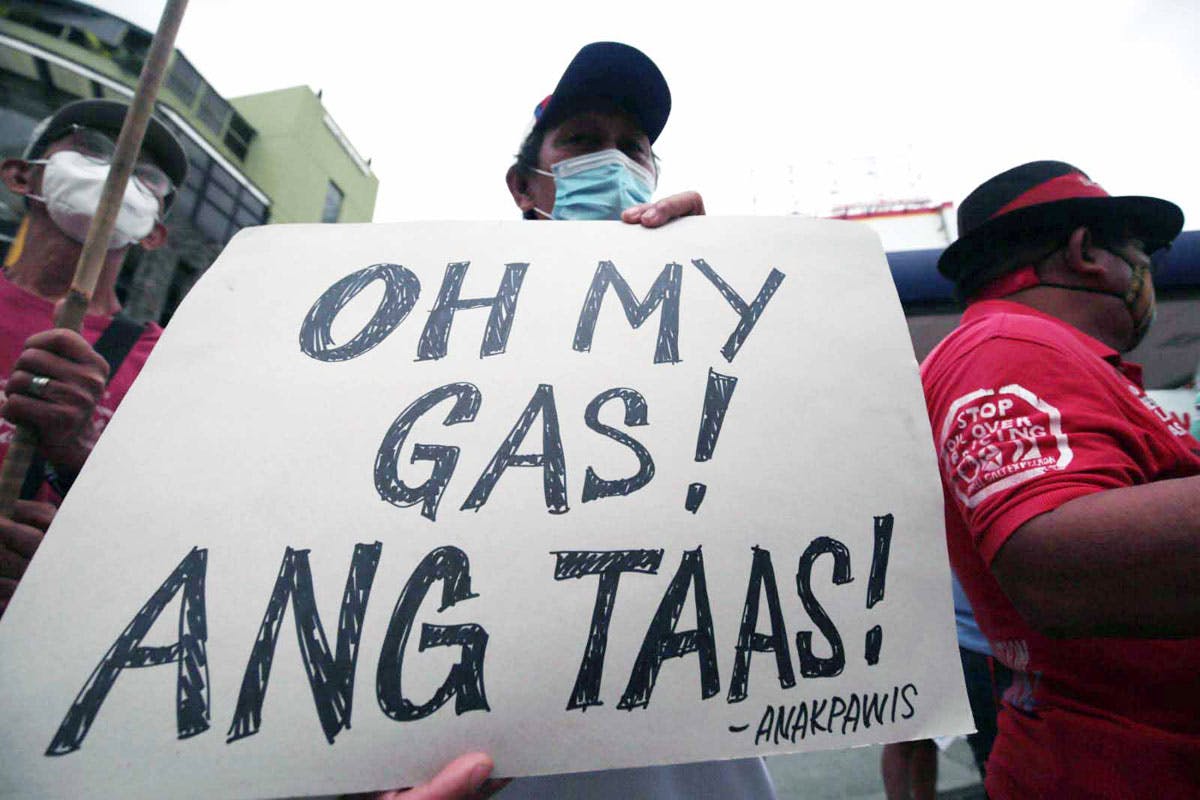
Sharp hikes in fuel pump prices – P13.15 per liter for diesel, P7.10 for gasoline and P10.50 for kerosene – take effect today, March 15, as global crude costs approach $130 per barrel amid the raging Russia-Ukraine conflict.
A ranking energy official said Filipinos should brace for the possibility of gasoline, diesel and kerosene prices reaching P90 per liter as crude prices remain volatile, exacerbated by continuing sanctions on other oil-producing countries.
Energy Undersecretary Gerardo Erquiza Jr. told the Senate committee on energy that if the price of oil hits $140 per barrel, the projected pump price per liter of gasoline would be at P86.72; diesel, P81.10 and kerosene, P80.50.
The price of liquefied petroleum gas – a common cooking fuel in households and dining establishments – is expected to reach P119.53 per kilogram under the same scenario.
The latest adjustments in the 11th consecutive week of increases come on the same day that transport groups led by PISTON launch protest actions in Metro Manila.
As of Monday, Dubai crude was trading at $120.34 per barrel, according to the Department of Energy (DOE).
At the same hearing, Manila Electric Co. (Meralco) head of utility economics Larry Fernandez said they expect higher monthly bill in May as a result of higher fuel prices.
Erquiza told the panel chaired by Sen. Sherwin Gatchalian that prices of crude started to increase in November when the global economy was beginning to recover from the pandemic that fueled demand for oil.
He said the Organization of Petroleum Exporting Countries has committed to increase supply but existing sanctions against Iraq, which can produce 700,000 barrels per day, and Venezuela, whose production capacity can reach 560,000 barrels per day, are hampering the effort.
Gatchalian is pushing for an increase in the minimum oil inventory of oil companies from 30 to 45 days to help stabilize pump prices.
He said that since oil companies are currently required to have reserves that can last for 30 days, these old inventories should be sold to the public at the old price.
“The government should subsidize the carrying cost because when these companies buy another 15 days, they have to pay for interest. And that’s where the government comes in terms of energy security,” Gatchalian, who is seeking reelection, said during the hearing.
He also asked the DOE to intensify its monitoring activities against profiteers taking advantage of consumers by imposing exorbitant pump prices of fuel products amid the escalating cost of fuel in the world and domestic markets.
“The DOE should make sure that oil companies and retailers are not abusing the situation,” he said.
Fuel-saving measures
Sen. Richard Gordon urged the Filipinos to resort to fuel-saving measures as pump prices continue to spike.
The reelectionist senator said the government must also find ways to set aside stock of oil and gas as the Philippines is competing with other countries for share in the supply.
To ease the suffering of the public, Energy Secretary Alfonso Cusi said oil players should implement hikes gradually and in small amounts. He is also seeking an expanded fuel subsidy to cover other vulnerable sectors.
“They’re not receptive to it because they brought to our attention their problem also, which is replacement inventory. They have to acquire it at a higher price. They are asking government if they can be helped in financing,” he said.
The DOE secretary also asked oil players to settle for lower take amid the oil price crisis.
“We even requested if they can lessen the industry take, do also that sacrifice as we have asked our consumers to do conservation. We are also asking industry players to sacrifice and take a cut in industry pay,” Cusi said.
The DOE is also proposing an expansion of subsidies to cover other sectors that need help such as tricycle and motorcycle riders, and households using LPG. This will be discussed at a meeting called by the President today, the DOE chief said.
Currently, fuel subsidies cover the public transport industry via the P5-billion Pantawid Pasada Program and farmers and fisherfolk through a fuel discount program amounting to P1.1 billion.
“We’re studying that maybe we can increase that and expand that to other sectors vulnerable to rising oil prices,” Cusi said. “We’re going to take that up with other economic managers, with Department of Finance on how it will affect if we increase the subsidy because of the rising oil price.”
Not enough
Sen. Risa Hontiveros said the fuel aid would not be enough to keep the transport system running.
“The increase in the budget for Pantawid Pasada to cover more drivers is a step in the right direction, but it really does not go far enough. P6,500 will help make ends meet for drivers only for a little over a month, but this international energy crisis looks like it will last far longer than just a month,” Hontiveros said in a statement.
She said the government was “just trying to run twice as fast just so the transport sector can stay in the same place, when what we need to do is to run faster and to shift to a new direction.”
The big necessary step, according to Hontiveros, is an expanded service contracting program that will not just run for a month or two, but for years. Service contracting, she said, will ensure that drivers and operators get their due in exchange for reliable and affordable services for the riding public.
Meanwhile, the Pagkakaisa ng mga Samahan ng Tsuper at Operator Nationwide (Piston) said it would be staging its protest along España Boulevard in Manila, as well as in various transport terminals, communities and gasoline stations.
“Let us rattle those responsible and hold protests in terminals, roads, gasoline stations, factories and communities to call on the government – as well as candidates for the 2022 election – that it is urgent to implement a price control on goods, fuel and raise the salary of workers!” Piston said in a statement.
Piston said its members would also be calling for the removal of the oil deregulation law and excise tax on fuel.
This week, some jeepney drivers are also expected to stay off the streets not as protest but due to lack of resources to continue operating.
This means that commuters may find it difficult to get rides next week despite the 100-percent public transport capacity under pandemic Alert Level 1.
Metropolitan Manila Development Authority (MMDA) Chairman Romando Artes said they would be offering free rides today to commuters affected by the transport strike.
“Agency buses and trucks will be prepositioned to provide free rides to commuters and transport them to the EDSA Bus Carousel,” he said.
Still no fare hikes
The Land Transportation Franchising and Regulatory Board (LTFRB) has yet to approve the P10 minimum fare petition that was submitted for resolution last week.
The LTFRB is still hearing main petitions to increase the minimum PUJ fare to as high as P15.
Rep. Alfred Vargas, chairman of the House social services committee, said he has filed a measure seeking to convene a body composed of government agencies and the private sector that would formulate an “integrated policy solution” to what he described as an impending national and global crisis.
“The social and economic impact of the war in Ukraine is being felt worldwide. It could lead to another great disruption, on a scale that could be similar to the pandemic. In the midst of uncertainty, it is imperative that our government and other sectors work as one in securing better protection for vulnerable segments of our society,” Vargas explained.
“It is critical that the problem-solving approach to this impending national crisis be carried out in a whole-of-government, whole-of-nation approach, taking into consideration the statutory authorities of various governmental bodies… to create a rational, comprehensive and integrated policy solution or a series of such actions,” he said.
He added that “fragmented policy solutions” could lead to “disconnect and miscoordination” among national government agencies, local government units and other government bodies. – With Cecille Suerte Felipe, Neil Jayson Servallos, Michael Punongbayan, Richmond Mercurio, Edu Punay