



Czech Republic Ready To Supply Philippines With Military Equipment
Czech Prime Minister Petr Fiala said Czech companies “are very interested” in helping in the modernization of the Armed Forces of the Philippines.
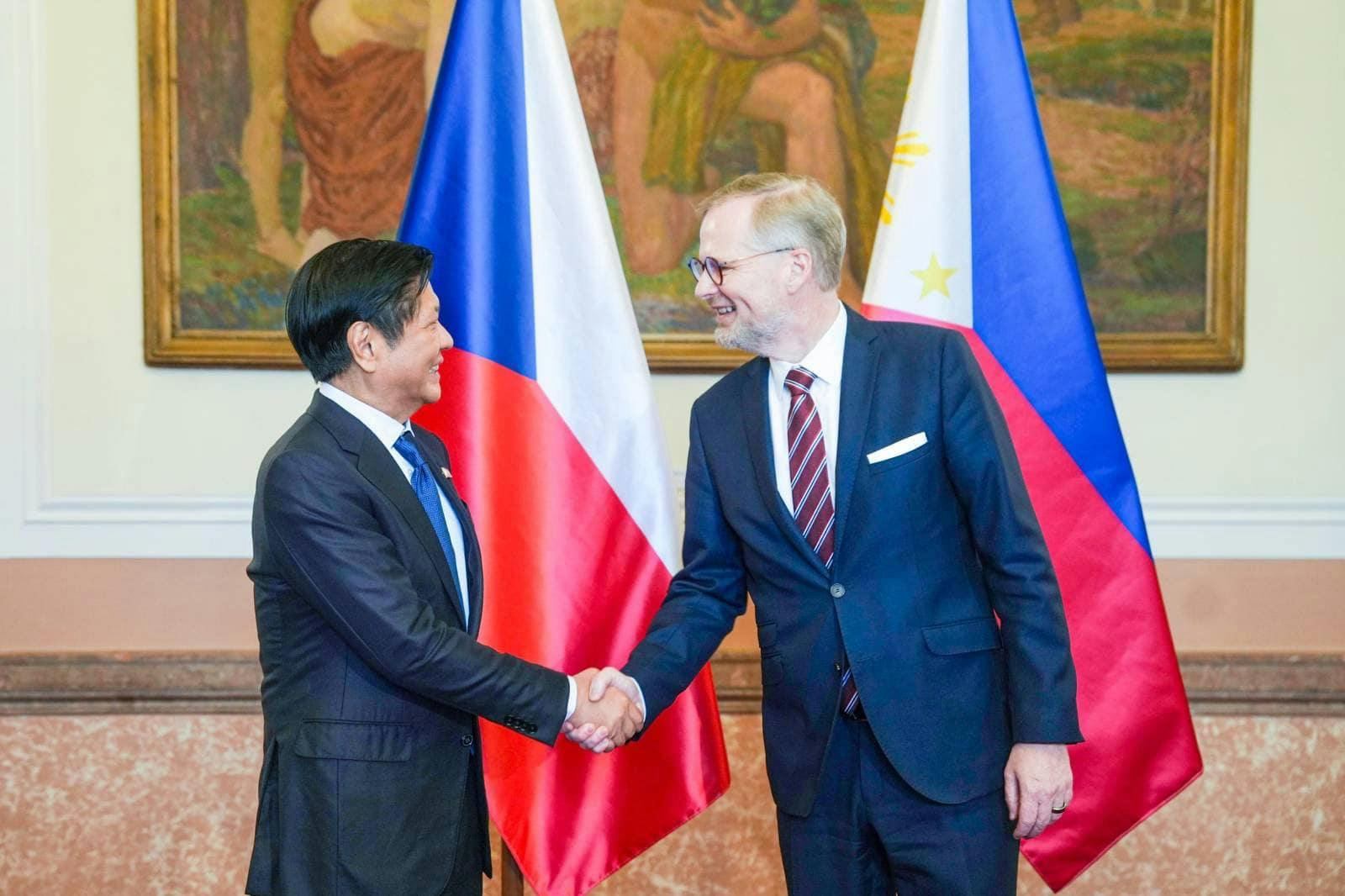
PRAGUE – The Czech Republic is ready to supply the Philippines with the latest defense technology and equipment to support its ongoing military modernization program, Prime Minister Petr Fiala told President Marcos.
During the two leaders’ bilateral meeting here on Thursday, March 14, Fiala assured Marcos of support for the Philippines’ efforts to boost the country’s defense amid rising tensions in the West Philippine Sea.
Fiala said Czech companies “are very interested” in helping in the modernization of the Armed Forces of the Philippines.
Marcos, for his part, said the Czech government’s assistance comes at a time when the country is in the process of strengthening the capabilities and the capacities of its military.
He told Fiala of the Re-Horizon Phase 3 of the Revised AFP Modernization Program, which involves the acquisition of more ships, aircraft and radar systems mainly for boosting the military’s archipelagic defense capabilities.
“The Czech Republic has always been active as a source of equipment for the Philippines. And so, we come again to Czech Republic and offer the partnership with the Czech Republic and the Philippines,” Marcos said.
“We invite the Czech defense companies, defense industry for them to submit proposals and to once again participate… to supply the Philippines’ future defense capability requirement,” the Chief Executive said.
Fiala said he acknowledged the Philippines as a key partner in the Indo-Pacific region.
“We are interested in stronger economic and trade with your country. We can assist this diversification of your country’s economic model,” the prime minister said.
“And I saw in Manila many possibilities for our future cooperation. We discussed cooperation, agriculture, defense, aviation and energy,” he said.
At a joint press briefing with Marcos on Thursday, Czech President Petr Pavel also assured the Philippine leader of his country’s commitment to assist in the AFP modernization.
“The Czech Republic has had a long tradition when it comes to defense industry. We have a lot to offer,” Pavel said when asked about the kind of cooperation the Philippines and the Czech Republic are exploring in defending international law, particularly in the South China Sea.
Czech agri exec
Also at the briefing held at the Octagon Hall of the Prague Castle on Thursday, Pavel announced that his country’s agriculture minister Marek Výborný and a delegation of businessmen are set to visit the Philippines next week with “specific plans” to expand cooperation in the area of food security.
“Very soon our minister of agriculture shall visit the Philippines with a numerous delegation of our businessmen with specific, particular plans to offer,” Pavel said.
“We also have companies that are involved in defense industry, manufacturing, in farming and agriculture, science, technology, energy sector, power sector, many of these businesses do have particular specific plans for the future cooperation with the Philippines,” he added.
Výborný will meet with Agriculture Secretary Francisco Tiu Laurel Jr. and lead a business forum to be held in Makati City on March 21.
The group will also visit Davao for a business forum and farm visit at the Tagum Agricultural Development Co. Inc., which is located in Davao.
The Czech Republic has provided the Philippines with assistance in analyzing and improving value chains in its dairy industry.
According to the Presidential Communications Office, the Czech Aid-for-Trade granted the National Dairy Authority (NDA)’s proposal to fund the technical exchange of experts. This initiative was in line with the DA’s five-year program to raise milk production in the country from one to 10 percent.
The NDA completed two projects in cooperation with the Czech Republic – the Expert Assistance on the in-depth Analysis of the Supply Chain of the Philippine Dairy Industry conducted in 2018 and the Strengthening Capacities of Dairy Farmers and Extension Workers project undertaken in 2019.
Marcos said he also tackled with his Czech counterpart the two countries’ potential in increasing bilateral trade.
“I also highlighted to the President, the Philippines’ remarkable economic performance, making it an attractive destination for Czech investments in the areas of IT-BPM (information technology-business process management), in electronics, manufacturing, food and agriculture and automotive/EV manufacturing, amongst others,” Marcos said.
Also on Thursday, Marcos and Pavel witnessed the signing of the Joint Communiqué on Labor Consultations Mechanism, which guarantees greater protection for Filipinos working in the Czech Republic.
The European nation is increasing its quota for workforce coming from the Philippines starting in May.
Department of Migrant Workers officer-in-charge Hans Leo Cacdac and Czech Republic’s Ministry of Labor and Social Affairs signed the joint communiqué.
“We are ready to cooperate in ensuring the orderly deployment of Filipinos to your country, in accordance with both Czech and Philippine laws,” Marcos said at their joint press conference.
As of December last year, there were 7,026 Filipinos in the Czech Republic based on data from the Czech Ministry of Interior.
The Filipino workers are engaged in the processing industry, automotive, repairs of appliances, manufacturing, IT communications, real estate, health/wellness and household service work.
Currently, Prague hosts the highest number of Filipinos in the Czech Republic with 1,511, followed by South Moravia with 1,242 and Central Bohemia, 905.
“I took note of the Czech Republic’s announcement that you have increased the quota for Filipino workers from 5,500 to almost double that from January 2024 to 10,300 per year starting in May of 2024,” Marcos said.
Pavel said the labor market in the Czech Republic suffers from shortage.
“The Philippines ranked among the top countries that send to us (workers) where we have topped qualified, highly skilled workers,” the Czech leader said.
“I’m glad that the Philippines is interested in upskilling. We also worked on legal and the mechanisms that would facilitate the work of such workers in the country. They also have to enjoy equal standing and protection of rights just like all others,” Pavel said.
Marcos was scheduled to fly back to Manila Friday night (Prague time), March 15, and arrive in Manila on Saturday, March 16. Czech Republic is seven hours behind Manila.


