



Conflict Impact On Phl Economy Minimal, For Now
“So far, based on what is happening today…as the conflict has subsided and the prices have gone down, it seems that the impact on our economy is minimal,” Energy department officer-in-charge Sharon Garin said.
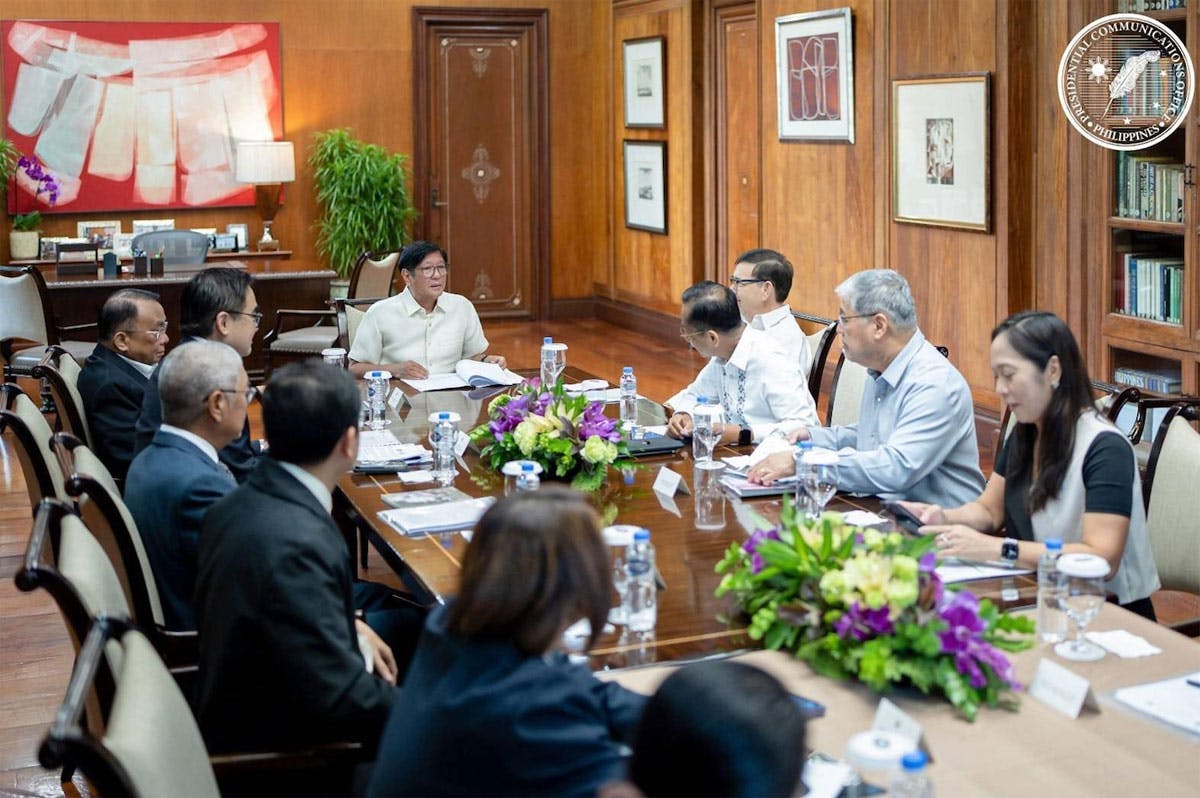
The ongoing conflict in the Middle East is seen to have a “minimal” economic impact for now, but the government is bracing for all possible scenarios, including the potential closure of the Strait of Hormuz, which may force the Philippines to look for other oil supply sources and routes.
President Marcos met with his economic team on Tuesday, June 24, at Malacañang to assess the effects of the war between Israel and Iran and to discuss measures that would cushion the impact of the price shocks on vulnerable sectors.
The meeting came hours after US President Donald Trump announced a six-hour ceasefire, which resulted in the easing of oil prices and sparked hopes that a peaceful resolution to the conflict would be achieved.
“So far, based on what is happening today, so far as the conflict has subsided and the prices have gone down, it seems that the impact on our economy is minimal,” Energy department officer-in-charge Sharon Garin, who was present at the meeting, said at a Palace press conference.
“I cannot give you the exact numbers, but the impact is minimal that I don’t think it’s alarming for our economic managers,” she added.
According to Garin, Department of Economy, Planning and Development Secretary Arsenio Balisacan also talked about the impact of volatile oil prices on overseas Filipino workers’ remittances, exports, imports and trade.
“With the current situation that may no longer escalate or is slowing down or the ceasefire, hopefully it will last longer, the ceasefire, among all the countries involved. And I think Secretary Arsi (Balisacan) added that of course, Iran and Israel will always have conflict. But other countries may not be involved,” the energy official said.
“With all those considerations, I don’t have the numbers here... but the impact is so minimal to our economy that it doesn’t seem alarming as of now as long as it does not escalate again or...worsen,” she added.
Garin said oil prices, which breached $70 per barrel last Monday, June 23, went down to $69 per barrel on Tuesday morning. The downward adjustment was linked to Trump’s ceasefire announcement, which lessened the speculations in the market. The administration, nevertheless, acknowledged that the situation in the Middle East remains volatile.
“We’ll see (on Wednesday, June 25) if there are changes in the situation in the Middle East. But, everybody’s closely monitoring what’s happening there,” Garin said.
Worst case
Garin said economic managers tackled several possibilities, including the closure of the Strait of Hormuz, the worst case scenario seen to cause supply pressures.
“If it gets cut off, then that’s not only... bad news for the Philippines, but the whole world,” the energy official said.
“If there is closure, which I really doubt and because that’s against the interest of everyone in the Middle East and the whole world, even the big countries, I don’t think they would allow that. But there are also alternative routes for shipping, also alternative sources – we are talking about the Middle East here,” she added.
Garin pointed out that there are other Organization of the Petroleum Exporting Countries (OPEC) members who could cover the possible supply gap. If that is not possible, there are other potential suppliers like US, Canada and Brazil, she noted.
“So, we have alternatives. It might not be as efficient, but the country has an option to find the alternatives,” Garin said.
“The worst case scenario is if we run out of supply. Prices will really increase. Right now, we have long-term options, but there are options also in finding other suppliers, finding other routes for our supply,” she stressed.
Aid readied
Garin said the government is readying the subsidies to be distributed to the farming and transportation sectors once the oil price breaches the $80 per barrel threshold.
The giving of ayuda or assistance is intended to prevent fare hikes, which will pose a burden to commuters.
“If we don’t allow increase of fares, we have to give them (drivers) something, otherwise they would shoulder the costs. The President does not want that,” Garin said.
“So, we need to make sure that everybody is protected and the government is willing to subsidize part of their costs of delivering our people from work to home and home to work. That is the subsidy to be given which is at P2.5 billion,” she declared.
Garin noted that oil firms have heeded the President’s appeal for them to implement a staggered price increase.
“I’m hoping by next week it will go lower and lower and there’s no need to stagger, unless we want to stagger the lowering, but I don’t think the people would want that. But if it does increase next week, then we will ask them to continue the staggered increases,” the energy chief said.
“And other than the ayuda, we are also asking for oil companies to expand or to increase their discounts or promos for public utility vehicles (PUVs). As of today, we have received confirmation that one company is willing to give P1 discount for our PUV drivers for every liter,” Garin disclosed.
According to her, the giving of aid would no longer be necessary if oil prices decrease, but the government would continue to prepare for the effects of the conflict.
“We want to be prepared. We want the oil companies to be prepared also, make sure they have enough stock. DOTr (Department of Transportation) is ready to distribute anytime, in case it escalates,” she said.
Suspend fuel taxes?
Asked to react to calls by transport groups to suspend the excise and value added tax (VAT) on oil, Garin said it would be up to Congress to decide on the matter.
“The excise tax and the value-added tax which is 12 percent are imposed because of a law. That’s legislation so the DOE (Department of Energy) cannot go against what is mandated by law, nor DOF (Department of Finance), nor even the President. So, the law has to be followed,” the energy official said.
“It will have to be an act of Congress. An amendment to the current law is needed to suspend, to lower or even to abolish taxes on fuel,” she added.
Garin noted that VAT and excise tax collections totaled P300 billion, and doing away with them could reduce the government’s budget.
“If we do away with the P300 billion, that’s also how many kilometers of roads, how many school buildings, health services that will be reduced,” she said.
“So, it’s a balance that the administration is trying to find. Riders of public transport are protected, but the basic service should also go on. So, that’s why ayuda might be a good start for now,” Garin emphasized.
AFP on standby
In case more Filipinos in the Middle East would need to be repatriated, the Armed Forces of the Philippines stands ready to assist the national government, AFP spokesperson Col. Francel Margareth Padilla said on Tuesday.
“The Armed Forces of the Philippines is prepared to be in sync with other government agencies in terms of the role that the AFP will play in terms of repatriation,” she added.
Padilla said the military is prepared and will be guided by instructions from President Marcos as the commander-in-chief “in tandem with other government agencies.”
Asked if there is any possibility that the enhanced defense cooperation agreement (EDCA) sites in the Philippines will be utilized by the United States, she stressed that the AFP “would not want to speculate on anything that’s happening.”
“We would want to hone in on the role of the Armed Forces of the Philippines. At this point in time, we are prepared for any contingencies. We are of course doing our mandate and our mission accordingly. And all of this, our focus is the repatriation to ensure that our people will come home safe,” she said.
On what assets can be used to repatriate Filipinos, Padilla emphasized that in such situations, it’s all hands on deck and “all of our assets are well-prepared to be deployed accordingly.”
“Whatever mandate from higher civilian authorities for the AFP to perform, our assets will be ready and our personnel will be there to assist,” she said.
Chartered flights
As the number of overseas Filipino workers (OFWs) seeking repatriation continues to rise, the Philippine government is now considering chartering a flight to bring them back home.
“Should the number escalate, we are at this point of considering or studying availing of chartered flight,” Migrant Workers Undersecretary Felicitas Bay said at a press conference on Tuesday.
She, however, stressed that the government needs to consider airspace restrictions and host country permits, among other factors, before opting for a chartered flight.
Bay reported that the number of requests for repatriation from OFWs in Israel has already jumped to 311. Of the figure, 26 are set to arrive on Tuesday night and 50 more on Thursday, June 26, or Friday, June 27.
Another batch of 20 OFWs is also ready to go home, but their repatriation date is yet to be confirmed.
Following the closure of Qatar’s airspace the other day, Bay said the Philippine government is also considering another route to bring home the OFWs.
Overseas Workers Welfare Administration (OWWA) administrator Patricia Caunan said there are around 30,000 OFWs in Israel and only about one percent expressed desire to be repatriated since the imposition of Alert Level 3.
Bay noted that some of the OFWs who already expressed desire for repatriation are still having second thoughts due to fear of traveling by land, or they are reluctant to leave their employers.
“We are urging them to go home, but we also have to understand if they change their mind,” she explained.
For this reason, Caunan said, the Department of Migrant Workers-OWWA, after receiving the requests for repatriation, has to confirm whether the OFWs are decided to come home before they can start processing the repatriation.
Qatar bombing
OWWA recorded a surge in the number of calls from OFWs and their families in Qatar after Iran bombed a US base in the country on Tuesday.
Caunan said the OFWs were in panic because it was the first time that they had experienced such a situation. There are about 270,000 OFWs in Qatar.
However, the request for repatriation came from mostly from OFWs in Israel, a few from Jordan and Iran. OFWs from other Middle Eastern countries are calling only for inquiries.
Caunan said DMW and OWWA are ready to provide necessary assistance to all OFWs in the Middle East, whether documented or not.
Based on government estimates, there are over 200,000 undocumented Filipino workers in the Middle East.
Meanwhile, Migrant Workers Secretary Hans Cacdac, who was escorting OFW repatriates back to the Philippines, was stuck in Doha Hamad International Airport as a result of the temporary shutdown of Qatari airspace. He and the OFWs – 26 from Israel, three from Jordan, one from Palestine and one from Qatar – had to deplane and stay in the airport terminal.
After a few hours, Cacdac said they were allowed to board the plane bound for Manila. He said the Qatari Ministry of Interior ensured the safety and security of all affected individuals.
“I urge all our OFWs to rely only on official government advisories from the Department of Migrant Workers, the Philippine embassy, Overseas Workers Welfare Administration and trusted authorities,” Cacdac said as he urged OFWs in the Middle East to stay calm but vigilant.
At the same time, OWWA reiterated the reminder of the Department of Foreign Affairs for Filipinos in Riyadh and Jeddah, Saudi Arabia to be on alert and closely monitor developments in the Middle East through reputable sources.
OFW assistance
The DMW reported that P150,000 cash assistance shall be provided to the first batch of 31 OFW repatriates who arrived on Tuesday night.
Aside from financial assistance, temporary shelter and transport to their provinces shall also be extended to the returning OFWs.
“Our key partner agencies, including the DSWD (Department of Social Welfare and Development) and DOH (Department of Health), are also on standby to provide psychosocial counseling and medical assistance to the repatriates,” the agency noted.
Technical Education and Skills Development Authority will also provide skills training while the Department of Trade and Industry will offer business and livelihood support. – With Michael Punongbayan, Mayen Jaymalin


