


Climate Warrior Greta Thunberg Has Autism, Speaks Only When Necessary
The passionate teenager from Sweden gave tidbits about herself in a TED talk on Nov. 24, 2018, including her condition called Asperger’s syndrome and selective mutism. But this does not stop her from calling for action to save the Earth.
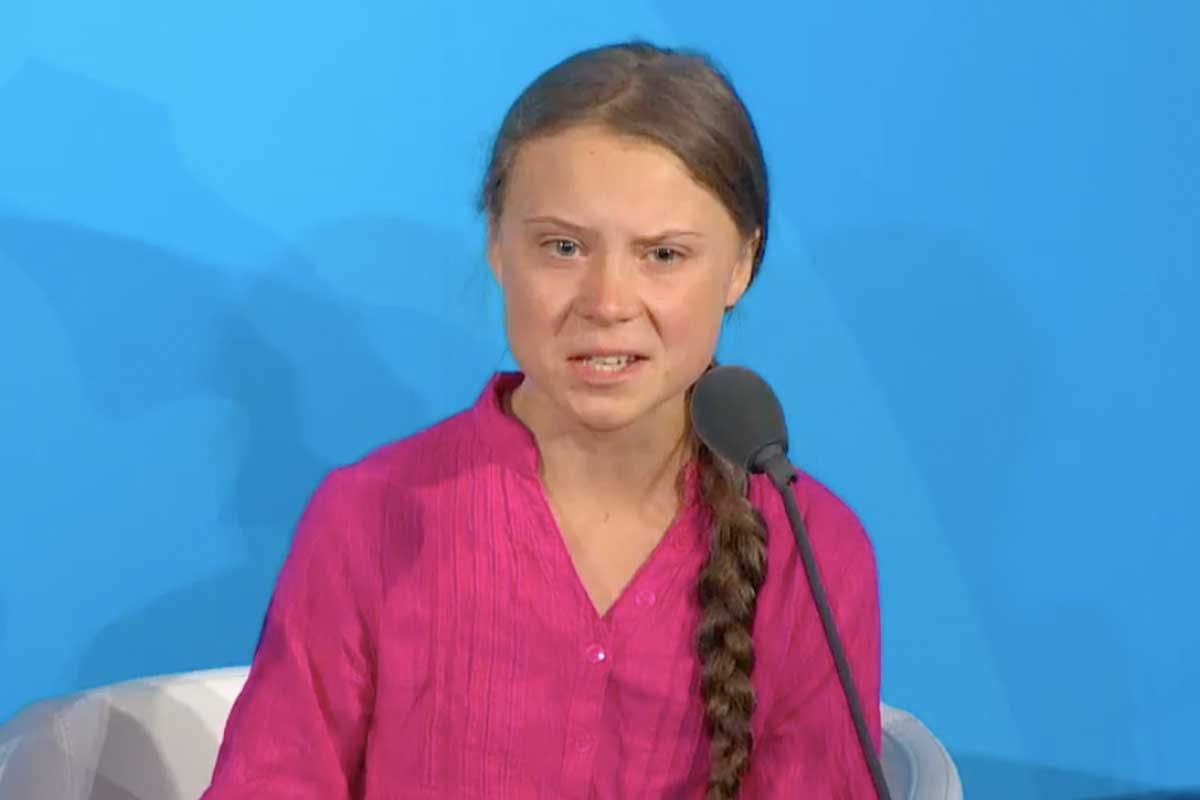
Sixteen-year-old Swedish student Greta Thunberg first heard about climate change or global warming when she was eight years old. She bared this herself in a TED talk on Nov. 24, 2018, which now has 1.6 million views.
TED is a nonpartisan, nonprofit organization devoted to spreading ideas, usually in the form of short, powerful talks covering almost all topics.
“Apparently,” Thunberg said, climate change “was something humans had created by our way of living.”
Thunberg recalled being asked to turn off the lights and recycle paper to save energy and resources, respectively.
“I remember thinking that it was very strange that humans, who are an animal species among others, could be capable of changing the Earth’s climate. Because, if we were, and if it was really happening, we wouldn’t be talking about anything else,” Thunberg said.
“As soon as you turn on the TV, everything would be about that. Headlines, radio, newspapers: you would never read or hear about anything else. As if there was a world war going on, but no one ever talked about it. If burning fossil fuels was so bad that it threatened our very existence, how could we just continue like before? Why were there no restrictions? Why wasn’t it made illegal? To me, that did not add up. It was too unreal,” she added.
When she was 11, Thunberg disclosed she became ill and fell into depression.
“I stopped talking, and I stopped eating. In two months, I lost about 10 kilos of weight. Later on, I was diagnosed with Asperger’s syndrome, OCD (obsessive-compulsive disorder) and selective mutism. This basically means, I only speak when I think it is necessary,” Thunberg noted.
“Now is one of those moments,” she declared, eliciting laughter from the crowd.
According to WebMD, Asperger’s is a type of autism spectrum disorder that affects social skills.
“For those of us who are on the spectrum, almost everything is black or white. We aren’t very good at lying and we usually don’t enjoy participating in the social games that the rest of you seem so fond of,” Thunberg explained.
“I think, in many ways, that we autistic are the normal ones and the rest of the people are pretty strange. Especially when it comes to the sustainability crisis – where everyone keeps saying that climate change is an existential threat and the most important issue of all. And yet, they just carry on like before,” she quipped.
“I don’t understand that. Because if the emissions have to stop, then we must stop the emissions. To me, that is black or white. There are no gray areas when it comes to survival. Either we go on as a civilization or we don’t,” Thunberg said.
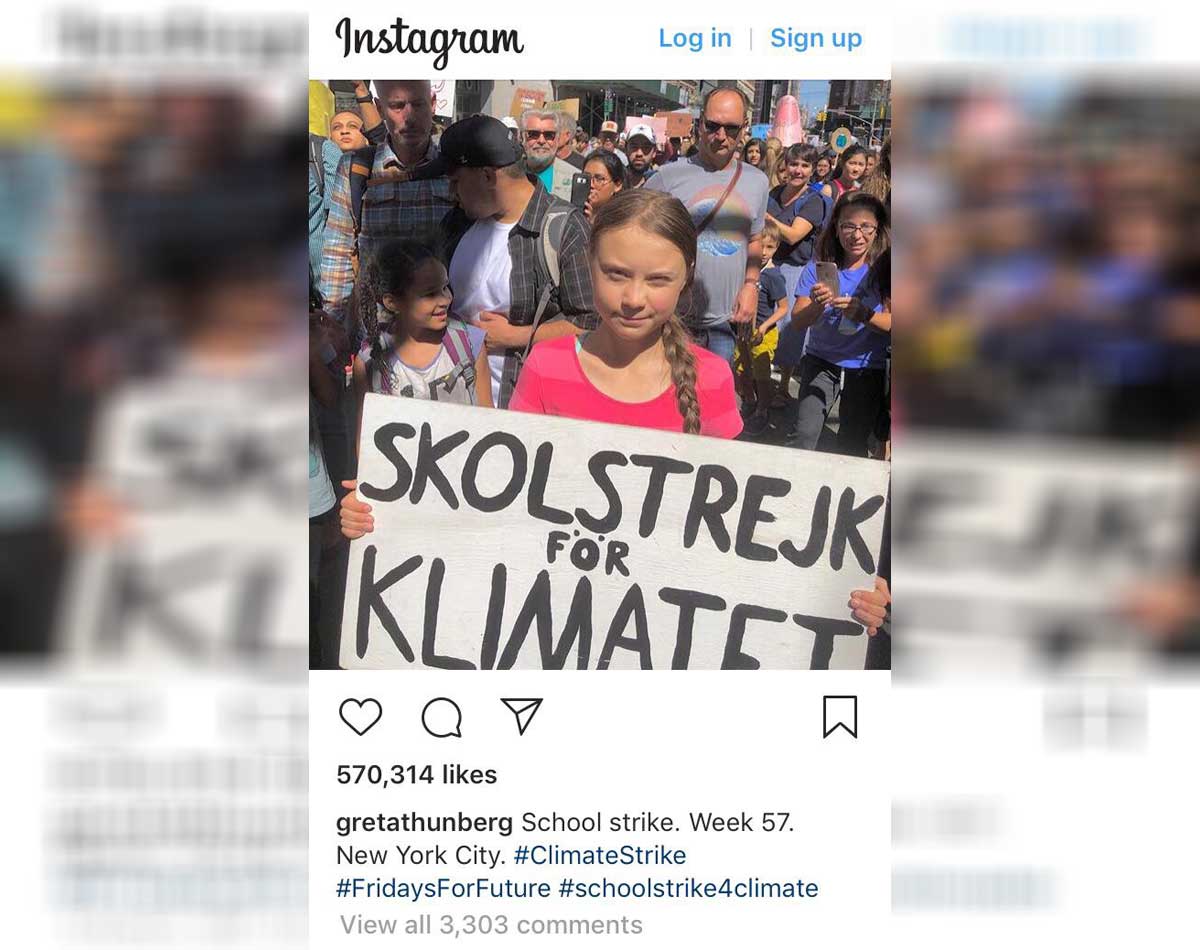
According to Thunberg, she decided it “was enough” and took action when school started in August of 2018.
“I set myself down on the ground outside the Swedish parliament. I school-striked for the climate,” Thunberg said, skipping school every Friday
to lobby the Swedish government into action on climate change.
Since Thunberg began her solo protest, wrote Pat Mitchell also on TED last March 11, it is estimated that thousands of students around Europe and the world have joined her protest each week.
“Pictures of Greta and other young activists have made their way around on social media (Greta has nearly 300,000 followers on Instagram), inspiring other teens to join her in protest,” Mitchell said, noting how inspired she was by the actions of young warriors like Thunberg.
Thunberg’s followers on Instagram have now reached 4.6 million and 1.87 million on Twitter. On Facebook, she has more than 1.6 million page likes. She was trending on social media as she spoke during the United Nations Climate Action Summit in New York on Monday, Sept. 23.
“Some people say that I should be in school instead. Some people say that I should study, to become a climate scientist so that I can solve the climate crisis.
But the climate crisis has already been solved. We already have all the facts and solutions. All we have to do is to wake up and change,” Thunberg stressed in her TED talk.
“Now we’re almost at the end of my talk and this is where people usually start talking about hope. Solar panels, wind power, circular economy and so on. But I’m not going to do that. We’ve had 30 years of pep talking and selling positive ideas. And I’m sorry but it doesn’t work because if it would have, the emissions would have gone down by now. They haven’t,” she said.
“And yes, we do need hope. Of course, we do. But the one thing we need more than hope is action. Once we start to act, hope is everywhere. So instead of looking for hope, look for action. Then and only then, hope will come today,” Thunberg added.

‘How dare you?’
At the historic UN Climate Action Summit aimed at securing global commitments to address the climate crisis, the young activist again delivered an impassioned speech, scolded world leaders and joined 15 other youths from around the world in filing a landmark children’s rights complaint against Argentina, Brazil, France, Germany and Turkey for “knowingly causing and perpetuating the climate crisis.”
“This is all wrong. I shouldn’t be up here. I should be back in school on the other side of the ocean. Yet you all come to us young people for hope. How dare you?” Thunberg told a hushed crowd at the UN headquarters in New York City on Monday
“You have stolen my dreams, my childhood with your empty words. And yet, I’m one of the lucky ones. People are suffering, people are dying. Entire ecosystems are collapsing. We are in the beginning of a mass extinction, and all you can talk about is money and fairy tales of economic growth. How dare you?” she complained, angry and in tears.
In her speech, Thunberg accused world leaders of continuously ignoring scientific evidence that the changing climate threatens the future.
She noted that it would be the youth who would live the consequences of climate change if no significant action is done to prevent global warming.
“You are failing us. But young people are starting to understand your betrayal. The eyes of all future generations are upon you,” she said. “And if you choose to fail us, I say we will never forgive you. We will not let you get away with this. Right here, right now is where we draw the line. The world is waking up. And change is coming whether you like it or not.”
Landmark complaint
Following her speech, Thunberg joined other young activists in filing a communication with the UN Committee on the Rights of the Child against the five countries for their contribution to the climate crisis.
Joining her were Chiara Sacchi, 17, of Argentina; Catarina Lorenzo, 12, of Brazil; Iris Duquesne, 16, of France; Raina Ivanova, 15, of Germany; Ridhima Pandey, 11, of India; and David Ackley III, 16, Ranton Anjain, 17, and Litokne Kabua, 16, all from Marshall Islands
Also included as petitioners were Palau-based Filipino Carlos Manuel, 17; Deborah Morayo Adegbile, 12, of Nigeria; Ayakha Melithafa, 17, of South Africa; Ellen-Anne, 8, of Sweden; Raslen Jbeli, 17, of Tunisia; and Alexandria Villaseñor, 14, and Carl Smith, 17, both from the United States.
“Each respondent — Argentina, Brazil, France, Germany, and Turkey — has known about the harmful effects of its internal and cross-border contributions to climate change for decades,” read the 97-page communication, which alleged violations of the UN Convention on the Rights of the Child.
“Despite their decades-long knowledge, each respondent has breached its human rights duties by causing and perpetuating the climate crisis and undermining international cooperation,” it added.
While the five countries are not among those with the highest emissions that contribute to global warming, the petitioners said their ability to influence international cooperation makes their impact on climate change greater than their actual share of emissions.
The petitioners could not include the four worst emitters — China, the United States, European Union and India — as they have yet to ratify the optional protocol of the convention that provides for mechanisms in filing communications.
In its communication, the young activists said the respondents failed to reduce emissions at the greatest possible rate and consistent with a scale that is scientifically established to protect life.
They also accused the respondents of failing to use all available legal, diplomatic and economic tools to ensure that the major emitters are also decarbonizing at a rate and scale necessary to achieve the collective goals.
“Each respondent has failed to prevent foreseeable human rights harms caused by climate change by reducing its emissions at the ‘highest possible ambition.’ Each respondent is delaying the steep cuts in carbon emissions needed to protect the lives and welfare of children at home and abroad,” read the petition.
“Not one of the respondents is on an emissions pathway that is consistent with keeping heating under three degrees Celsius much less under 1.5°C. Each respondent has set inadequate emission reduction targets in its Paris Agreement pledges — and then failed to even meet these inadequate goals,” it added.
The petition urged the committee to recognize that climate change is a children’s rights crisis and that the respondent countries, along with other states, “has caused and is perpetuating the climate crisis by knowingly acting in disregard of the available scientific evidence.”
It also urged the committee to recommend to the respondents a review of policies on mitigation and adaptation efforts.

Climate summit
The communication was filed even as UN Secretary-General Antònio Guterres pushed world leaders to commit to significant action plans to address the climate crisis.
“Young are here providing solutions, insisting on accountability, demanding urgent action. They are right. My generation has failed in its responsibility to protect our planet. That must change,” Guterres said at the opening of the Climate Action Summit he convened.
“The climate emergency is a race we are losing, but it is a race we can win. The climate crisis is caused by us — and the solutions must come from us. We have the tools; technology is on our side,” he added.
The Philippines sent a lean delegation to the summit, which included representatives from the Philippine Permanent Mission in New York, National Economic and Development Authority and the Climate Change Commission.