Catastrophic Floods Kill Over 390 In Nepal And Tibet; Filipino Among More Than 1,400 Missing
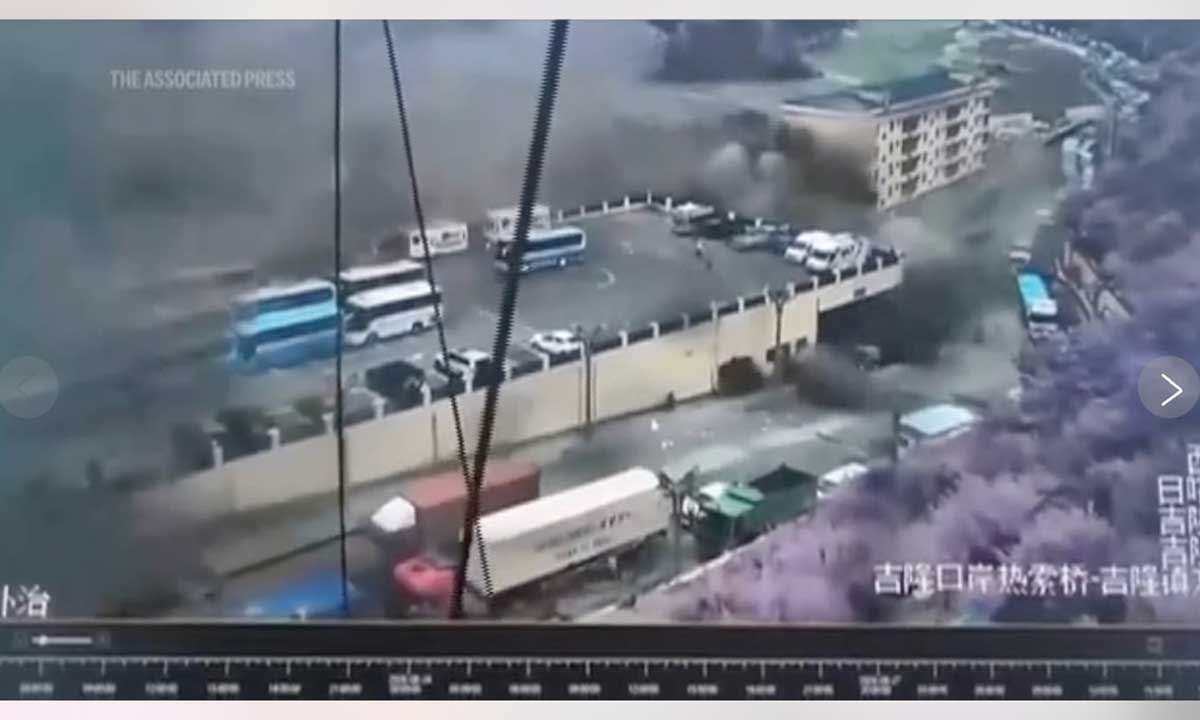
Videos of the disaster showed people running before the floodwaters swallowed them up and washed out buildings and bridges on Wednesday, Aug. 26.
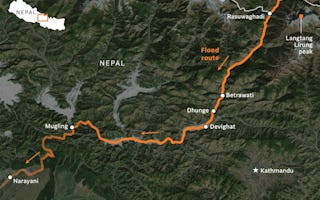
DEVIGHAT – A Filipino was among hundreds reported missing as rescue teams searched on Thursday, Aug. 27, along the Nepal-China border after a catastrophic and deadly torrent of floods and mud swept through several communities following a glacier collapse.
Videos of the disaster showed people running before the floodwaters swallowed them up and washed out buildings and bridges on Wednesday, Aug. 26. More than 390 people were killed, according to authorities in Nepal and China, and more than 1,400 were missing, including hundreds of foreigners and pilgrims. Hundreds of others have been displaced across the Himalayan region.
The steep slopes and lush valleys below the Himalayan mountain range – home to many of the world’s highest peaks and remaining glaciers – are especially vulnerable to flooding and landslides. Melting glaciers have become more common because of human-caused climate change.
Images showed what appeared to be the second floors of buildings in Nepal’s hard-hit Nuwakot district slathered in mud after the torrent rushed by. Riverbanks and village streets were covered in mud. Debris hung from tree branches and wires. Vehicles were buried, and some stunned survivors were caked in mud.
Before-and-after images aired by state broadcaster China Central Television showed a multistory building and more than a dozen vehicles covered in mud. A two-lane road running along a river in a valley in Tibet’s Shigatse prefecture was completely buried. Aerial footage also showed that a lake had formed and expanded on the China-Nepal border, with authorities warning of a possible dam break.
Nirajan Paudyal, a journalist based in Nepal’s capital of Kathmandu, worried for his parents and other relatives in the district’s village of Soley.
“I fear there won’t be any update,” Paudyal said.
US President Donald Trump said the flooding was terrible to see, describing how “strong, well-built buildings were wiped out like they were toothpicks.”
Speaking to reporters in the Oval Office, Trump said the US spoke with Nepalese leaders and offered to provide “anything they want.”
The torrential floods that ran miles through mountains left at least 389 people dead and more than 460 injured in Nepal, according to police. Another 910 people are reported to be missing in Nepal. Authorities in Tibet, an autonomous region of China, reported at least three dead and 558 missing.
Nepalese officials said dozens of bridges were destroyed and nearly 40 kilometers (25 miles) of roads were damaged, complicating search efforts.
The Nepalese army has rescued more than 100 people by helicopter, army spokesperson Brig. Gen. Raja Ram Basnet said. Army teams also evacuated people trapped inside facilities linked to the Trishuli hydropower project, he added.
Dozens of injured people were transported to Kathmandu for medical care.
Rescuers found bodies in Chitwan district hundreds of kilometers downstream from the hardest-hit areas.
Bishal Kumar Bhandari, chairman of the Nepal Red Cross Society, said the agency has shifted its focus from rescue to large-scale relief operations in the flood-hit districts. He said that around 1,200 people were displaced from at least three villages.
In Tibet, the roaring mudslide that struck Wednesday engulfed a multistory port building and swallowed a bus parking lot at the land border crossing of Gyirong Port. Mud left in the surrounding areas was more than 1.5 meters (five feet) deep on average, Chinese state broadcaster CCTV reported. Roads leading to the crossing were all damaged, while secondary collapses or landslides might occur as rain continued in the area, it added.
China’s premier, Li Qiang, arrived Thursday in Gyirong to direct rescue efforts, alongside 500 military and paramilitary personnel. Military helicopters circled overhead, searching for survivors, assessing the disaster and mapping out possible rescue and evacuation routes.
Chinese authorities also warned that the newly formed lake at the confluence of the Tsogyal and the Purupqiangzangbu rivers is overflowing and may burst. The lake contained 2 million cubic meters (70 million cubic feet) of water as of Thursday morning and was expected to receive another 3 million cubic meters (106 million cubic feet) in the next three days, China’s Ministry of Water Resources said.
The ministry warned there was a high risk the dam could fail, causing further flooding.
The United Nations’ humanitarian chief, Tom Fletcher, announced Thursday on X that he ordered the release of $2 million from the U.N.'s Central Emergency Response Fund to help with medical care, shelter and water. He called the floods “horrifying.”
“We pledge to support national efforts to deliver emergency aid and support,” U.N. Secretary-General Antonio Guterres told reporters.
Shova Shrestha, 33, has spent more than a day seeking word of her husband, Rajan Shrestha. She said his phone rang when she first called after the floods, but it later became unreachable. Since then, she has watched every helicopter that landed in Bidur, the capital of Nuwakot district, hoping he might be among the survivors.
“I keep looking at each helicopter, hoping he will step out of it,” Shova said.
Among the missing are 517 foreigners, according to Nepal’s tourism board.
They include 178 people from India, more than 60 from the U.S. and people from 30 other countries, including Ukraine, the UK, South Africa and Japan, the board said.
Many of the missing may have been on a pilgrimage to Mount Kailash in Tibet, a sacred site for Hindus, Buddhists and others.
Seventy-seven people from one pilgrimage group were caught in the floods at the immigration office at the border, according to a post on X from Indian spiritual guru Sadhguru Jaggi Vasudev.
A visibly emotional Sadhguru said in a video that the group included 22 Americans and others from various countries. He said that there was no official information on their whereabouts.
The US State Department said 90 Americans were unaccounted for in China and Nepal after the flood. The department said it was unaware of any U.S. deaths and that three Americans had been rescued.
The Indian Ministry of External Affairs said Thursday that 288 of the country’s people, including some workers on a power project, were missing.
Chinese Ministry of Foreign Affairs spokesperson Lin Jian said that nearly 100 Chinese citizens were missing in Nepal. According to preliminary information, 260 of those missing in Tibet were foreigners, he said.
A glacier collapse may have caused floods
The US Geological Survey first reported a magnitude 4.4 earthquake early Wednesday, about 65 km north of Kathmandu, near the border.
The agency later updated its analysis to say the seismic event was instead a magnitude 5.2 glacier collapse that sent debris flowing downstream.
Climate experts at the Kathmandu-based International Center for Integrated Mountain Development said an avalanche from a glacier likely caused Wednesday’s flash flood.
In an emailed statement, they said water levels at one point on the Trishuli River rose by as much as nine meters (27 feet) in half an hour.
The increasingly unstable Himalayan ice system threatens communities, infrastructure and water supplies across one of the world’s most densely populated regions.
The region saw similar flash floods in August 2025, when a glacial lake in Tibet overflowed because of high temperatures. Nine people were killed, and critical infrastructure, including a bridge connecting Nepal and China, was damaged.
Marcos calls for prayers
In Manila, President Marcos asked for prayers for the communities hit by the flash floods in Nepal as the Philippine government continues to monitor the situation in the disaster-struck areas.
“His (Marcos) message is he was saddened by the incident and let us continue to pray for the improved condition of the people affected by the calamity in Nepal,” Palace press officer Claire Castro said in a media briefing on Thursday.
In an X post, Marcos joined other world leaders in expressing grief over the flash flood in Nepal.
“The Philippines extends its deepest condolences to our friends in Nepal and to all those affected by the deadly flash flood yesterday,” the President said.
“Our deepest sympathies go out to those who lost family, loved ones and friends. Please accept our most heartfelt prayers for strength in this difficult time,” he added.