



Carlos Celdran’s Life Celebrated In Final ‘Walk This Way’ Tour
As fans and friends trooped to Fort Santiago for the final iteration of late artist and cultural activist Carlos Celdran’s “Walk This Way” tour, every turn and stop spoke of Intramuros’ tremendous loss.
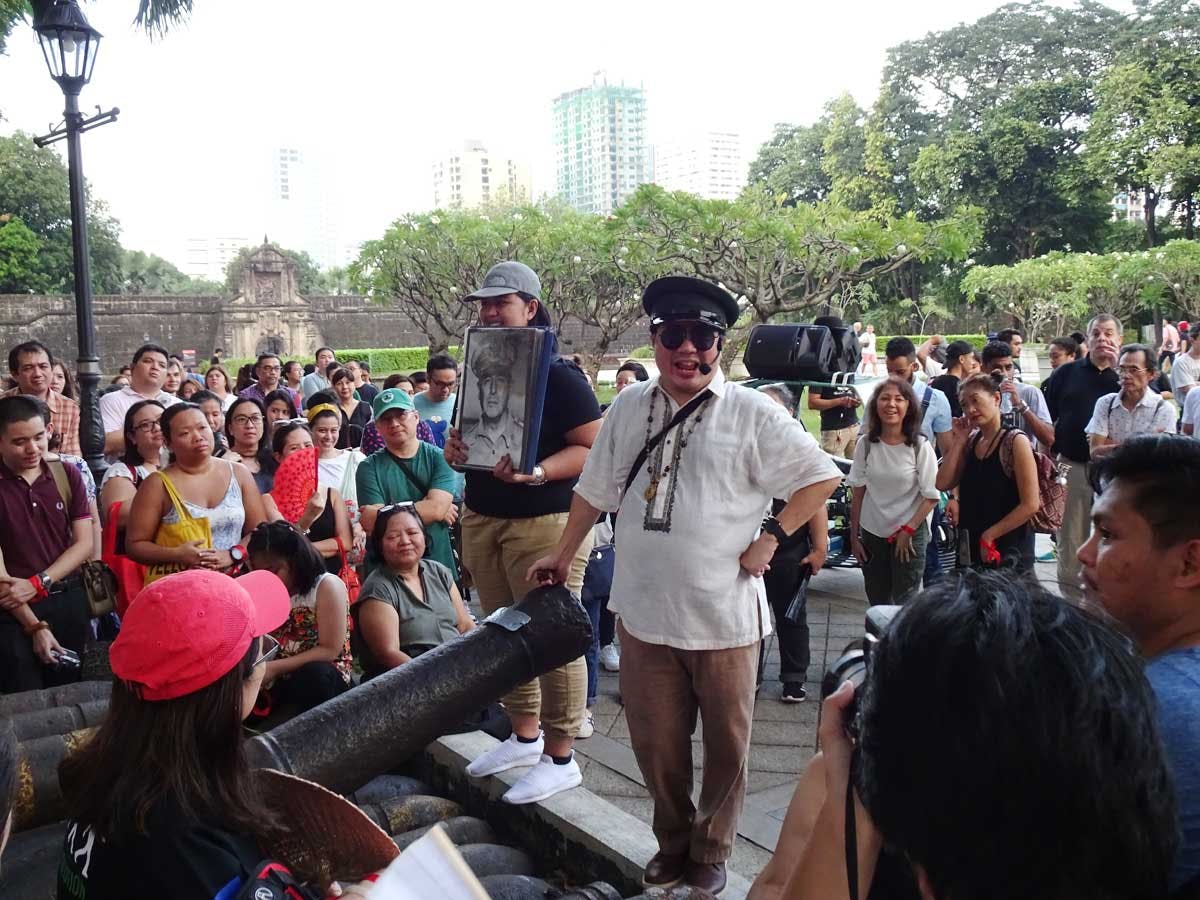
The Pied Piper of Manila lives.
Even in death, the late artist and cultural activist Carlos Celdran, who died early this month in Madrid, Spain, still enticed hundreds of fans and volunteers to the ancient grounds of Fort Santiago for the final staging of his “Walk This Way” tour on Saturday, Oct. 19.
People of all ages and from walks of life — from millennials and post-millennials to Gen-Xers and a few Baby Boomers — came to witness the tour, hosted by actor and Third World Improv president Gabe Mercado, the only person “anointed” by Celdran in 2012 to perform the tour.
Organized by community organization VivaManila, creative hub Puesto Manila and the Intramuros Administration, the tour paid tribute to Celdran, who once roamed the Walled City’s streets, attracting tourists both foreign and local, showing and telling them a different story of Manila and the Philippines that is seldom found in history textbooks.
Wearing Celdran’s signature bowler hat and dressed in a white barong and brown loose trousers that is typical of the tour guide, Mercado led the participants through an audio-visual experience of what life was during the colonial period. He gave two tours that day, in the morning and in the afternoon, starting from the Fort Santiago grounds and ended inside the Casa Manila at Plaza San Luis Complex.
His voice boomed through loudspeakers driven in a pedicab by volunteers as he explained the history of Intramuros’ establishment and the complex relationship that existed between Manila’s natives, the other Asian migrants that thrived there and the invading Hispanic, and later, American, colonizers.
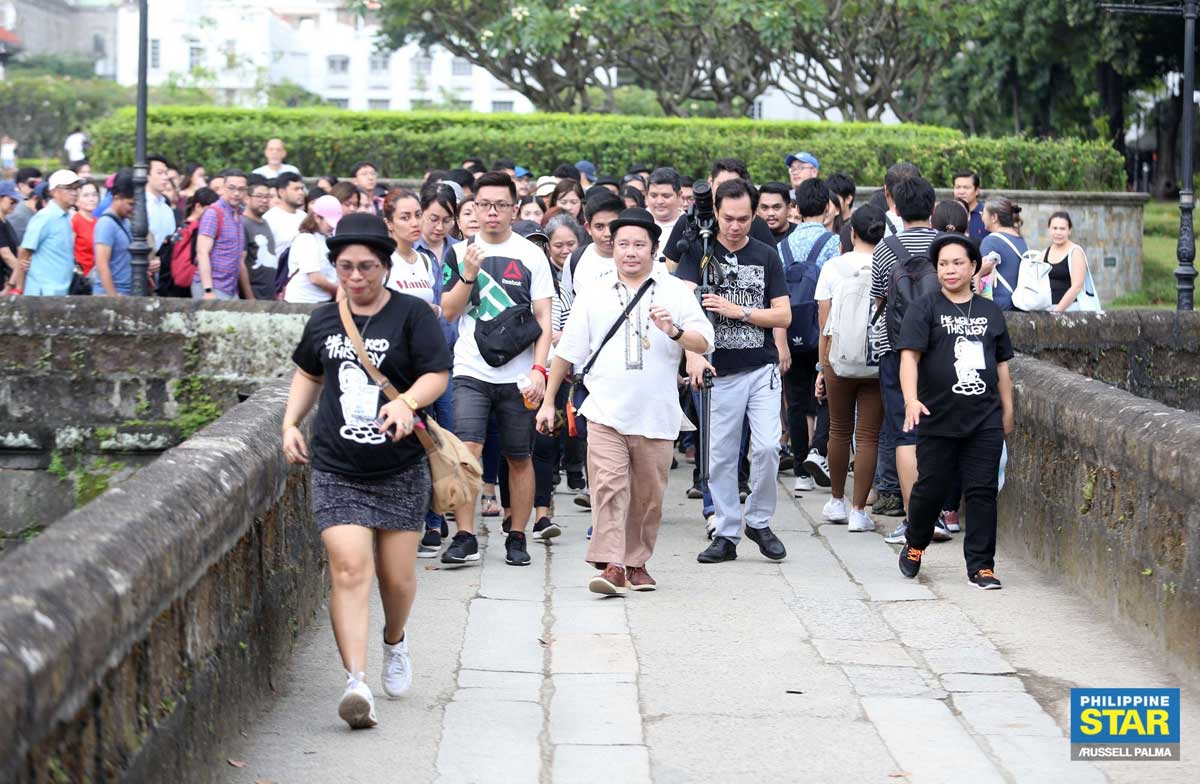
Walking in Celdran’s footsteps
Amid the spontaneous jokes and juicy trivia about the city’s capital, which the crowd adoringly consumed by laughter and applause, deep inside Mercado is devastated.
“His death really, really hit me very hard. We were frequent collaborators, we were friends, and we were the same age. We had so many things in common and one of the things was he had allowed me to run his tours. I did one Christmas season of his tour and whenever he had corporate clients who wanted to do the tour, ako ‘yung pinapadala niya because he didn’t like corporate so much,” Mercado told The Philippine STAR after the tour.
“I was emotionally devastated and running a tour that I haven’t run in five years, all the tension and buhos ng emotion, it was weighing heavily on me, but you know, once you started doing the tour, the morning and the afternoon, it just all flowed completely. I felt I did justice. I did them proud throughout this,” Mercado added.
Amid all emotions stirred by Celdran’s death, Mercado said he tried to keep to the spirit and the letter of the tour, using the only script that the late artist sent him. Mercado spent hours going through video and audio recordings and listening to Celdran’s voice and trying to get a semblance of him.
“Just because I’m the one doing it, and just because I already have a personality that people are aware of, siyempre pumapasok na ‘yung own interpretation ko,” Mercado said.
“But I also knew that I had to follow the spirit because, we’ve been through dozens and dozens of his tours, and it’s always been the same. You can’t capture Carlos like that. So I tried to capture the irreverence, spontaneity and the fun while still following the main pillars of the tour and to be as accurate as possible,” he added.
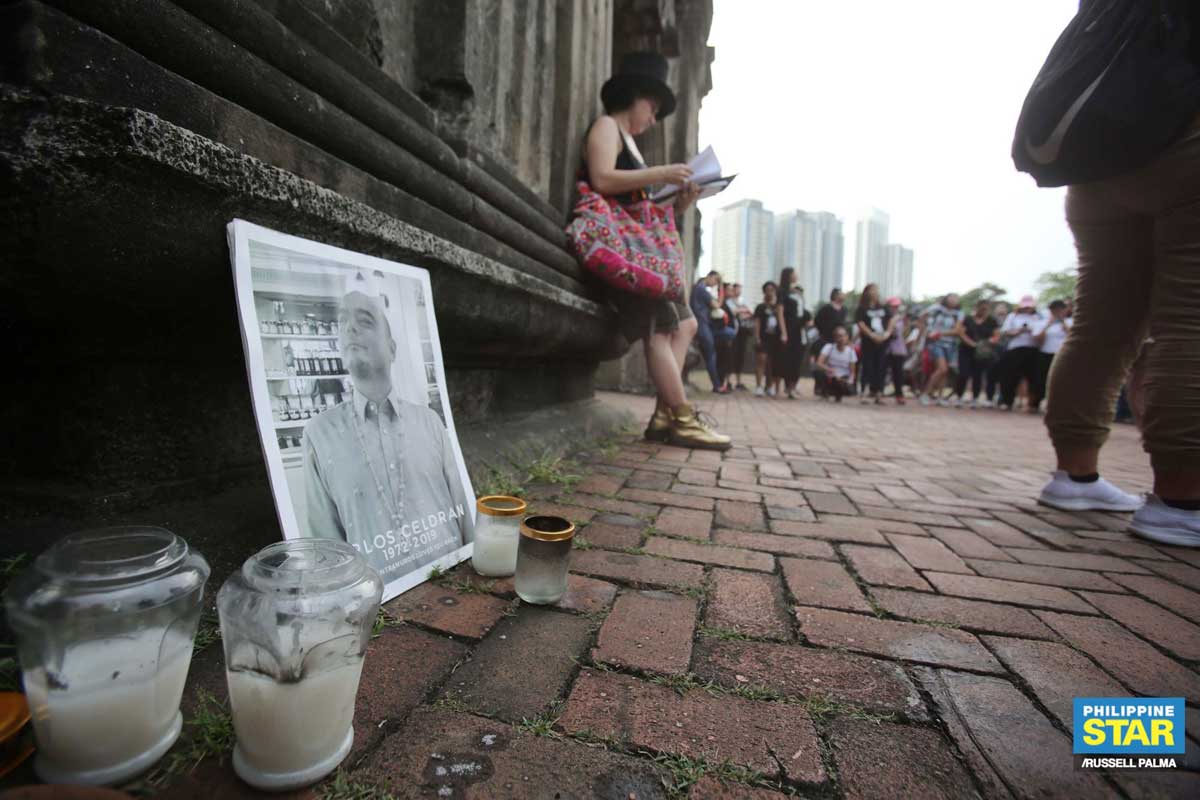
It also helped Mercado that a lot of the people whom Celdran worked with for several years in his tours and other performances showed up to lend a hand. One of them, Sabrina Schnabel, who was a former researcher for Celdran’s tours, served as Mercado’s assistant and played a part in the skits.
“I was so incredibly flattered to be asked. When I heard about (Carlos’ death), I was utterly shocked. I didn’t even cry. And then Gabe called me like, ‘Listen, we’re gonna do the final tour. I want you to be there.’ It just felt so good to be able to commemorate him, to remember him. And this, I think, is the best way to do it. He loved the work, he loved this place,” Schnabel said.
While studying European History at Skidmore College in New York, Schnabel worked for Celdran’s tour for three months in 2009, ensuring that his script is grounded on solid historical facts and backed by credible primary and secondary sources. She also answered any follow-up questions from tour participants.
Schnabel reminisced: “My favorite memories of Carlos were like right after the tour, when he would sit down and like talk about all the things he didn’t like about the tour and we would make notes and we would just sit in Barbara’s (restaurant in Intramuros) and drink San (Miguel beer). He would drink most of mine because I am a terrible drinker.”
“It was just amazing to be back here again, to be going through it all again. He is so conspicuously not here. But I would walk around every corner and expect him to be there. I expect him to be at every station, and I’m expecting him at Puerto Real when I go there. I feel I would always think of Carlos everywhere in Intramuros,” she added.
Despite her mentor’s demise, Celdran continues to live in what Schnabel does nowadays. Now in her early thirties, the historian has found her niche through writing her own podcast called What’s AP: Araling Panlipunan Rebooted, which she and her friend, communications specialist Ceej Tantengco, host. The podcast is part of the PumaPodcast network in Spotify.
“I’ve spent my whole life trying to be Carlos and now I get to write a podcast about Filipino history…and it’s sort of my way of honoring my mentor. I get to talk about Manila, the Philippines and the history we all share and I get to share that in a way that is funny, exciting and different, and so I think that’s how I can continue ‘walking his way,’” Schnabel said.
Who will don the bowler hat?
It was already past seven in the evening when the tour concluded to wide acclaim and applause at the jam-packed courtyard of Casa Manila. It was followed afterward by a tribute party for Celdran at the nearby Puerto Real Gardens.
“(It captured Carlos’) spirit, yes. Gabe was still Gabe, but speaking using Carlos’ words and with ad lib. It’s like doing Shakespeare, but through generations you have to be relevant to a new audience. Kumbaga for millennials, millennial-speak or whatever speak works,” said Mariano Andres Garchitorena, director of sales and marketing for The Peninsula Manila and cousin of Celdran.
According to Garchitorena, he was among his cousin’s guinea pigs when the latter started the tour in Intramuros 17 years ago. Garchitorena had been to dozens of Celdran’s tours that he almost knew it word for word.
“I don’t always agree with what he said, but he gave it so much life. In ‘If These Walls Could Talk,’ the walls could not speak (so) he spoke for the walls. He made dusty old history books come alive; he made the dead talk. I think he will be so missed because of that,” Garchitorena said.
While the tour was highly satisfactory for him, there are big questions still lingering in Garchitorena’s mind now that his cousin is gone.
“What will happen now to Intramuros? Who will care for Intramuros the way he did? Will Gabe do it? Will the tour guides he trained do it? Will it just be work for them or talagang amor?” he asked.
While Celdran’s work in cultural activism and heritage promotion lives in the likes of Ivan Man Dy of Old Manila Walks and the other historians and tour guides that give their own tours of the city, Garchitorena believes each one has its own niche, just as Dy found his own Sino-Filipino niche in his tour of Binondo, Intramuros and the Chinese Cemetery.
“For me, Intramuros was Carlos. That is my opinion, which may not be shared by everybody. I want somebody to take over. It will be such a waste and he will be such a big void. Sayang. I won’t be the same but it doesn’t matter. Maybe he died for that purpose — to give way to a new generation, who could make it even further, even deeper to the younger generations,” Garchitorena said.
He also noted that Celdran’s legacy is in reviving Intramuros and giving it a louder voice as a tourist destination and a place worthy of conservation.
“I think he added more spice to the pot. He gave it a voice. One thing about Carlos is you cannot ignore him. You may want to but you cannot ignore. You may not agree with him, but you cannot ignore. The karitela drivers, the boys who would play in the streets know him. He became like a fabric of Intramuros. Before, I would not go here. Binuhay niya. He gave it a kick in the butt,” he said.
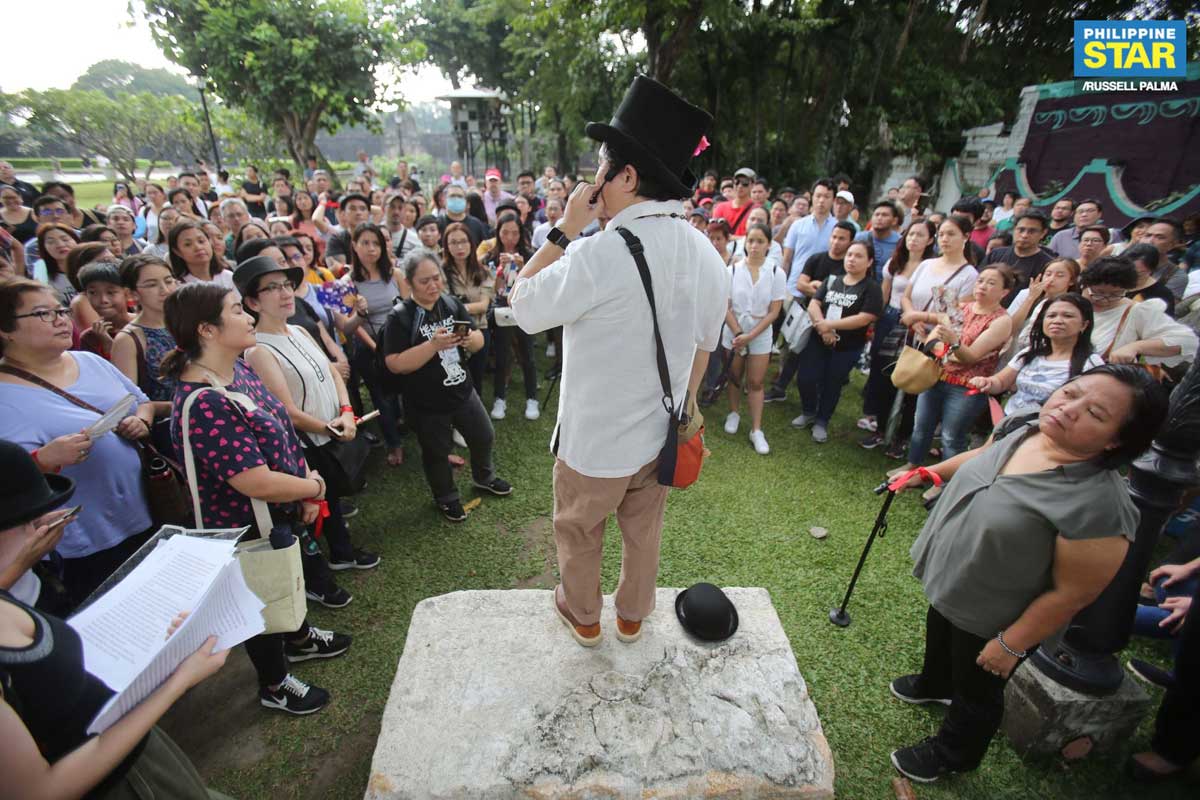
Also in the crowd of Celdran fans on Saturday was RockEd Philippines founder and executive director Gang Badoy-Capati, who was nothing short of praise for Mercado’s performance.
“I don’t think Gabe really came to replace Carlos. Nobody can do that. Gabe brought in his own energy, which is really an energy of a colleague, fan and friend of Carlos,” Capati said.
She was also glad to hear that there are other historians continuing Celdran’s work through their own tours.
“Contrary to popular belief, Carlos did not do his work for himself. It just sounds like it because he’s loud and attention’s always on him in the room. But I think what he really was building was a way to see Manila. We don’t love Manila if we don’t see it. You don’t love anyone or anything if you don’t see it. Regarding the new crop that’s coming out, I’m really happy and very proud, just as I’m sure Carlos is. And it’s not to continue the legacy of Carlos but to continue the love of Manila. I think that’s more Carlos actually,” Capati explained.
She added, “The movement to conserve and preserve is not just Carlos. It’s composed of very many people and institutions. But Carlos, because he is himself, he is louder than most of us, he is heard than most of us, you can see him from across the room more than you would see me or anyone else, he really did it his way, he really walked his way. So what a loss.”
It is indeed a loss as the tour was the last time for everyone to ever experience a semblance of Celdran’s sheer talent and love for culture. Mercado, who is now based in Baguio City, revealed after the tour that he would only perform it again if the Celdran family wants it and only on special occasions.
“Pero ako mismo, initializing it myself, it’s not easy. It takes a lot to pull it off. And also my life is no longer in Metro Manila. So, there’s that actual limit na, I cannot be regular anymore,” Mercado said.
Nevertheless, Mercado is happy that there are many others who will don the bowler hat one way or another after his performance.
“They always co-existed naman and they co-existed peacefully. There’s enough to tell about Manila and there’s always room for everyone,” Mercado stressed. “In terms of Carlos’ legacy, as it was, a lot of it died when he left. Will his legacy be celebrated, cherished, will it live on? Yes, but not necessarily in this form. Whatever that form is, we’ll be open to it and we’ll explore it. Being a friend, artist and frequent collaborator, he was all about creating new forms rather than making his legacy into a stiff, non-living canon.”


