


Beijing Claims Julian Felipe Reef As EU Slams China
Beijing’s claim on the reef, located in the West Philippine Sea and well within Manila’s exclusive economic zone, was stated in its rejoinder to the European Union, which had called out China for endangering peace in the South China Sea.

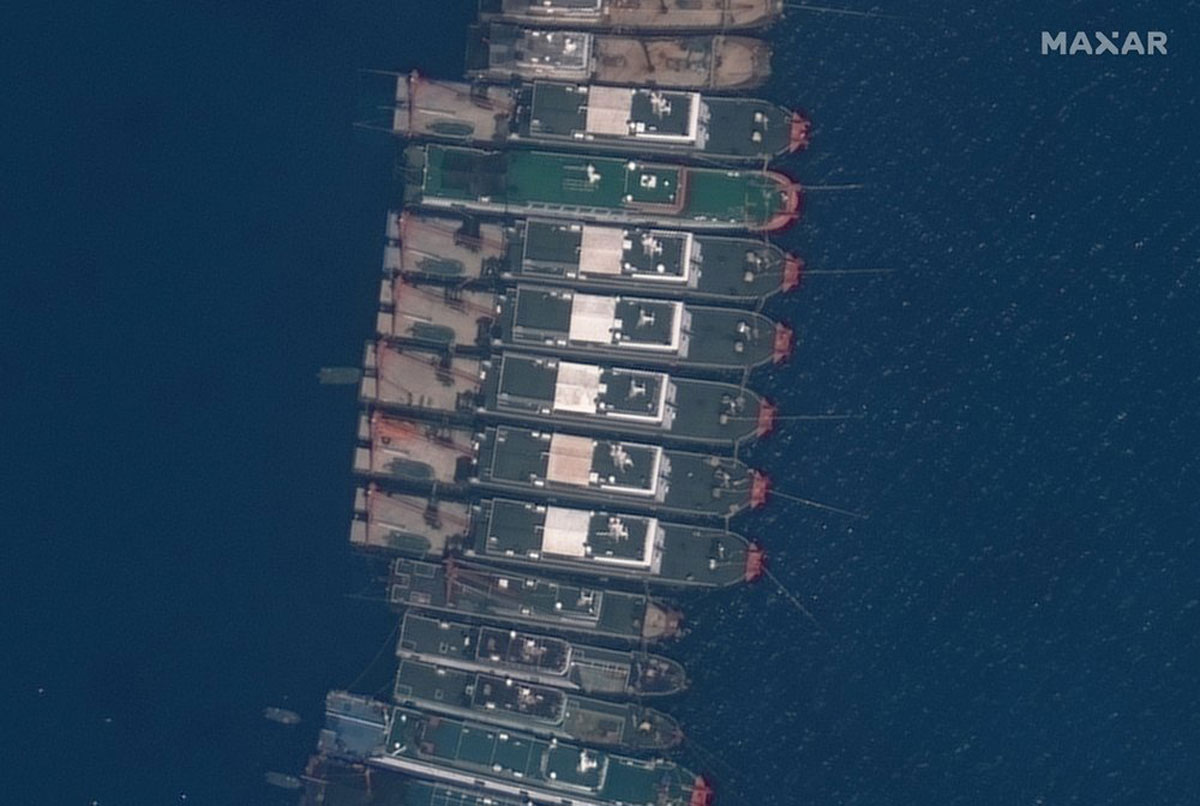
China asserted over the weekend its claim over Julian Felipe (Whitsun) Reef, calling it Niu’E Jiao and stating it is part of Nansha Islands (Spartly Islands)which it insists are within its maritime territory.
Beijing’s claim on the reef, located in the West Philippine Sea and well within Manila’s exclusive economic zone (EEZ), was stated in its rejoinder to the European Union (EU), which had called out China for endangering peace in the South China Sea.
“Tensions in the South China Sea, including the recent presence of large Chinese vessels at Whitsun Reef, endanger peace and stability in the region,” an EU spokesperson said in a statement on Saturday, April 24.
The statement was released a day after the Philippines filed its second protest to China in a week over its failure to withdraw what are believed to be maritime militia vessels disguised as fishing boats around the reef.
EU reiterated its strong opposition to “unilateral actions that could undermine regional stability and international rules-based order” and called on all parties to abide by the 2016 tribunal ruling which rejected most of China’s claim to sovereignty in the sea.
The United States, United Kingdom, France, Germany, Japan and Australia have also formally supported the 2016 arbitral ruling that the Philippines won in The Hague.
In highlighting the arbitration award, the EU urged all parties to resolve the dispute through peaceful means in accordance with the United Nations Convention on the Law of the Sea or UNCLOS.
In reply, the Chinese Mission to the EU reiterated that the reef is part of China’s Nansha Islands and that it was “reasonable and lawful” for Chinese fishing boats to operate there and shelter from the wind.
The Chinese statement also insisted that China’s sovereignty, rights and interests in the South China Sea were formed in the “long course of history and consistent with international law” and rejected the 2016 tribunal ruling as “null and void.”
“The South China Sea should not become a tool for certain countries to contain and suppress China, much less a wrestling ground for major-power rivalry,” the Chinese statement said.
Third parties
China is increasingly worried that Europe and other countries are heeding US President Joe Biden’s call for a “coordinated approach” toward China, which had so far materialized in the form of sanctions over its security crackdown in Hong Kong and treatment of Uyghur Muslims.
US Secretary of State Antony Blinken last month said Washington “stands by its ally, the Philippines,” in the face of China’s massing maritime militia at Whitsun Reef.
Last week, the EU released a new policy aimed at stepping up its influence in the Indo-Pacific region to counter China’s rising power.
The 27-member EU bloc expressed support for the “ASEAN (Association of Southeast Asian Nations)-led process toward an effective, substantive and legally binding Code of Conduct, which should not prejudice the interests of third parties.”
“The EU urges all parties to pursue sincere efforts towards its finalization,” the EU said.
Ivy Banzon-Abalos, executive director of Manila’s foreign affairs office for strategic communication and research, said the EU statement came as a result of a meeting between Department of Foreign Affairs (DFA) Undersecretary for policy Elizabeth Buensuceso and EU managing director Gunar Wiegand last Wednesday.
Appeasement policy
On Sunday, April 25, Senate Minority Leader Franklin Drilon slammed the Duterte administration’s appeasement and accommodation policy toward China for having emboldened Beijing to continue encroaching in the country’s maritime territories.
Drilon pointed out how Beijing remains “undeterred” by the numerous diplomatic protests filed by the DFA and demand made by Defense Secretary Delfin Lorenzana for the Chinese maritime militia vessels “to leave the country’s sovereign territories and abide by international law.”
“We’re being ignored because we neglected the issue in the past,” Drilon told radio station dwIZ over the weekend. “That is a result of our appeasement and accommodation policy towards China. We will continue to be ignored because of that policy.”
The opposition senator stressed the need for the country to get the support of the ASEAN, particularly countries with claims on the South China Sea, to strengthen Manila’s stance on the WPS issue.
He said it is President Duterte who should initiate the move to present a united front with other claimants in the WPS, including Brunei, Malaysia, Taiwan and Vietnam, “in order to make China realize that what it is doing is wrong and against international laws.”
“Bilateral talks with China on the maritime dispute do not work in the country’s favor,” Drilon said.
“We should, as an objective, get the other nations to confront China, including our allies – United States, Japan and Australia. We must unite against the unlawful Chinese incursion in the West Philippine Sea,” he added.
‘Verbal agreement’
Drilon also addressed the alleged “verbal fishing agreement,” which some sectors cited as a possible reason why Chinese vessels refuse to leave the country’s EEZ, calling it “invalid” if it indeed exists.
Speculations were raised that Duterte might have verbally committed to allow China’s fishing boats to fish in the WPS.
“To me, any verbal agreement is invalid. Any agreement between two nations, whether in the form of an executive agreement or a treaty must be in written form, otherwise it cannot be enforced,” Drilon said.
If indeed a verbal fishing agreement exists, the senator said the Filipino people and the Senate must be informed of the exact parameters of the agreement.
On Friday, April 23, presidential spokesman Harry Roque denied that Duterte has entered into a fishing agreement with Chinese President Xi Jinping, contradicting a 2019 statement of Chief Presidential Legal Counsel Salvador Panelo who claimed that the deal was "informal" but "binding."
Retired Supreme Court Senior Associate Justice Antonio Carpio, a vocal critic of Duterte's handling of the WPS row, has claimed that the Chinese government is not taking the Philippines' diplomatic protests and protests seriously because of its fishing agreement with Duterte.
"There is no truth to the speculation of a purported 'verbal fishing agreement'…nor that Chinese vessels were encouraged to stay in West Philippine Sea despite the diplomatic protests and strongly-worded statements of Philippine government officials," Roque said in a statement.
"This is without basis and is quite simply, conjecture," he added.
Roque's statement contradicted an earlier remark by Panelo, his predecessor, who claimed that the verbal fishing agreement between Duterte and Xi is binding because there is mutual consent from the two parties.
"Alam mo, kahit sa batas, kahit na verbal eh valid and binding iyon basta mayroong mutual consent ang dalawang partido. Kaya nga agreement eh, (You know in law, even if it is verbal, it is valid and binding as long there is mutual consent from the two parties. That's why it is an agreement)," Panelo said in a press briefing on July 1, 2019.
"Palagay ko walang pinirmahan. Parang ano lang iyon eh, parang nag-usap lang sila. Alam ko kung minsan, ang mga heads of state, may mga word of honor iyong mga iyon eh (I think they did not sign anything. It seems that they just talked. You know, sometimes, heads of state have a word of honor)," he stated.
Roque did not respond to questions seeking to clarify the apparent contradiction between his statement and that of Panelo.
Roque said under Philippine laws, a fishing agreement can only be done through a treaty. He cited Article 2 (1) (a) of the Vienna Convention on the Law on Treaties, which states that a treaty is an international agreement concluded between states in written form.
"Clearly, a treaty must be in writing. No such treaty or agreement exists between the Philippines and China," the Palace spokesman said.
"The President does not condone unlawful commercial fishing by any state on Philippine waters," he added.
Roque, nevertheless, said the President recognizes that subsistence or non-commercial fishing may be allowed as a recognition of the traditional fishing rights pointed out by the arbitral tribunal itself in its award on jurisdiction in the case between the Philippines and China.
"Let us therefore stop making malicious speculations and false claims made to pointlessly inflame the situation. We ask everyone to just focus our time and effort on productive activities that will enable us to help one another at this time of pandemic," Roque noted. - With Paolo Romero, Alexis Romero, Reuters