



All Set For Start Of SIM Card Registration
“It is important to note that failure to register will result in the deactivation of the SIM, which means the subscriber will not be able to use it," Department of Information and Communications Technology Undersecretary Anna Mae Lamentillo said.
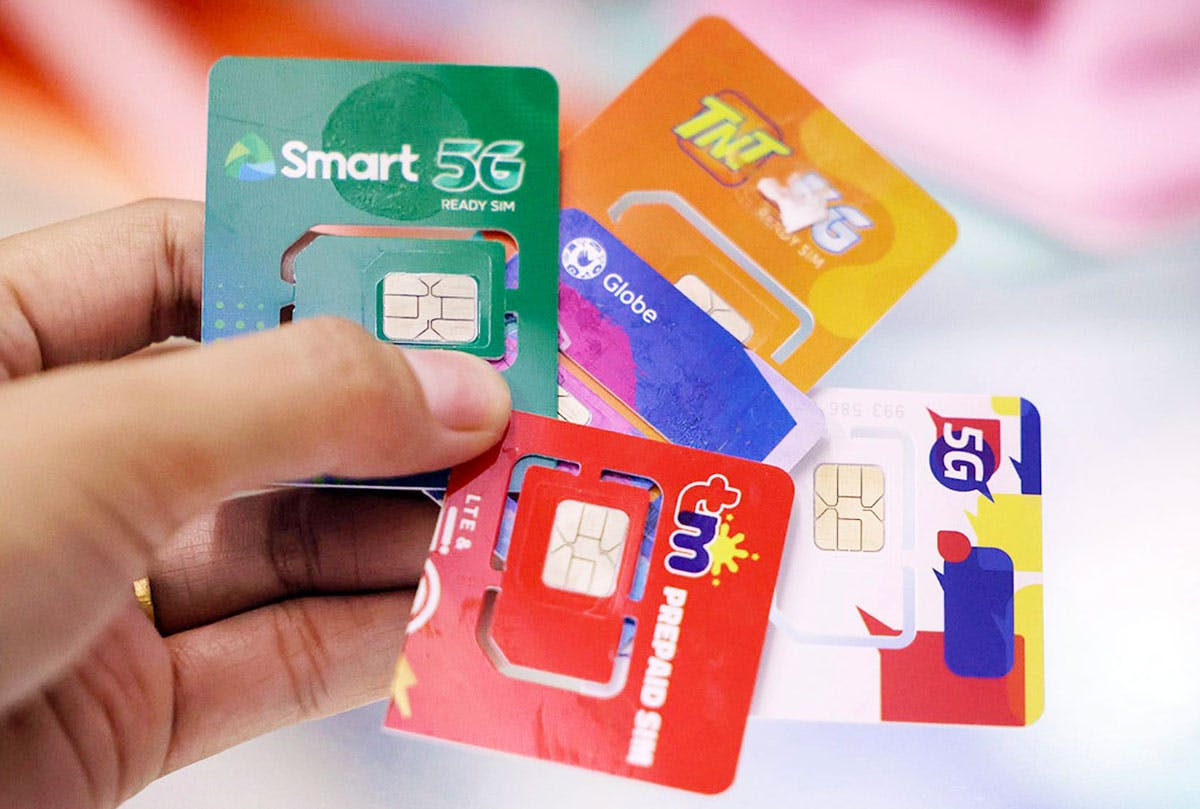
Beginning today, Dec. 27, mobile phone users are required to register their SIM cards – around 170 million in all – in compliance with a recently enacted law designed to keep them from being used for fraud and other criminal activities.
“Those who are required to register are all SIM subscribers, whether postpaid or prepaid, including embedded SIMs or eSIMs and other variations that are provisioned by any PTE (public telecommunication entities) to provide text messages, calls, and/or data services; as well as SIMs intended for data-only or used for fixed wireless broadband modem and/or wireless local loop, machine-to-machine service, and/or Internet of Things,” Department of Information and Communications Technology (DICT) Undersecretary Anna Mae Lamentillo said at a media briefing at the National Telecommunications Commission (NTC) office on Monday, Dec. 26.
“Thus, we enjoin every SIM subscriber or end-user to register their SIMs with their respective public telecommunication entities. The implementation of this law shall be at no cost to the end-users. Each PTE will set up a secure website or platform where users will register their SIM,” Lamentillo said.
“It is important to note that failure to register will result in the deactivation of the SIM, which means the subscriber will not be able to use it. And if an individual intends to buy a new SIM, he or she would need to register first before the SIM is activated,” she added.
Also at the press briefing were Justice Secretary Jesus Crispin Remulla, Interior and Local Government Undersecretary Margarita Gutierrez, NTC officer-in-charge and deputy commissioner Ella Blanca Lopez and ranking executives of mobile service providers Smart Corp., Globe Telecom and Dito Telecommunity.
Jon Paulo Salvahan, NTC deputy commissioner, said the telcos have committed to make the process smooth and glitch free.
“The PTEs have already developed their respective and unique SIM registration systems and have committed to keep their systems up by tomorrow,” Salvahan said, adding that foreigners are also covered by the requirement.
“All SIM registration will be done online, through the platform that will be provided by the PTEs. To facilitate registration with limited telecommunication or internet access, the DICT and NTC will work with other agencies, local government units and concerned PTEs to establish registration facilities in such areas,” he said.
“The DICT reminds all end-users that it is their responsibility to register their own SIMs with their respective PTEs and to immediately inform their PTEs if there are changes in the information of the SIM card holder, in case of loss of the SIM, or if the owner wants to deactivate the SIM, the end-user must inform the PTE. In case of death of an end-user, the immediate family, relatives or guardian should report to the concerned PTE,” Lamentillo said.
Lopez, for her part, said that the NTC will endorse the blocking of SIM cards containing dubious data.
180 days
Lamentillo said DICT Secretary Ivan John Uy hopes that the SIM registration process can be completed within 180 days.
She said that the 120 days provided for the exercise would be extended for another 60 days if needed.
“Thus, we encourage subscribers to register early. The first two weeks will be a test registration, which means that registrations are valid but there could be some difficulties and minor errors as the PTEs fine-tune the implementation process. We advise those who experience difficulties, glitches or technical issues to immediately report to the telcos or relevant government agencies to be addressed accordingly,” Lamentillo said.
“We would also like to remind everyone to be mindful of fake websites, phishing and other scams that may take advantage of people trying to register their SIMs,” she pointed out.
“The SIM Registration Law aims to protect citizens from fraudulent acts perpetrated through phone calls and text messages. But in order to do this, everyone must cooperate in the registration of SIM cards. The sooner we are able to accomplish the registration the better, so that we can start experiencing the effect and protection of the law,” she maintained.
Remulla, for his part, is urging the public not to fear the law, as it would not be used for “nefarious purposes” such as state surveillance.
The DOJ chief said the data collection of telcos would be done under strict regulatory oversight and monitoring from concerned government agencies to protect the privacy of subscribers.
Citing Sections 9 and 10 of the SIM Card Registration Act, Remulla explained that all information gathered during the registration process would be confidential.
“For the general public and fellow Filipinos, please do not be afraid of the SIM Registration Act. This will not be used for state surveillance, red tagging or any such nefarious purpose. The collection of data by the telcos will be under stringent regulatory oversight and monitoring of concerned government agencies so the public can be assured that their data and information will be safeguarded,” he told reporters on Monday.
He also explained that the disclosure of the full name and address of a subscriber should only be made in four instances: in compliance with any law obligating the disclosure of such information in accordance with the Data Privacy Act, in compliance with a court order or legal process, upon the issuance of a subpoena based on a sworn complaint that a specific mobile number was or is being used in the commission of a crime and with the complainant unable to ascertain the identity of the perpetrator, and with the written consent of the subscriber.
Monitoring
Remulla stressed that the compliance of telcos with the law would be periodically monitored by relevant government agencies, including the DICT.
Telcos have also been required to submit to the NTC, DICT and both houses of Congress on or before April 30 every year an annual report on the implementation of the law.
“This will be a whole-of-government approach to ensure that in the implementation of this law, respect for freedoms enshrined in the Constitution are maintained. Moreover, the public may be assured that any doubt in the interpretation of any provision of the law and its IRR shall be in a manner that accords the highest respect for privacy, and liberally interpreted in a manner mindful of the rights and interest of SIM subscribers,” Remulla said.
“Finally, we assure the public that the IRR is not etched in stone. The IRR may still be subject to amendments or alterations and the NTC is not precluded from releasing additional issuances to supplement the implementation of any particular provision or group of provisions under the IRR,” he added.
DILG’s Gutierrez said local government units have been tapped to help in the SIM registration process, specifically through information dissemination.
“All local government units – provincial, city or municipal and barangays levels – will conduct an information drive to roll out the SIM card registration in coordination with the DILG’s partner agencies,” Gutierrez said in the briefing.
“The local government units know their constituents better. They know the people up to the barangay level. So this will speed up information dissemination,” Gutierrez said.
Citing figures from telcos, Gutierrez said Globe blocked 784 million scam and spam messages and 8,973 SIM cards last September as part of the crackdown on fraudulent text messages.
Smart has blocked 51 million text scams, she added.
Reminder to telcos
Sen. Grace Poe, meanwhile, reminded the NTC and telcos to make sure the mandatory SIM card registration would be secure, convenient and as easy as texting.
“The SIM registration should be as easy as texting or sending a message,” Poe, who chairs the Senate public services committee, said.
She enjoined the telcos, NTC, key regulators and other concerned agencies to see to it that all hands are on deck for the orderly and effective rollout of the law.
“Telcos should have portals for registration that are user-friendly and secure to encourage mobile users to enlist without hassle and interruption of services,” the principal author and sponsor of the law said.
She said the system should also provide the means to register for people in need of assistance such as persons with disabilities, senior citizens, minors, pregnant and those without internet connection.
Massive and constant information drive should also be undertaken to encourage subscribers to register their SIM and to assure them of the safety of their data, Poe said.
Poe has also been issuing through her social media accounts Q&As about the law and helpful tips on how to register.
The SIMs of those who fail to register within the given period would be deactivated. The SIM may be reactivated only after registering, but not later than five days after deactivation.
For existing subscribers, the telcos are tasked to include their information and data in the SIM register.
To complete the registration, postpaid subscribers must confirm their information and data in the SIM register through the telcos’ platform.
SIM registration will be done electronically through a secure platform or website provided by the telcos.
The IRR states that those who will provide false or fictitious information to register a SIM will face imprisonment or a fine.
“We can reap the SIM Registration law’s full potential with an effective implementation, and we must do it together as a nation,” Poe said.
The SIM Registration Act is the first law signed by President Marcos. It is backed by a majority of Filipinos, according to a recent Social Weather Stations survey. – With Paolo Romero, Marc Jayson Cayabyab


