



Alert Level 3 Raised Over Taal Volcano: Evacuation Ordered After Powerful Blast
Phivolcs director Renato Solidum Jr. said the institute may decide to lower the alert level if there is no escalation or the trend is downward after two weeks of close monitoring.
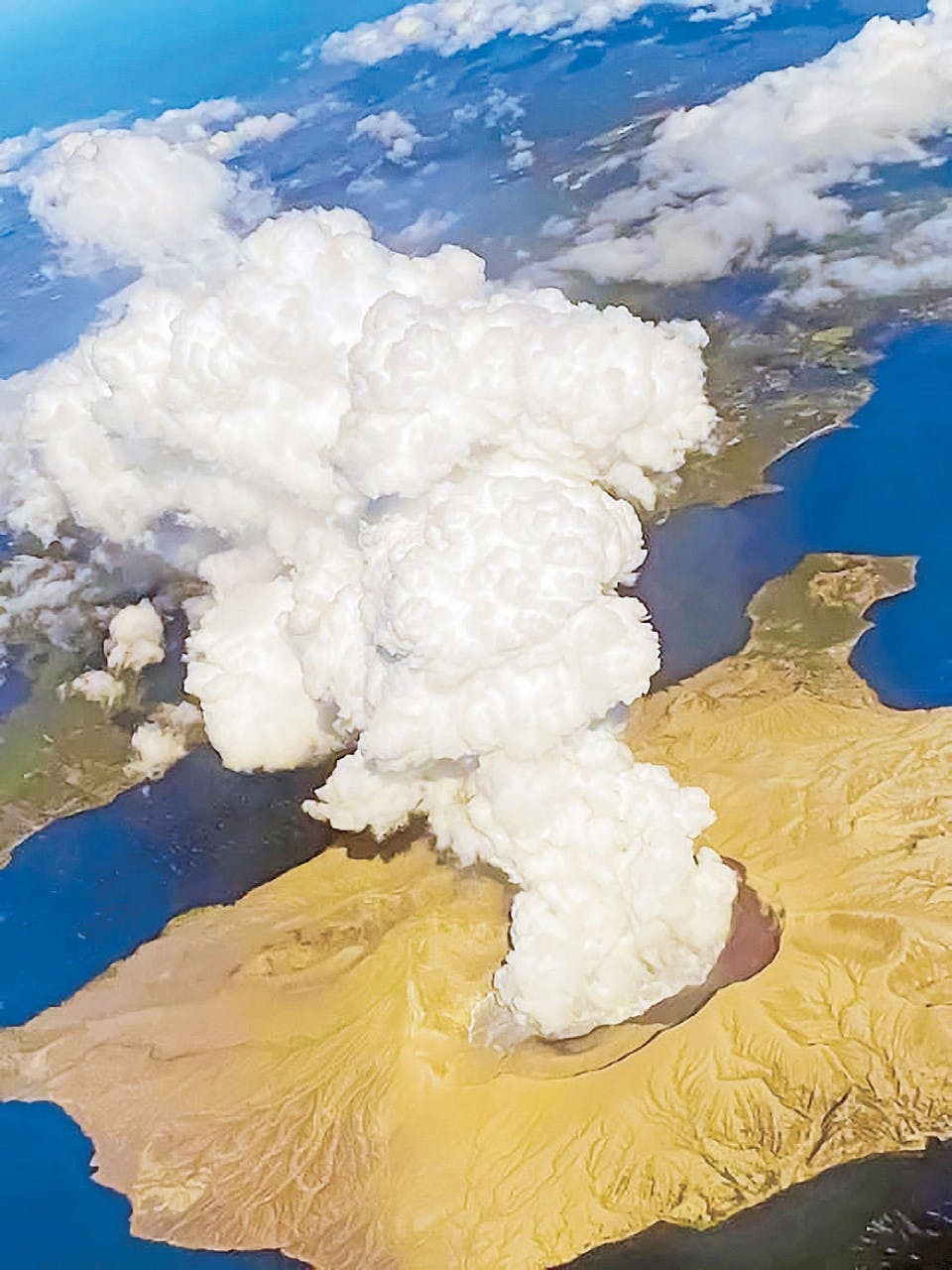
Taal Volcano blew a white plume of steam and ash 1.5 kilometers into the sky in a brief but powerful explosion Saturday, March 26, prompting authorities to raise the alert level and evacuate hundreds of residents from high-risk villages.
Magma came into contact with water in the main crater of Taal Volcano in Batangas province, setting off the steam-driven blast that was followed by smaller emissions and accompanied by volcanic earthquakes, the Philippine Institute of Volcanology and Seismology (Phivolcs) said.
The institute raised the alarm at the 1,020-foot Taal, one of the world’s smallest volcanoes, to Level 3 at 8 a.m. in a five-step warning system, meaning “there is magmatic intrusion at the main crater that may further drive succeeding eruptions.”
Alert Level 5 means a life-threatening eruption that could destroy communities is underway.
Residents of five lakeside villages within a seven-kilometer danger zone from the crater in the Batangas towns of Agoncillo and Laurel were warned of possible hazards, including fast-moving gas and molten materials and “volcanic tsunami” in Taal Lake, and began evacuating to safety.
More than 1,200 villagers had moved into emergency shelters by noon, the government’s disaster-response said.
“It was a powerful burst but now the volcano has calmed down,” Laurel Mayor Joan Amo told AP by telephone, adding that up to 8,000 residents in high-risk villages in her town would need to be moved to safety if the volcanic unrest continues.
A video showed a white column of steam and ash billowing from the low-slung volcano into the blue sky. A villager witnessing the explosion amid the scorching summer heat can be heard in the background saying, “The volcano is exploding again, one blast after another, due to the intense heat.”
Phivolcs director Renato Solidum Jr. said it remains to be seen if Taal would suddenly grow more restive or eventually settle down.
“If we see that there is no escalation or the trend is downward” after two weeks of close monitoring, the institute may decide to lower the alert level, Solidum said.
As a precaution, authorities temporarily banned all activities, including fishing, in the lake surrounding the volcano and asked nearby communities to brace for possible ashfall.
Aircraft were warned to stay away from the volcano due to the danger of possible “ash and ballistic fragments from sudden explosions” and other super-hot volcanic emissions.
Taal erupted in January 2020, displacing hundreds of thousands of people and sending clouds of ash to Manila, about 65 kilometers to the north, where the main airport was temporarily shut down. Since then, the volcano has sporadically shown signs of restiveness.
“For initial activities in Taal, we don’t expect it to be like the 2020 eruption because of the lesser amount of S02 (sulfur dioxide) gas trapped within the magma. For the worst case, we need to monitor deeper magma, if it ascends rapidly that will trigger bigger eruption,” he explained.
“But as to the scale of the 2020, we’re not yet seeing that activity so far,” he said.
Phivolcs noted the alert level may be lowered if there is no phreatomagmatic activity in the next two weeks.
Solidum said it is still safe to visit areas in Cavite and Batangas, including Tagaytay City.
“The approach here is ‘managing the risk.’ Not that strong yet, and no threat except in mentioned barangays,” he added, referring to barangays of Bilibinwang and Banyaga in Agoncillo and Boso-boso, Gulod and eastern Bugaan East in Laurel in Batangas.
Residents of five villages were ordered to leave their homes, regional civil defense spokesman Kelvin John Reyes told AFP.
More than 12,000 people live in the settlements, according to the latest available official data.
Col. Glicerio Cansilao, Batangas police director, said his men are under orders to stop people entering the high-risk areas.
“The five communities are considered high risk due to their proximity and elevation relative to the volcano,” Mark Timbal, spokesman of the National Disaster Risk Reduction and Management Council (NDRRMC) said.
Calabarzon regional DRRMC chair Ma. Theresa Escolano said they are coordinating with mayors of affected areas for situation updates and resource deployment.
Philippine Coast Guard (PCG) Commandant Admiral Artemio Abu ordered the PCG District Southern Tagalog to maintain heightened alert.
Abu said the PCG station in Batangas dispatched a team to monitor the activity of Taal Volcano and directed substations in Talisay and San Nicolas to implement “forced evacuation” of fishing communities within Taal Volcano Island.
Phivolcs again reminded the public that the entire Taal Volcano Island is a permanent danger zone and that entry to the barangays at high risk should be prohibited.
Phivolcs also warned the public of harmful carbon dioxide emissions around Taal and advised residents to wear masks.
“Communities around the Taal Lake shores are advised to remain vigilant, take precautionary measures against possible airborne ash and fog and calmly prepare for possible evacuation should unrest intensify,” Phivolcs added.
The Department of Health (DOH) also issued a similar warning. “Anyone who already suffers from problems such as bronchitis, emphysema or asthma should avoid exposure to volcanic ash,” the DOH said.
The DOH pointed out ashfall could lead to nose and throat irritation, coughing, bronchitis-like illness, discomfort while breathing, eye irritation, minor skin problems and “injuries/death due to roof collapse or vehicular accident resulting from slippery road and poor visibility.”
“Minimize exposure to ash. Stay indoors as much as possible, keep doors and windows closed,” it said.
The DOH also said homes should be kept free from harmful dust and emissions by using damp curtains, blankets or clothing. It said pets should be kept in closed shelters while roofs should be cleared of ash.
The Philippines lies along the Pacific “Ring of Fire,” a region prone to earthquakes and volcanic eruptions.
A long-dormant volcano, Mount Pinatubo, blew its top north of Manila in 1991 in one of the biggest volcanic eruptions of the 20th century, killing hundreds of people.
Presidential candidate Sen. Manny Pacquiao said he is ready to mobilize relief operations in areas in Batangas affected by Taal’s latest activity.
“Me and my team are closely monitoring the situation and are ready to mobilize support if needed.” he said in a statement.
“I have full confidence that our national government and local government authorities are prepared to do whatever is necessary to ensure the safety of the people around Taal,” he said. – With Ralph Edwin Villanueva, Emmanuel Tupas, Arnell Ozaeta, Robertzon Ramirez, Ed Amoroso, Sheila Crisostomo, AP, AFP


