



A Dominican Chronicle Miscast As A Jesuit Triumph
The well-preserved 1693 Zaragoza edition of Diego Aduarte’s milestone history of the first Dominican missions in the Philippines, Japan and China is up for auction by Leon Gallery.
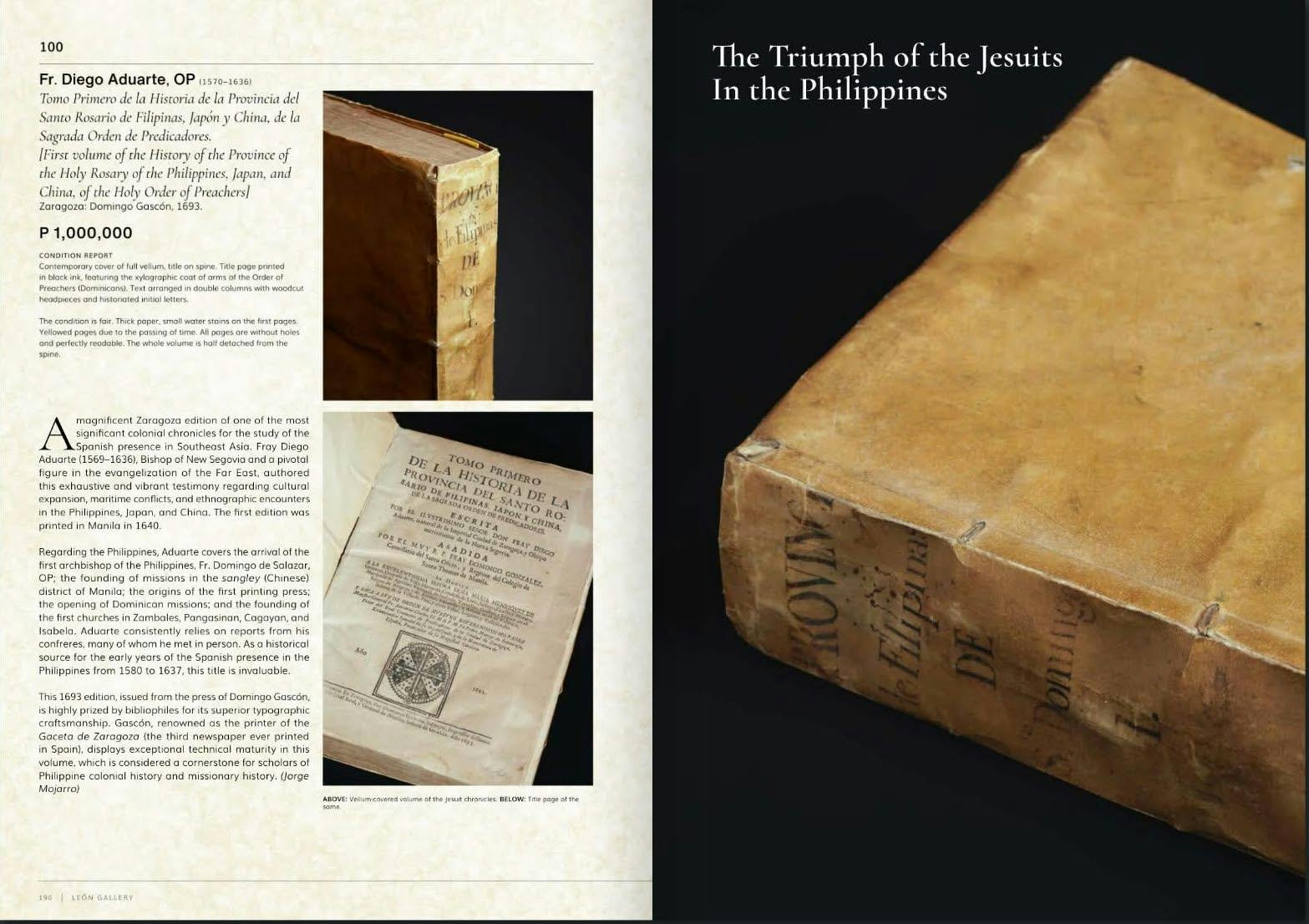
Among the treasures to be offered at Leon Gallery’s “Spectacular Midyear Auction” on Saturday, June 13, one lot stands above the rest for both its rarity and historical significance. Lot 100, carrying a floor price of ?1 million, is a 1693 Zaragoza, Spain edition of Fray Diego Aduarte’s “Historia de la Provincia del Santo Rosario de Filipinas, Japón y China,” one of the most important chronicles of the Spanish missionary enterprise in Asia.
Yet the auction catalogue contains a curious and glaring error.
The book is presented under the headline: “The Triumph of the Jesuits in the Philippines.”
The problem is that Aduarte’s work is not about the Jesuits. It is the definitive history of the Dominican Order in the Philippines, Japan, and China.
Puzzling mistake
The mistake is particularly puzzling because the catalogue entry itself correctly identifies the volume as the history of the Provincia del Santo Rosario, the Dominican province that spearheaded missionary work throughout East Asia. The title page reproduced in the catalogue even bears the coat of arms of the Order of Preachers, the formal name of the Dominicans. The erroneous headline appears to be an editorial oversight rather than an error by the entry's author, Jorge Mojarro.
Mojarro is the respected Spanish scholar whose bibliographical research into the vast holdings of the UST Archives and UST Heritage Library has established him as one of the leading authorities on Philippine rare books and colonial literature. In his catalogue essay, Mojarro accurately describes the volume as “one of the most significant colonial chronicles for the study of the Spanish presence in Southeast Asia” and a work that remains “invaluable” for understanding the early decades of Spanish rule in the Philippines.
The distinction matters.
Foundational
Aduarte’s “Historia” is not merely another missionary narrative. It is among the foundational texts of Philippine historiography. First printed by the old UST Press in 1640, the work chronicles the expansion of Dominican missions across the Philippines, Japan, and China, recounting the establishment of churches in Pangasinan, Zambales, Cagayan, and Isabela, the evangelization of Manila's Chinese community, and the lives of the friars who ventured into some of Asia's most difficult mission fields. (Aduarte himself did grueling and dangerous mission work in Cambodia.)
The Zaragoza edition offered by Leon Gallery is especially prized among collectors. Printed by Domingo Gascón, one of 17th century Spain’s most accomplished printers, it is admired for its elegant typography, double-column layout, woodcut ornaments, and handsome vellum binding. Mojarro notes that the edition is highly sought after for its superior craftsmanship and remains a cornerstone for scholars of Philippine colonial and missionary history.
The life of its author was no less remarkable.
Incorrupt body
Born in Zaragoza in 1569, Diego Aduarte arrived in the Philippines as a young Dominican missionary and spent decades traveling through the archipelago and beyond. He served as prior of the Dominican convent in Manila, rector of the then College of Santo Tomas, procurator of the province, and eventually Bishop of Nueva Segovia.
When he died in 1635, he was buried in the former cathedral of Nueva Segovia in Lalo, Cagayan. Some years later when his body was transferred to the Dominican cemetery, it was found incorrupt, a sign of sanctity.
But Aduarte saw himself not as a saint or hero but as a custodian of memory.
In the prologue to his “Historia,” he explained that he wrote the book so that future generations might benefit from “the lives of so many Apostolic Men” who had left Spain to preach in distant lands. He lamented that many worthy missionaries had already been forgotten through what he called "our omission and laziness," which buried their virtues alongside their bodies.
Sacrifice
His commitment to preserving that history bordered on obsession. In one of the most moving passages in the prologue, Aduarte declared that if necessary he would “sell the blood of my heart to print it and bring it to light” so that the world would not lose the hidden treasures of the Order's past.
Nearly four centuries later, that sacrifice survives in paper and ink.
Which makes the catalogue’s invocation of a “Jesuit triumph” all the more ironic. The volume being offered is, in fact, a monument to Dominican perseverance – a record of missionaries who crossed oceans, learned new languages, and built institutions that helped shape the history of the Philippines.
For collectors, Lot 100 represents a rare opportunity to acquire one of the great books of Philippine colonial history. For historians, it is a reminder that titles matter. And for Diego Aduarte, whose life’s work was devoted to rescuing memory from oblivion, accuracy may be the least tribute that posterity can offer.


