


90 Percent Of OFWs In Iraq Undocumented
The total ban on the deployment of Filipino workers to Iraq was imposed in 2014, but this was partially lifted in 2018. Still, Filipino workers either sneak in or are trafficked to Iraq by recruitment syndicates.
Long before the conflict between the United States and Iran erupted following the killing of top Iranian general Qasem Soleimani, the Philippine government had already banned the deployment of Filipino workers to Iraq.
Philippine Overseas Employment Administration (POEA) chief Bernard Olalia said the total ban on the deployment of Filipino workers to Iraq was imposed in 2014, but this was partially lifted in 2018.
“We have a partial deployment ban so there is no agency hired in Iraq, and only returning workers employed in US bases and by international organizations are allowed,” Olalia explained.
In 2014, the Philippines imposed a total deployment ban to Iraq and raised to Alert Level 4 the state of caution for Filipinos working there following the capture by the Daesh of Mosul and other key cities. The Islamic militant group went as far as threatening to overrun the capital Baghdad as well as Erbil.
Alert Level 4 means mandatory evacuation under the caution protocol of the Department of Foreign Affairs (DFA) for Filipinos working and staying overseas.
On Nov. 21, 2018, the POEA issued Memorandum Circular No. 17, allowing overseas Filipino workers (OFWs) to work for the Iraqi government, governments of member-states of the International Coalition, the United States, the United Nations and other international organizations and non-government organizations.
OFWs who work as private staff of foreign diplomats in Baghdad and senior officials of the Iraq government are also allowed to return to Iraq. Their workplaces must also be safe, the circular read.
Black market
The deployment of household service workers to Iraq is not allowed based on the circular. However, OFW advocacy group Blas F. Ople Policy Center head Susan Ople previously reported that illegal recruitment of Filipino workers to Iraq remained unabated despite the deployment ban.
Based on the data of the Department of Labor and Employment (DOLE) and POEA data, there are 2,191 OFWs in Iraq. This varies from the figures cited by the DFA and Environment Secretary Roy Cimatu, who was designated by President Duterte as special envoy to the Middle East. There are 1,640 OFWs in Iraq, the DFA said, while Cimatu cited 4,400 Filipinos, 1,600 of whom have signed up for repatriation as of yesterday.
Labor Secretary Silvestre Bello III admitted that undocumented Filipino workers are not among the 2,191.
Bello said 90 percent of the OFWs in Iraq are undocumented. Most of them are women employed as household service workers.
The documented Filipino workers in Iraq are mostly skilled and employed as drivers, equipment operators and service workers, Bello added.
Citing information from the Iraq embassy, Ople previously said five to 10 Filipino women sneak into Iraq every week to work as household service workers.

Last year, Ople said their group provided help to 10 Filipino women workers who were illegally recruited to work in Iraq.
“There is a black market of Filipino workers in Iraq,” Ople said as she urged the government to take immediate measures to prevent the trafficking of OFWs.
Ople said the syndicates recruit Filipino workers online and provide tourist visas to enable the OFWs to go to Iraq using a third country like the United Arab Emirates as entry point.
She noted that OFWs, mostly women, are put in harm’s way considering that the DFA has placed Iraq under Alert Level 4.
Olalia said the government is preparing for the repatriation from Iraq of all Filipino workers, including the undocumented.
He stressed that employers of the legally deployed Filipino workers are mandated to help in the repatriation of their employees.
The POEA governing board, Olalia said, is set to come out with a resolution on Friday reimposing the total deployment ban to Iraq.
While the resolution is yet to be issued, Olalia said the POEA has already stopped the processing and deployment of OFWs seeking employment in Iraq.
Alert level in Iran, Lebanon downgraded
Meanwhile, Bello said Filipino workers in Iran and Lebanon can opt to remain in those countries and will no longer be forcibly repatriated after alert levels in the two countries were downgraded.
“Initially, the level of alert for Iran, Iraq and Lebanon were the same – 4. Although it was unofficial, I was informed yesterday that the alert level in Lebanon was put down to Level 2 and I understand that there’s no more alert level in Iran,” Bello said in a statement.
Bello, however, pointed out that deployment of Filipino workers to the two Middle Eastern countries is still prohibited.
Bello said the Philippines has no bilateral agreement with Iran and thus deployment of workers to that country is actually not allowed under the law.
‘We must move now’
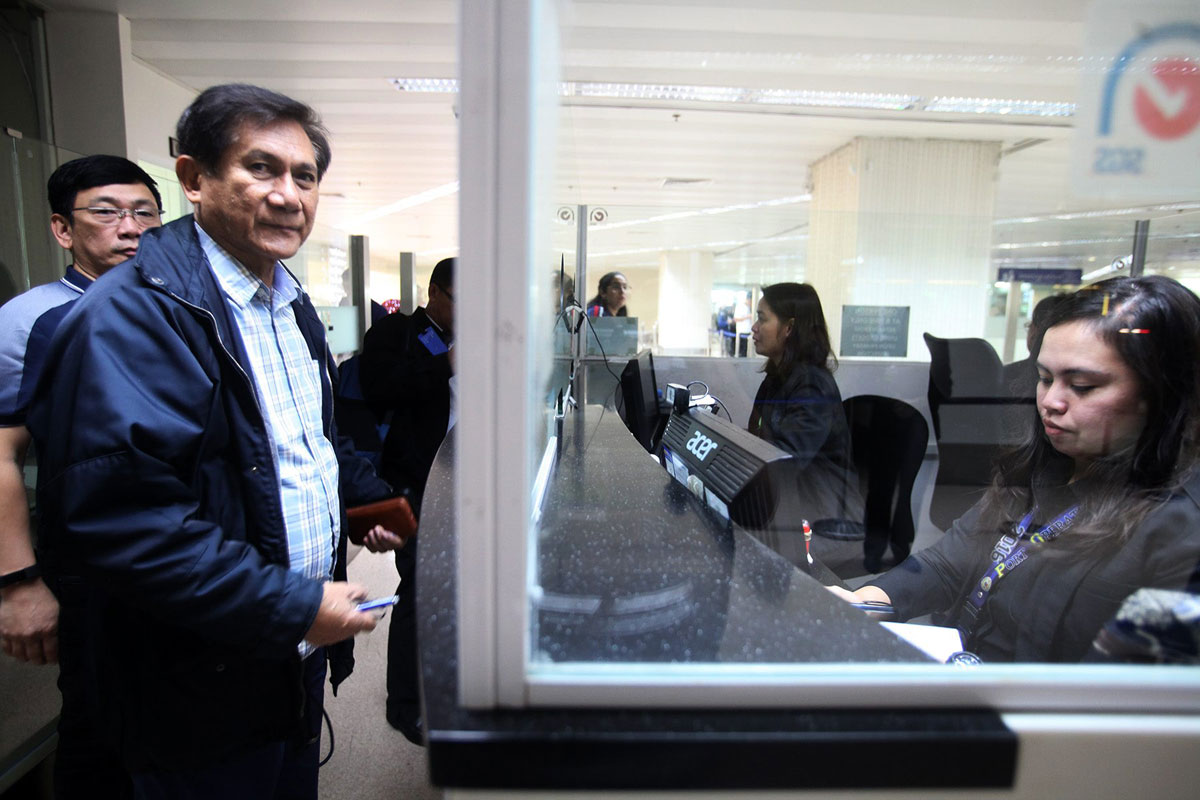
Cimatu left for Baghdad via Qatar on Philippine Airlines flight PR 684 yesterday morning to move out the OFWs in Iraq while the airports and roads are still open.
“The worst scenario might come. We will never go wrong if we move now,” Cimatu said in a press conference before his departure at the Ninoy Aquino International Airport.
Once in Qatar, Cimatu said he would meet with government representatives or the rapid response team to discuss how to evacuate the OFWs.
“Assuming Baghdad is closed, they will go to Erbil. But there is no direct flight to Manila so they will have to fly to Qatar and Dubai (in the UAE),” Cimatu said.
“I was told there are some airlines still operating and roads are still open so we will take the opportunity to move out our people in Iraq,” he added.
Cimatu said they must prepare for the worst-case scenario: if US bases in and around Kuwait, Bahrain and Qatar are targeted by Iran.
On Wednesday, Iran retaliated by firing missiles at two Iraqi bases housing US troops as it branded the US killing of Soleimani an “act of war” and “state terrorism.” No Filipino was reported hurt in the attacks, the Philippine government said.
Every country in the Middle East has its own missiles, Cimatu said, thus the situation is unpredictable. There have been instances of surprise missile attacks in the past, Cimatu added.
“They have the option to press the trigger. We have to be ready in case there will be some incidents along the way,” he emphasized.
He said given the risks involved, the government decided to take the safest route, which is repatriation.
Cimatu said the repatriation of OFWs in Lebanon is not necessarily because of the tension between the US and Iran, but to prepare “for possible actions of Hezbollah, a militant group there.”
“If (Hezbollah and Israel) will be included in this conflict, lalong dapat mapabilis ang departure nila (all the more that Filipinos there need to hasten their departure),” he said. “This time, the conflict is unpredictable. I would really suggest to move them out already even if there is no conflict yet.”
He said he received information that there were about 1,600 Filipinos so far who have expressed interest in being repatriated. Twenty-nine of them, he said, were set to go to the Philippine embassy in Baghdad to fly out.
Cimatu said they would also ask the families of undocumented OFWs in Iraq to convince their loved ones to move out and go directly to the Philippine embassy for possible repatriation. – With Rudy Santos