5.3 Million Of 18 Million Families Receive Cash Aid After Monthlong ECQ
A total of P25.4 billion has been distributed to 5.3 million beneficiaries, falling way short of the 18 million target as of the 36th day of the enhanced community quarantine in Luzon.
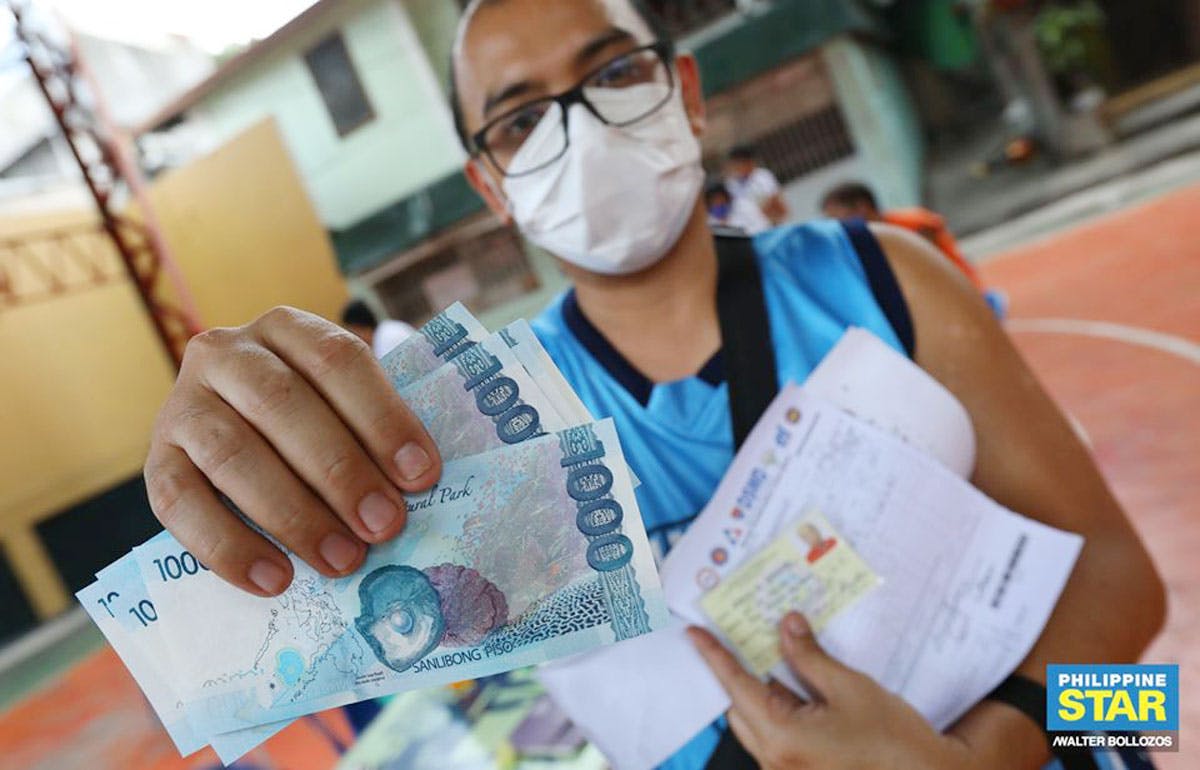
Nearly a month after Congress granted President Duterte special powers to address the coronavirus disease 2019 (COVID-19) pandemic, the government has distributed cash assistance to only 5.3 million so far out of the targeted 18 million families affected by the enhanced community quarantine or ECQ measures.
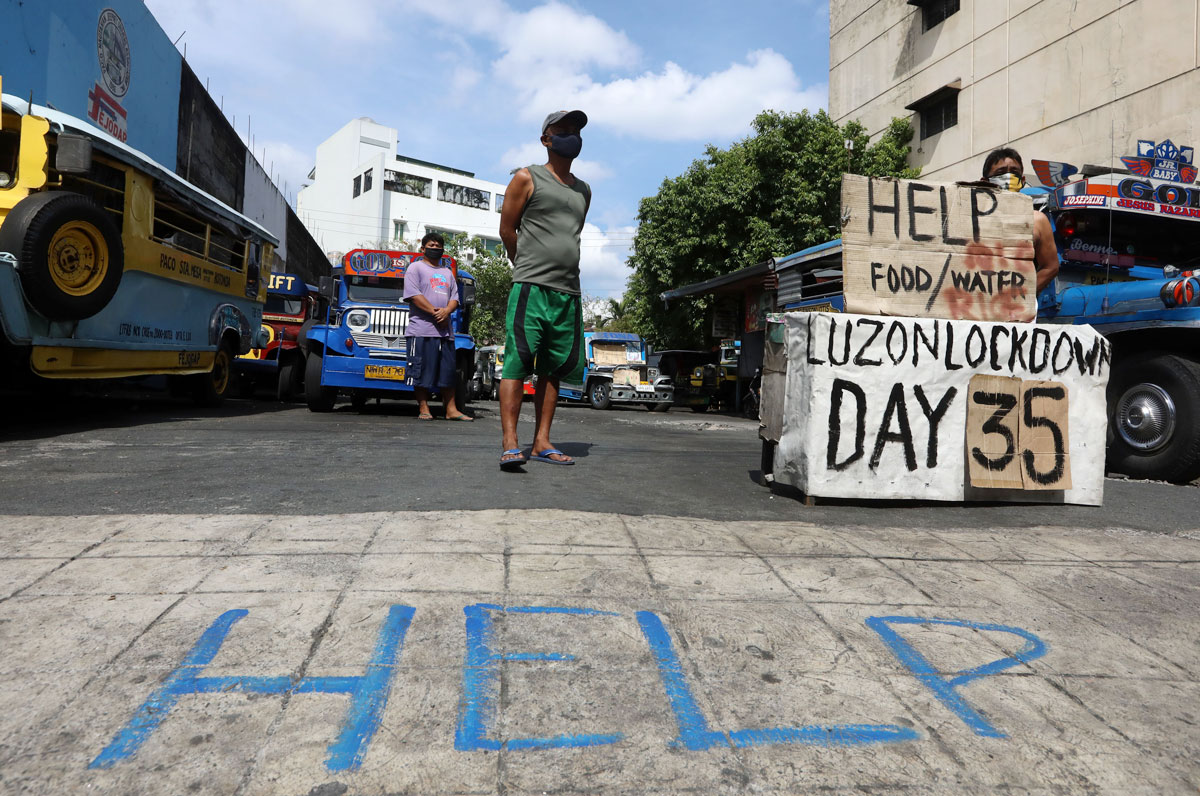
In other words, seven out of 10 families seen to qualify for the two-time monthly cash assistance have not yet received financial assistance, 36 days after their livelihoods were disrupted and their movements restricted by the ECQ declared in the entirety of Luzon on March 16.
These numbers, as of April 21, were disclosed by Department of Social Welfare and Development Undersecretary Rene Glen Paje during the government’s Laging Handa livestreamed briefing on April 22.
“Sa pangkalahatan, mahigit P25.4 billion na ang naipahatid sa 5.3 million na beneficiaries ng Social Amelioration Program (SAP) natin (Overall, more than P25.4 billion has been distributed to 5.3 million beneficiaries of our Social Amelioration Program),” Paje reported.
This means 25.4 percent of the total P100-billion budget for the first tranche of cash assistance was released to 29.5 percent of the targeted beneficiaries totaling 17.96 million families (73.1 percent of the total of 24.55 million families nationwide, or three out of four families).
According to Paje, “P16.3 billion” of this amount was received by cash cardholders who are beneficiaries of the conditional cash transfer or Pantawid Pamilyang Pilipino Program (4Ps) even before the COVID-19 pandemic.
There seemed to be little change from the data as of April 18 (or a three-day span), which was cited in Duterte’s weekly report to Congress on April 20. Duterte said P16.35 billion was released to 3.72 million of the 4.4-million 4Ps beneficiaries.
The implementation of the SAP was much worse for non-4Ps beneficiaries, whose information had to be gathered first by local government unit personnel and then submitted to the Department of the Interior and Local Government.
The government estimates that 13.56 million households are qualified to receive the cash aid of P5,000 to P8,000. A family can qualify for the aid if there is at least one member who is a senior citizen, a person with disability, a pregnant or lactating woman, a solo parent, or an overseas Filipino worker repatriated or banned from traveling outside the Philippines. Also qualified are families that may be classified as indigent indigenous people, homeless persons, informal settlers, or may have a combined income falling below the poverty line.
But as of April 21, Paje said only “1.6 million non-4Ps beneficiaries” had received a total of P9.1 billion.
Still, these numbers were a marked improvement from the April 18 data presented by Duterte to Congress. The President reported that only 617,141 beneficiaries were served as of that date. In other words, the number of non-4Ps beneficiaries who received the dole-outs increased by nearly a million in the past three days.
Paje also reported that P323 million was distributed to some “40,000” public utility vehicle drivers in the National Capital Region – a slight difference from the 40,418 figure cited by Duterte.
Where’s the bottleneck?
Paje did not say where the bottleneck is, but he mentioned that the DSWD already downloaded around P76 billion to 1,369 local government units (LGUs). This was nearly the entire budget allocated to the non-4Ps beneficiaries.
The DSWD official said the distribution to all beneficiaries would be completed before the end of April, and the delay would be avoided for the distribution of the second tranche of cash assistance for the month of May.
“Tinataya o tinatantiya natin na marami pang mabibigyan ng ayuda sa mga susunod na araw dahil tuluy-tuloy naman po ang pag-payout sa mga lokal na pamahalaan sa bansa at inaasahan natin na matatapos ang pamimigay ng ayuda bago rin matapos ang kasalukuyang buwan (We project or estimate that many more will be given assistance in the coming days because the payout to the local governments nationwide is continuous and we expect that the distribution of assistance will be finished before this month ends),” Paje explained.
“Kung ma-e-extend po ang enhanced community quarantine, makakapagbigay pa rin po tayo ng tulong sa mamamayan, at mapapabilis po iyon kasi may karanasan na po tayo ng pamamahagi noong unang buwan (If the enhanced community quarantine is extended, we can still give assistance to the people, and it will be quicker because we already have experience in the distribution in the previous month),” he added.
Amid reports of DSWD personnel allegedly being met with threats or harsh words by the beneficiaries, Paje also appealed to the public for “pag-unawa at haba ng pasensya (understanding and patience).”
The spokespersons for the DSWD and DILG, Irene Dumlao and Jonathan Malaya, respectively, did not respond to The Philippine STAR’s questions about the reasons for the delay, and the final number of beneficiary households as identified by the local government units.
But when the aid program was starting during the third week of the lockdown, DSWD Secretary Rolando Bautista on April 2 promised that the assistance would be given to the majority of beneficiaries within a “minimum of three days.” At the time, Malaya also noted that some LGUs had been acting slowly in coming up with the master list of beneficiaries.
The lists of beneficiaries coming from the DSWD, however, were different from those of the LGUs, which pointed out that in some areas, only half of the people who were supposed to receive aid were included in the slots of the social welfare department.
Duterte also decided to centralize the distribution of the assistance through the DSWD – a move that he said was meant to prevent the aid from being used for political patronage.
Read more: DSWD to take charge: Duterte centralizes distribution of aid despite delays;
LGUs request for more cash aid slots from DSWD
Sonny Africa, executive director of the independent think tank Ibon Foundation, said the delays in the distribution of cash assistance are “the biggest cause of quarantine violations which erode the benefits of the lockdown. A lockdown that is most of all, as ever, borne by the poor.”
The monthly subsidy is P8,000 for qualified households in the National Capital Region; P6,500 in Central Luzon and Calabarzon; P6,000 in Western Visayas, Central Visayas, Northern Mindanao and Davao Region; P5,500 in the Cordillera Administrative Region, Ilocos Region and Cagayan Valley; and P5,000 in Mimaropa, Bicol Region, Eastern Visayas, Zamboanga Peninsula, Soccsksargen, Caraga Administrative Region and Bangsamoro Autonomous Region in Muslim Mindanao.
In a statement on April 18, the Department of Budget and Management said it had released a total of P199.975 billion to the DSWD to fund its SAP, consistent with the “Bayanihan to Heal as One Act” or Republic Act No. 11469 that granted the President special powers to deal with the COVID-19 crisis.
The budget department noted that the combined allotments released to the DSWD included its regular social services appropriation and the additional allotments in response to the COVID-19 outbreak for its social amelioration programs such as the Assistance to Individuals in Crisis Situations.
The amount released for the SAP was sourced from the pooled savings from discontinued unreleased appropriations consistent with Section 4(v) of the “Bayanihan” Law, as well as from the DSWD’s regular appropriations under the 2020 General Appropriations Act and its continuing appropriations under the 2019 GAA.