



‘Policy On 20% Use Of Chocolate Hills Illegal’
An environmental watchdog said Proclamation No. 1037, issued by then president Fidel V. Ramos, established the Chocolate Hills and the areas within, around and surrounding the Chocolate Hills as protected areas.
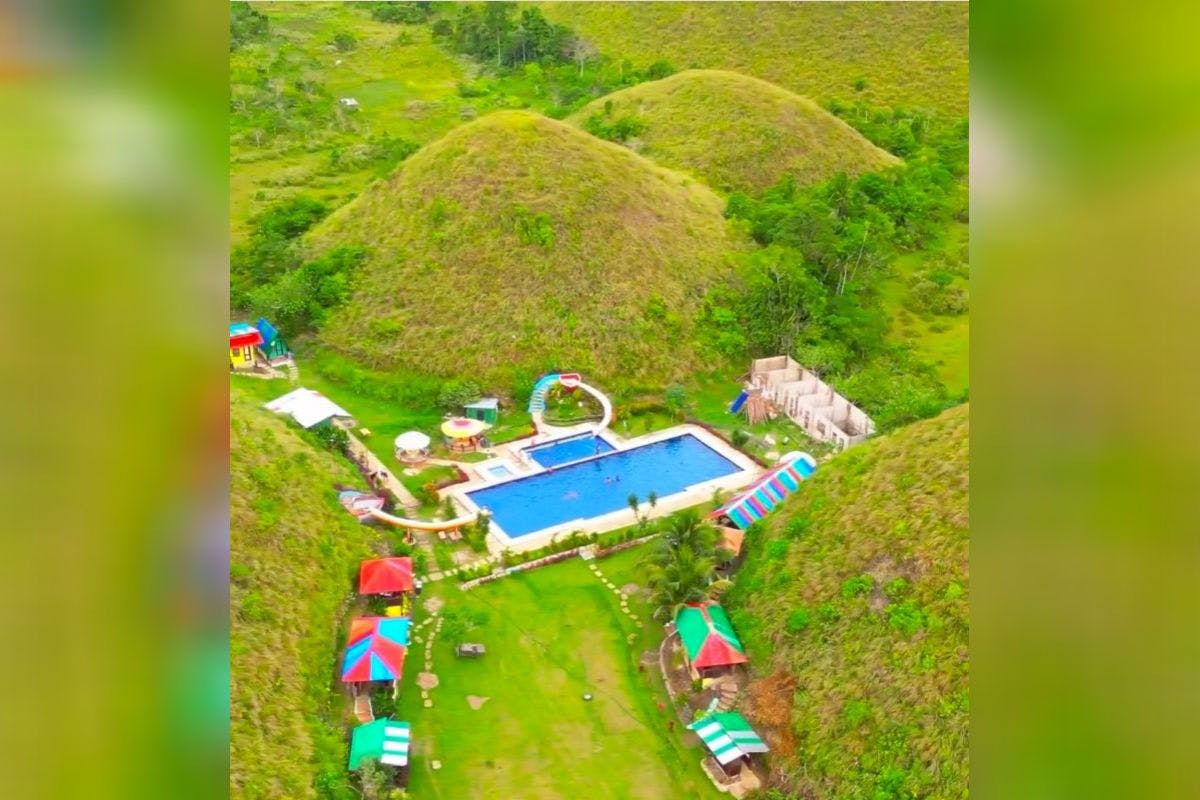
As the controversy over the Chocolate Hills continues to rage, an environmental watchdog has joined the fray, describing as unlawful the policy of the Department on Environment and Natural Resources-Protected Area Management Board (DENR-PAMB) that allows the use of 20 percent of the hills for development.
“This DENR-PAMB resolution allowing the development of up to 20 percent of the Chocolate Hills is illegal as it violates Proclamation No. 1037 issued by then president Fidel V. Ramos in 1997, which established the Chocolate Hills and the areas within, around and surrounding the Chocolate Hills as protected areas,” Tagbilaran Baywatch, a watchdog for sustainable coastal development in province, said in a statement.
The DENR-PAMB in 2018 approved Resolution No. 01, endorsing the proposed Captain’s Peak Garden and Eco-park Tourism Resort in Barangay Canmano in the province’s municipality of Sagbayan.
The resolution provides that “function hall and all other infrastructure should be erected and/or constructed within the 20 percent area from the base of the hill, which is considered as multiple use zone following the sustainable infrastructure design in accordance with the guidelines of DAO 2009-09.”
Tagbilaran Baywatch, which is also responsible for blocking the planned reclamation of the city’s narrow sea channel, said the resolution should be revoked by the DENR-PAMB and demanded the permanent closure and demolition of the structures of the resort.
The group also called for the DENR to initiate legal action to cause the demolition of the structures after the issuance of the cease and desist order.
If legal action is sanctioned and the resort is found to be violating the law, the environmental watchdog urged the imposition of penalties for the resort operating without an environmental compliance certificate (ECC).
Tagbilaran Baywatch likewise said that the prosecution of erring government officials might be in order.
The Chocolate Hills of Bohol was declared as a National Geological Monument on June 18, 1988 by the National Committee on Geological Sciences for its special characteristics, scientific importance, geomorphic uniqueness and high scientific value.
In a CBCP post, Bishop Alberto Uy of the Diocese of Tagbilaran called on the faithful to take “pro-active” steps in safeguarding the environment “through conservation efforts, sustainable practices or advocating for policies that prioritize environmental protection.”
“Together, we can make a meaningful impact and ensure a harmonious coexistence with nature,” Uy said.
In a separate statement, Bohol Gov. Aris Aumentado is contemplating on creating the review and development committee (RedCom) in a bid to screen all public and private development projects within the protected areas prior to their submission to the DENR-PAMB.
The committee will be composed of the provincial tourism council and multi-sectoral representatives.
Aumentado also urged the DENR to do an inventory of all private lands, which will be under the scrutiny of the RedCom.
Another ‘blunder’?
Meanwhile, the DENR and local government unit (LGU) of Sagbayan allegedly committed another blunder, this time in the bulldozed barangay road between the two hills within the Captain’s Peak resort site in Barangay Canmano.
This surfaced during the ocular inspection of the resort sometime last year by members of the provincial board led by Vice Gov. Victor Balite.
Since then, there has been no word about how to resolve the issue since the officials concerned were focused on the questioned amenities, like the swimming pool with water slides carved beside the two hills, where the resort’s titled lot is located.
Sagbayan has offered to restore the allegedly defaced two hills where the barangay road traversed near the resort.
“We are more than willing to restore what has been allegedly and perceived to be defacement of the hills as a result of the LGU’s effort to rehabilitate or repair the old existing barangay road as described above on the basis of a request of Barangay Canmano,” Sagbayan Mayor Restituto Suarez III said in his three-page position paper submitted to the board.
Suarez further explained that the town had “no ulterior motive to deface, alter or mutilate the hills within its territorial jurisdiction,” contrary to malicious newspaper reports.
The mayor said the move to repair the road was prompted since the town tried to reopen the tourism sites that would necessitate improving its services and provide amenities in accordance with the mandate of the national government for economic recovery after the onslaught of the COVID-19 pandemic.
Another reason is that the municipal government has responded to the barangay’s request to repair the road bordering Canmano and Libertad Norte, according to the local chief executive.
To prove that it is an existing barangay, Suarez has provided the Sangguniang Panlalawigan (SP) with the certified copy of cadastral survey No. 959-D on lot No. 3558 and 10 meters wide.
The document indicated that the road repair was only 4.5 meters wide.
The town “has just initially repaired the existing barangay road with 4.5 meters in width only by simply clearing both sides of the existing road and grubbing on it” and it does not mean defacement of the hills, according to Suarez.
Jamie Villamor, the provincial board environment committee chairperson, said she is thinking of crafting legislative measures to lay down the groundwork for such guidelines and forming the technical working group for the purpose of protecting the world-renowned Chocolate Hills.
Another measure that Villamor is planning to propose is an ordinance defining terms, such as “defacement” and other related terms, in determining what is proper in protecting and con-serving the hills.
“The hills should not be altered nor defaced, and extraction is strictly prohibited” was one of the provisions of Resolution No. 01, series of 2018, executed by the DENR-PAMB, governing the Chocolate Hills Natural Monument, for the Captain’s Peak Garden Eco-park Tourism Resort.
Resolution
In a related development, another resolution to seek a probe on the construction of the Captain’s Peak resort has been filed at the House of Representatives.
In filing House Bill No. 1652, authors ACT-CIS party-list representatives Erwin Tulfo, Jocelyn Tulfo and Edvic Yap; Quezon City 2nd District Rep. Ralph Wendel Tulfo and Benguet Rep. Eric Go-Yap asked the House committee on natural resources to do the inquiry.
The lawmakers cited the construction of the resort even without an ECC from the DENR.
“The construction of the Captain’s Peak Garden and Resort raises serious concerns on a possible avenue for the circumvention of laws and issuances on building, business and environmental permits, certifications or licenses in the guise of tourism or economic development,” the resolution stated.
The measure underscored the “utmost need to ensure that Natural Monuments and UNESCO (United Nations Educational, Scientific and Cultural Organization) World Heritage Sites of the Philippines are preserved, maintained and protected at all times against any and all private interests.”
In a statement, Tulfo said “someone should be held liable” for the construction of the resort in Chocolate Hills, which has been recommended by the local UNESCO committee to be declared as a World Heritage Site. This, however, is still under evaluation.
“This is a blatant disrespect of our natural resources. The question here now is who allowed that resort to be constructed in a place that we are supposed to protect. This should really be investigated by the House,” he added.
Party-list lawmakers Raoul Manuel of Kabataan, Arlene Brosas of Gabriela and France Castro of ACT Teachers had earlier filed a resolution to investigate the resort. – With Sheila Crisostomo


