



Online Enrolment In June, Distance Learning By Aug. 24 To Proceed, But Is Everyone Prepared?
Presidential spokesman Harry Roque clarified that only physical or face-to-face classes, not blended learning, will be affected by the lack of a vaccine against coronavirus disease 2019.
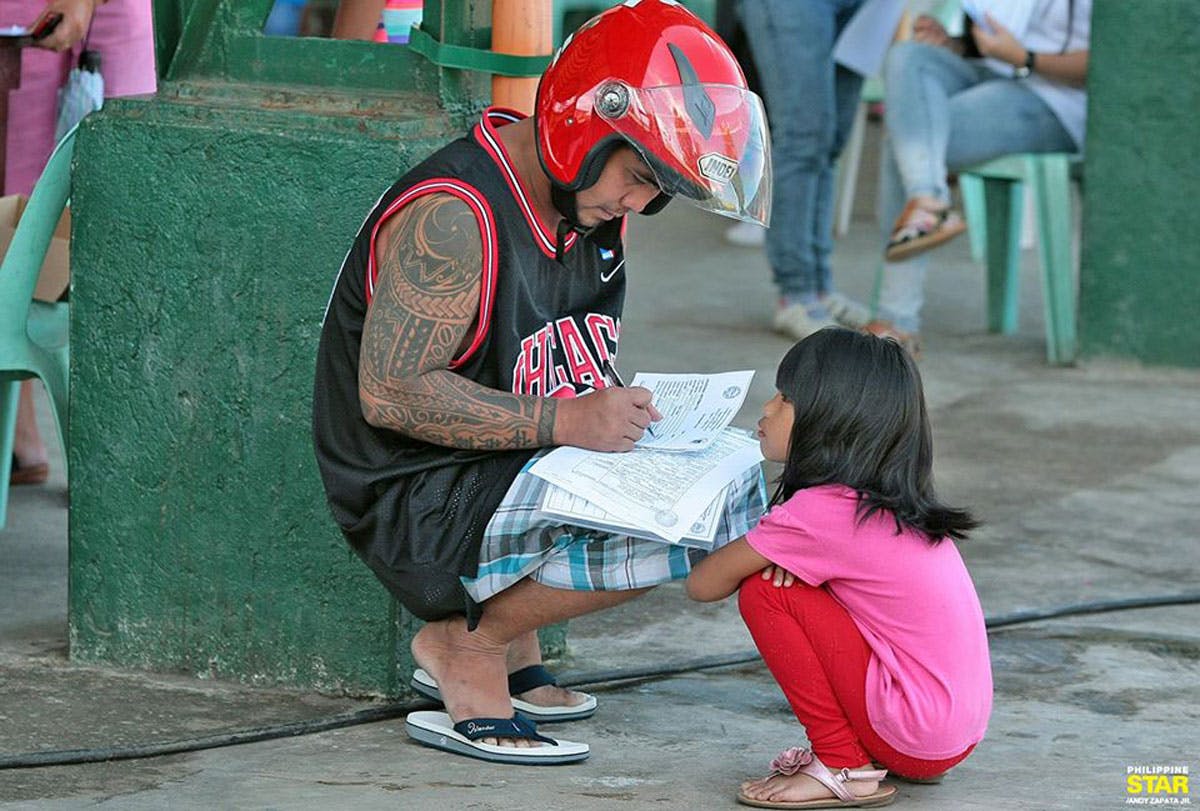
Parents should enroll their children in schools as formal learning will start on Aug. 24 despite quarantine restrictions being implemented to contain the coronavirus disease 2019 (COVID-19) pandemic, according to presidential spokesman Harry Roque.
According to Roque, students should enroll because they have to be assessed on whether they can be promoted to the next educational level.
“What is certain is by Aug. 24, formal learning will resume. What is uncertain is whether or not face-to-face classes will resume. That would really depend on whether we have achieved the new normal. But DepEd (Department of Education) now is preparing for blended learning,” Roque said.
“Enrollment will proceed because whether it be face-to-face or blended, you have to enroll your children, because there has to be a basis for assessing whether or not after one year, your children will progress to the next level,” he told ABS-CBN News Channel.
The DepEd earlier announced that enrolment could be done online but did not say how this could be done by parents and students who have no computers or gadgets as well as access to the internet.
The DepEd has set the opening of classes on Aug. 24. However, confusion arose when President Duterte announced last Monday that classes won’t open until a vaccine against COVID-19 is developed.
The following day, Roque clarified that the President was just referring to face-to-face classes that cannot be held until the country remains under community quarantine. He said schools could resume classes but should adopt blended learning, a combination of face-to-face classes, online sessions, and the use of television and radio.
In a statement on May 5, DepEd said its Learning Continuity Plan (LCP) would be in place by the time school year 2020-2021 opens on Aug. 24. It also released on May 11 the school calendar and calendar of activities for school year 2020-2021 along with the implementing guidelines.
“The LCP is our major response and our commitment in ensuring the health, safety and well-being of our learners, teachers and personnel in the time of COVID-19, while finding ways for education to continue amid the crisis for the upcoming school year,” the agency stated.
It said the opening of classes was delayed to ensure that teachers and students would be given time to be properly equipped to adjust to the new learning environment.
“We have repeatedly consulted and collaborated with our partner institutions and organizations in crafting the LCP, which includes key features on K-12 curriculum adjustments; alignment of learning materials; various modalities of delivery; and corresponding teacher and parent/guardian training for homeschooling. These modifications on certain policies and practices were necessary steps in adapting to the ‘new normal’ while still remaining true to the framework of Sulong EduKalidad and Education Futures,” DepEd noted.
It emphasized that this will not necessarily mean that teachers and students would undergo the traditional in-classroom set-up when classes open in August.
In the LCP, DepEd says the choice and contextualization of the learning delivery modality of schools will depend on the local COVID-19 situation as well as access to certain learning platforms.
“Even as we set policies in the central office, we will primarily consider local public health conditions in adjusting our LCP. Preventive measures will be put in place to secure the health and well-being of our personnel and our learners under this new normal,” DepEd said.
“Access, as we are all aware, is another issue of utmost concern, and we have devised various modalities to ensure that online learning is only one of the options among all others in this new learning environment. Our field units will determine the most appropriate combinations or strategies for every locality as we look into addressing equity concerns of our constituents in this new arrangement,” it added.

Grueling
DepEd said it expects a grueling transition and birth pains, and will need the help and support of all stakeholders to make things work.
Roque reiterated the position of DepEd on Wednesday amid questions on the readiness of all public and private schools to carry online enrolment by next week as well as blended learning.
There is also a pending bill before the Senate seeking to delay the school opening until September, not only because of the risks posed by physical or face-to-classes but also due to the lack of internet access especially among students from marginalized families.
With less than a week to go before June 1, the Alliance of Concerned Teachers (ACT) Philippines also raised concerns on what it described as unclear and inadequate guidelines regarding the school opening, leaving teachers in limbo.
The group cited the President’s “no vaccine, no classes” pronouncement, followed by Roque’s clarification that only face-to-face classes would be prohibited. The DepEd has yet to respond to the conflicting statements, while the Commission on Higher Education said it shared Duterte’s sentiments, hence the “rolling of class opening” with flexible modes.
“Government discord a few days before we’re set to return to work leaves us in a restless limbo, adding to our anxiety caused by the still uncontained COVID-19. Officials’ conflicting statements make it clear that the country is not actually ready to open schools. As such, we fear that the unpreparedness and premature decisions may put to risk the lives of teachers, staff and parents,” ACT secretary general Raymond Basilio said.
Pending DepEd’s clarifications, ACT noted that public school teachers and staff anticipate their return to work on June 1. However, the group stressed that DepEd has not resolved several pressing concerns publicly raised by teachers, particularly concerning the circumstances that are likely to compel them to work on-site despite the lack of mass testing.
These circumstances include teachers’ lack of laptops and internet connection, and enrollment procedures for students and parents without internet and computer access.
“These are the realities on the ground. With DepEd’s lack of clear guidelines, arrangements, and provision of requisites to make virtual reporting possible, the agency may be putting teachers in harm’s way amid a still uncontained pandemic. Likewise, parents and students’ who will have to enroll on-site also risk contracting and spreading the virus. What is the government’s plan on these very real and dangerous possibilities?” Basilio pointed out.
Basilio said that DepEd’s claim of giving primacy to the health and safety of education workers and students amounted to “nothing but mere lip service, without anything to show for it.”
The group added that other concerns also need immediate attention such as the transportation options for school workers. Earlier, ACT issued a five-point requisite before school opening for employees and students – even if only 15 to 20 learners will be allowed in a classroom if physical classes are allowed. The group wants to see a significant headway in the fight against COVID-19, safe schools, accessible and quality education, respect for labor rights, and democratic consultations.
“DepEd has yet to respond to these demands. So far, all we’ve got from DepEd officials are exasperated reiterations of the contents of their questionable, vague, and quite frankly, unviable and out-of-touch learning continuity plan. If teachers and staff are unable to render service on June 1, DepEd (officials have) no one to blame but themselves for their failure to address the requisites for such,” ACT said.
“And for those of us who will brave the dangers of reporting on June 1, the government shall be responsible for our health and safety, as well as that of our families and our students,” Basilio declared.
DOH backs ‘no vaccine, no face-to-face classes’
The Department of Health (DOH) has expressed support for the position of Duterte that face-to-face classes should be allowed only when a vaccine for the coronavirus disease 2019 or COVID-19 becomes available.
“We would like to reiterate the position of the DOH, that face-to-face classes should remain suspended while we still don’t have a vaccine,” Health Undersecretary Maria Rosario Vergeire said in a press briefing Wednesday afternoon.
She made the statement a day after DOH Secretary Francisco Duque III issued varying positions on the school opening.
During a Senate hearing on Tuesday, May 26, Duque said it is safe to open classes on Aug. 24 provided that minimum health standards are followed.
He later clarified that he supported the President’s position to suspend face-to-face classes until a vaccine against COVID-19 becomes available.
In explaining the DOH position, Vergeire noted the difficulty in ensuring physical distancing in all parts of the campus, which is part of the minimum health standards requirement.
“The health and safety of every student would be ensured if they would remain at home while the teachers are finding ways to implement flexible alternative learning methods,” she said in Filipino.
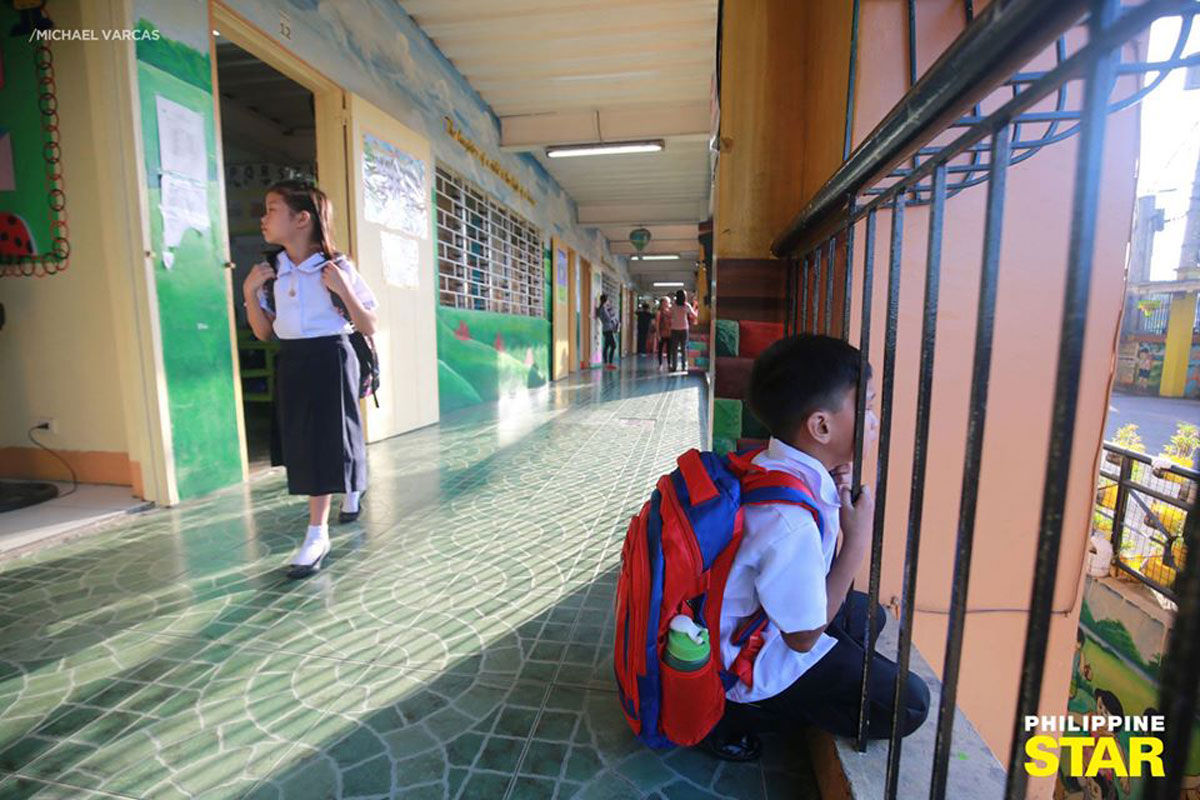
During the DOH press conference, DepEd Undersecretary for curriculum and instruction Diosdado San Antonio said they have prepared different learning modalities to take into account the risks of the pandemic.
He said face-to-face classes with physical distancing would be conducted if the DOH and the Inter-Agency Task Force for the Management of Emerging Infectious Diseases would allow teachers and students to go to schools.
“This may be possible in areas where teachers and students would be allowed to go to schools because there are only few COVID cases. But we will observe social distancing,” he said in Filipino.
In such cases, San Antonio said classes would be divided and students would be required to go to schools only on certain days. They would have to study at home for the rest of the week.
San Antonio said they have prepared other learning modalities, such as distance learning that uses the internet, television or radio to deliver educational content to children.
For those without access to gadgets, he said they are also preparing printed materials that would be delivered to the homes of students.
Easy to cancel
In a separate interview on Wednesday, Roque said schools could push through with their plan to start the enrollment on Monday.
“It’s easy to cancel depending on the situation... Even if it’s blended learning, we need to have a basis for promoting students to the next grade,” he told radio station dzRH.
The DepEd, Roque said, should also prepare for the influx of students to provinces with lower coronavirus risks compared to Metro Manila.
“We can’t blame parents (if they enroll their children in the provinces) because of the lower risks. And we encourage our countrymen to return to the provinces,” he said.
According to Roque, the restrictions on face-to-face classes are intended to protect students from the risks posed by the virus, which has so far infected more than 14,000 people in the country.
“The President is correct: we will never... expose our children to any form of danger. So it’s been very clear, although we are preparing for Aug. 24 opening – that is actually based on the assumption that it will be safe to do so for the children,” Roque said. “Because for as long as there is a community quarantine, schools will remain shut. So in other words, the assumption is by Aug. 24, we would be under a new normal... that’s why we’d have to prepare.”
Roque said the use of blended learning acknowledges the reality that not all students have access to the internet.
“So in addition to online learning, we will be tapping community radio stations, community TV stations, PTV-4 and even private companies such as ABS-CBN for instructional purposes,” he said.
Broadcasting giant ABS-CBN has been off the air since May 5 because of a cease and desist order issued by the National Telecommunications Commission. Its franchise expired last May 4 without the House of Representatives acting on bills for its renewal.
“This (blended learning) is a bold move on the part of the Department of Education. We have not done it on this scale, but we have to adopt with the times, in the same way that media has adopted to the times – that we’re now both broadcasting from our homes,” Roque noted.
He said private institutions with small numbers of students per section could seek accreditation from DepEd to hold face-to-face learning.
“In fact, they may have (to hold) small meetings just for assessment purposes or for enforcement purposes,” he said. “We can be creative about it and I think there are alternative learning specialists. Now, if you’re asking about special schools, I think it’s a matter of getting accreditation from DepEd. If it’s special learning, which really has about only about 15 students, I see no reason or obstacle for the DepEd not to allow it.”


