



In 2018, SC Ruled Filing Of Cyber Libel Can Be Done Within 15 Years. But Is This Binding?
The Supreme Court has tackled the relatively new Cybercrime Prevention Act of 2012 in only a handful of cases, and lawyers have differing views on a 2018 resolution declaring a 15-year prescriptive period for libel.

The Supreme Court has mentioned the relatively new Cybercrime Prevention Act of 2012 in only a handful of cases.
In 2018, it held that the time limit for an offended person to file a cyberlibel case is 15 years – but it did so in an “unsigned resolution” that may not be a binding precedent and part of case law.
The June 15 conviction of Rappler executive editor Maria Ressa and former writer- researcher Reynaldo Santos Jr., renewed attention to the law, Republic Act No. 10175, the constitutionality of which was partially upheld by the SC in its Feb. 18, 2014 en banc decision on Disini versus Secretary of Justice.
One of the biggest sticking issues in Rappler’s case is prescription, or the time limit for the filing of a complaint counted from the discovery of the crime.
The case concerned Rappler’s May 29, 2012 article that cited a purported intelligence report “prepared in 2002” that supposedly talked about businessman Wilfredo Keng’s “alleged involvement in illegal activities, namely ‘human trafficking and drug smuggling.’”
On Feb. 19, 2014, the article was edited to correct one misspelling – the phrase “tax evation” in the 28th paragraph was changed to “tax evasion.”
Keng filed the complaint before the National Bureau of Investigation in October 2017, several years after the publication and correction of the article. Keng argued that he first tried to ask Rappler to take down the article and send a reporter to air his side of the story before he decided to file a case. He complained that Rappler did not publish his side or take down the article.
DOJ’s 12-year prescription theory
In order to charge Ressa and Santos, the Department of Justice applied the pre-war Act No. 3326 to extend the prescription period to 12 years. It argued that because the Cybercrime Prevention Act of 2012 was silent on the prescription period for cyberlibel, the general rule on special laws should apply.
Act No. 3326 provides for a 12-year prescription period for offenses under special laws that are punishable by more than six years’ imprisonment.
Prosecutors applied this for cyber libel, which is punishable by prision correccional in its maximum period to prision mayor in its minimum period.
This is equivalent to imprisonment of four years, two months and one day up to a maximum of eight years. (In general, the penalties for cybercrimes, including cyber libel, are higher by one degree than that for similar crimes when they are not committed through electronic means.)
Manila Regional Trial Court (RTC) Branch 46 Judge Rainelda Estacio-Montesa upheld the prosecution’s position. The judge considered cyber libel to be “an offense separate and distinct” from ordinary libel under the Revised Penal Code (RPC).
By applying a 12-year period, Keng would still have until the mid-2020s to file his complaint in relation to an article published in 2012 or “re-published” through the update in 2014.
The court disagreed with the contention of Free Legal Assistance Group regional coordinator Theodore Te, who led Rappler’s defense, that cyber libel is the same crime as ordinary libel.
Under the RPC, as amended by RA 4661, the crime of “libel or other similar offenses” shall prescribe in one year. Te’s argument was hinged on the SC’s pronouncement in its Disini decision that cybercrime is “not a new crime but is one already punished” under the RPC.

SC’s Tolentino resolution
Caloocan City Metropolitan Trial Court Branch 83 Judge Marlo Campanilla, however, pointed out that the SC had the opportunity in 2018 to discuss how long an offended person can wait before filing a complaint regarding an online post.
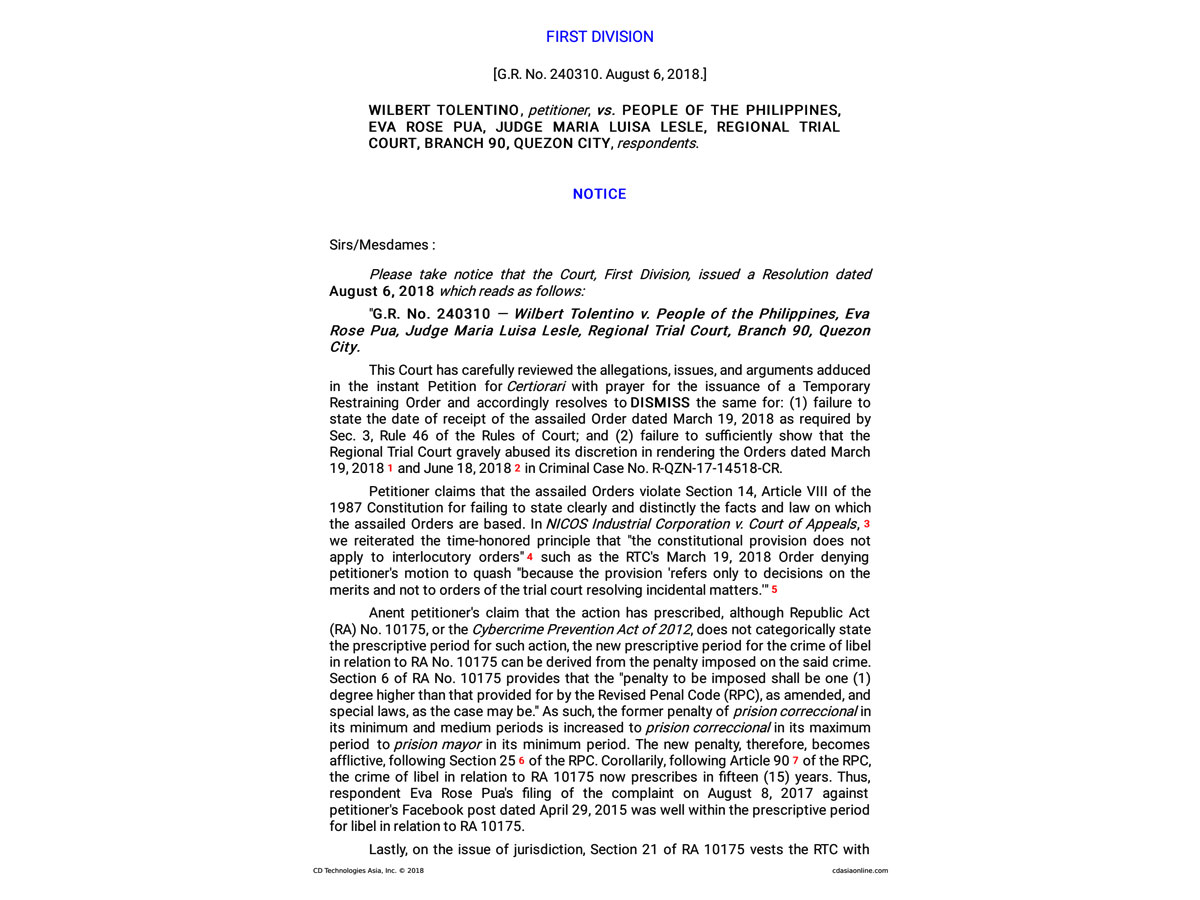
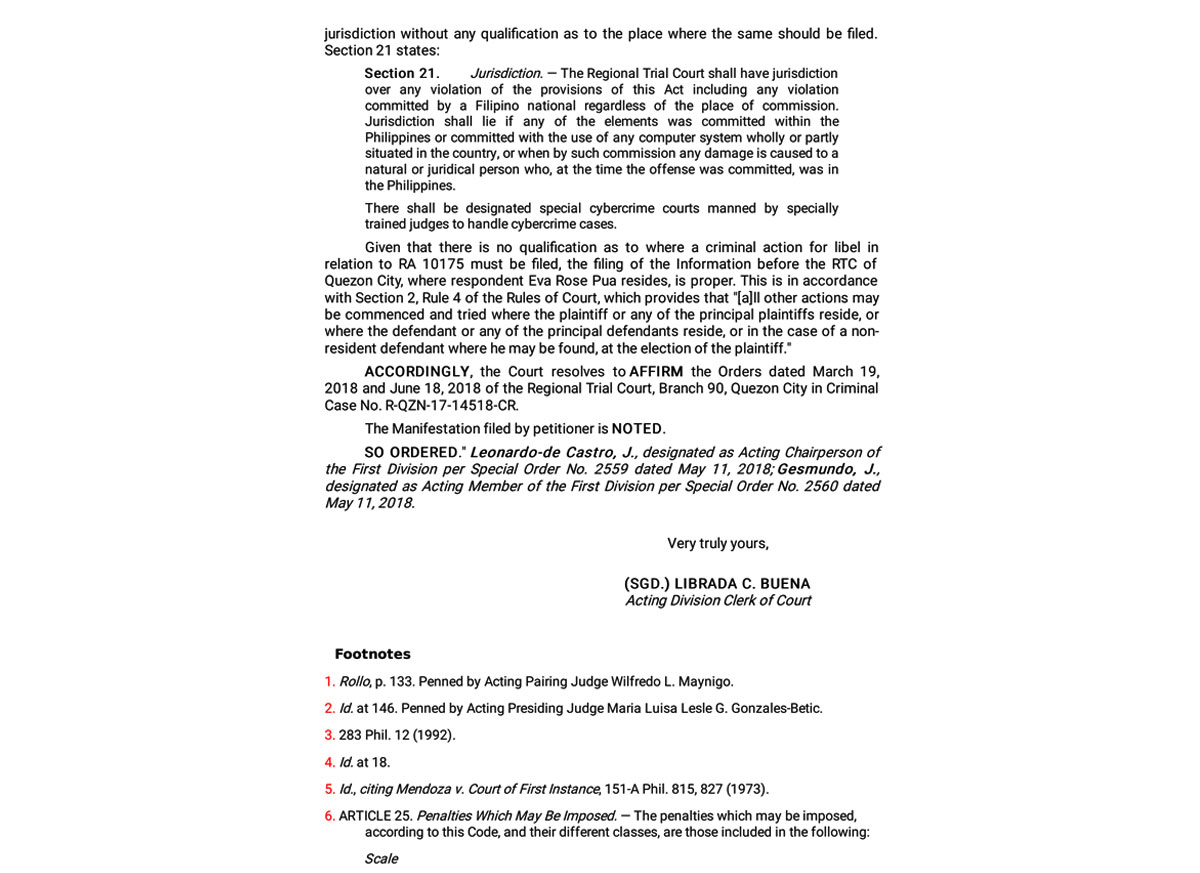
Campanilla, an author of criminal law review books, cited the SC First Division’s Aug. 6, 2018 unsigned resolution on the case of Tolentino versus People. A search of available records showed that this was the only time that the SC discussed the issue thus far.
The case concerned Wilbert Tolentino’s Facebook posts on April 29, 2015, which accused ERP Wellness Enterprises owner Eva Rose Pua of selling bogus products and shortchanging him by giving fewer tablets than he ordered.
Pua claimed to have found out about the posts only in April 2017, or two years after the posts were made. She filed a cyber libel case and the Quezon City RTC Branch 90, in a March 19, 2018 order, denied Tolentino’s motion to quash the case.
Tolentino’s appeal eventually reached the SC, where he argued that the prescription period was only one year. But the First Division affirmed the Quezon City RTC’s order.
The SC said that because the Cybercrime Prevention Act did not explicitly provide for the prescription period, it should be based on the penalty.
But the SC used a different basis. Instead of Act No. 3326 applied by prosecutors and the Manila court in the Rappler case, the SC used the RPC itself.
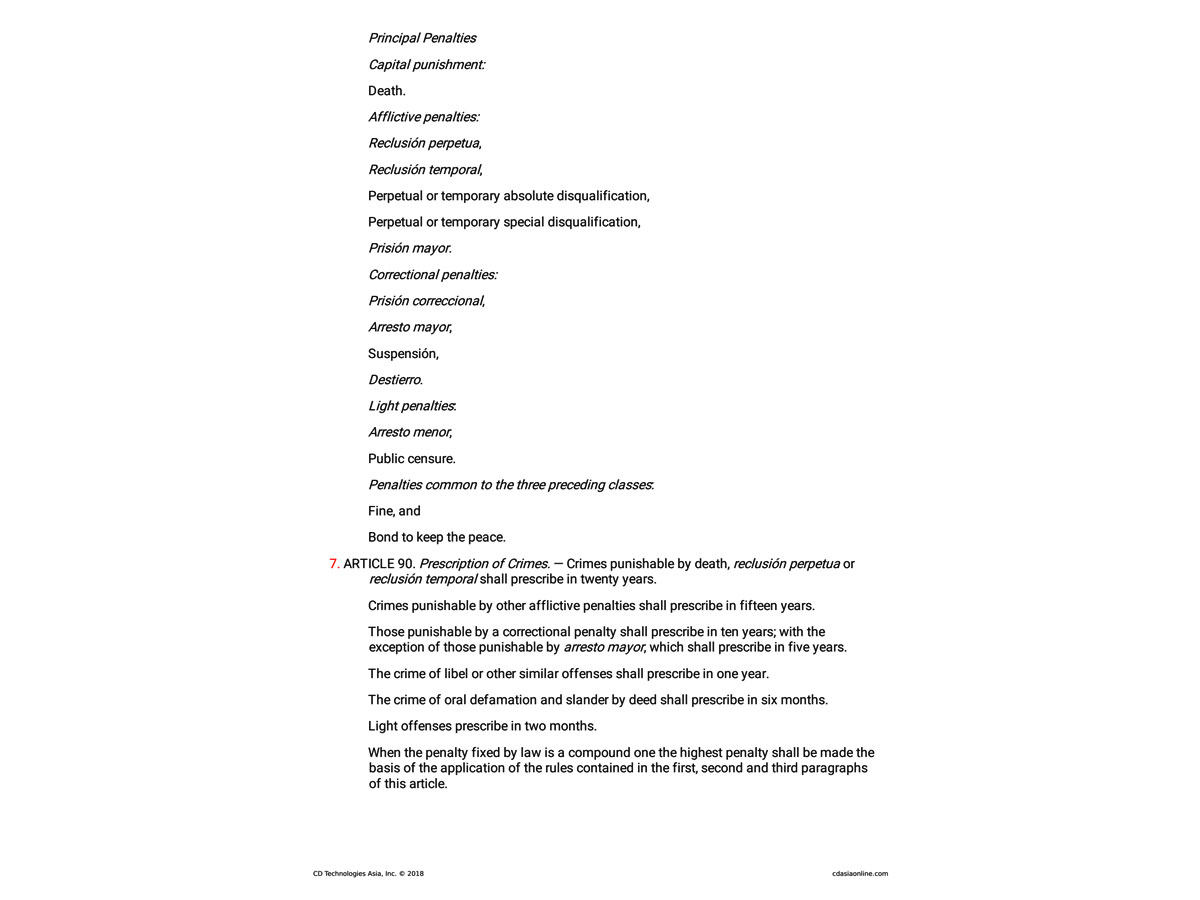
The maximum penalty for cyberlibel is prision mayor in its minimum period (or eight years’ imprisonment). This is called an “afflictive” penalty under Article 25 of the RPC.
Following Article 90 of the RPC, the prescription period for crimes punishable by afflictive penalties is 15 years – although, again, the very same section provides for a one-year period for libel.
The SC, in this resolution, did not mention if it was treating cyber libel as a different crime from ordinary libel. It did not even include the Disini case among its citations.
The unsigned resolution was signed by First Division Clerk of Court Librada Buena, not any of the five justices who composed the First Division at the time – Associate Justices Teresita Leonardo-de Castro (who later became chief justice), Mariano del Castillo, Francis Jardeleza, Noel Tijam and Alexander Gesmundo.
The SC’s resolution allowed the case against Tolentino to proceed to trial. But unlike Ressa and Santos, Tolentino ended up being acquitted in a Sept. 27, 2019 decision, according to defense lawyer Berteni Causing. The trial court found that it was not enough that Tolentino used offensive language against Pua.
Gesmundo is currently the only member of the division that tackled Tolentino’s case who has not yet retired – and can still participate in a future case where the prescription issue may be raised again.

Unsigned resolution
Does it matter then that the SC’s pronouncement of a 15-year prescription period was made in an unsigned resolution?
Caloocan City prosecutor Darwin Cañete – known for his June 12, 2017 Facebook post that compared the “yellows” or the political opposition and its supporters to “cockroaches” and said “you kill them” – lashed out at the “apologists relying on technicalities to put Ressa off the hook” and claimed the Tolentino resolution was a “precedent.”
“Basahin niyo may precedent na. May ruling na Supreme Court sa prescription period on cyber libel. 2018 pa you f***ing moron (Read it, there is precedent already. The Supreme Court already has a ruling on the prescription period on cyber libel. As early as 2018, you f***ing moron),” Cañete said.
Lawyer Manuel Rodriguez II said Cañete’s remarks were “wrong” and the Tolentino resolution was inapplicable in other cases because “it is not a ‘decision.’ ”
He pointed out that Rule 13 of the Internal Rules of the SC provides that unsigned resolutions are “essentially meaningful only to the parties” and have “no significant doctrinal value.” Thus, they are of “minimal interest to the law profession, the academe or the public.”
Meanwhile, Article 8 of the Civil Code states that “judicial decisions applying or interpreting the laws or the Constitution shall form a part of the legal system of the Philippines.”
“It said decisions… judicial decisions. Not orders. Not writs. Not resolutions,” Rodriguez said. “When can a mere resolution become part of the ‘law of the land?’ Only when the Supreme Court itself referenced to it in an actual decision.”
Rodriguez said this meant that the Tolentino resolution was “binding only between the parties involved and cannot be used as a ‘case law.’ ”
He noted that not even the state prosecutors or Judge Montesa used the Tolentino resolution to justify entertaining Keng’s complaint.
“It cannot be cited as a source of legal authority by any lawyer to a proceeding or by a lower court judge in his or her official decisions,” Rodriguez stressed.
Far Eastern University Institute of Law dean Mel Sta. Maria, host of One PH public affairs show Relasyon, agreed with Rodriguez’s opinion.
Even if the Tolentino resolution was considered a binding precedent, Sta. Maria argued that “decisions interpreting a law only apply prospectively.” This could not be done in the Rappler case because the article was published in 2012 and updated in 2014, long before the resolution was issued in 2018.
Campanilla, on the other hand, declined to discuss the Tolentino resolution directly in the context of Rappler’s case.
But he argued that the phrase “no significant doctrinal value” under the rules “does not mean that legal finding of the Supreme Court in an unsigned resolution has no doctrinal value at all.”
“In my honest interpretation, the lower courts are still bound to follow the doctrine in an unsigned resolution such as that enunciated in the Tolentino case,” Campanilla said, as he recommended that those taking the Bar examinations should still study it.
There is another way to break the impasse – through Congress.
Cagayan de Oro City 2nd District Rep. Rufus Rodriguez sought to “put to rest the issue of prescription of the crime of cyberlibel” by filing House Bill No. 7010, which would specify a one-year period.


