



'Great Day For Humanity': Pfizer, BioNTech Say Their COVID-19 Vaccine Is Over 90 Percent Effective
Pfizer Inc. and German partner BioNTech SE are the first drugmakers to release successful data from a large-scale clinical trial of a coronavirus vaccine. The companies said they have so far found no serious safety concerns.
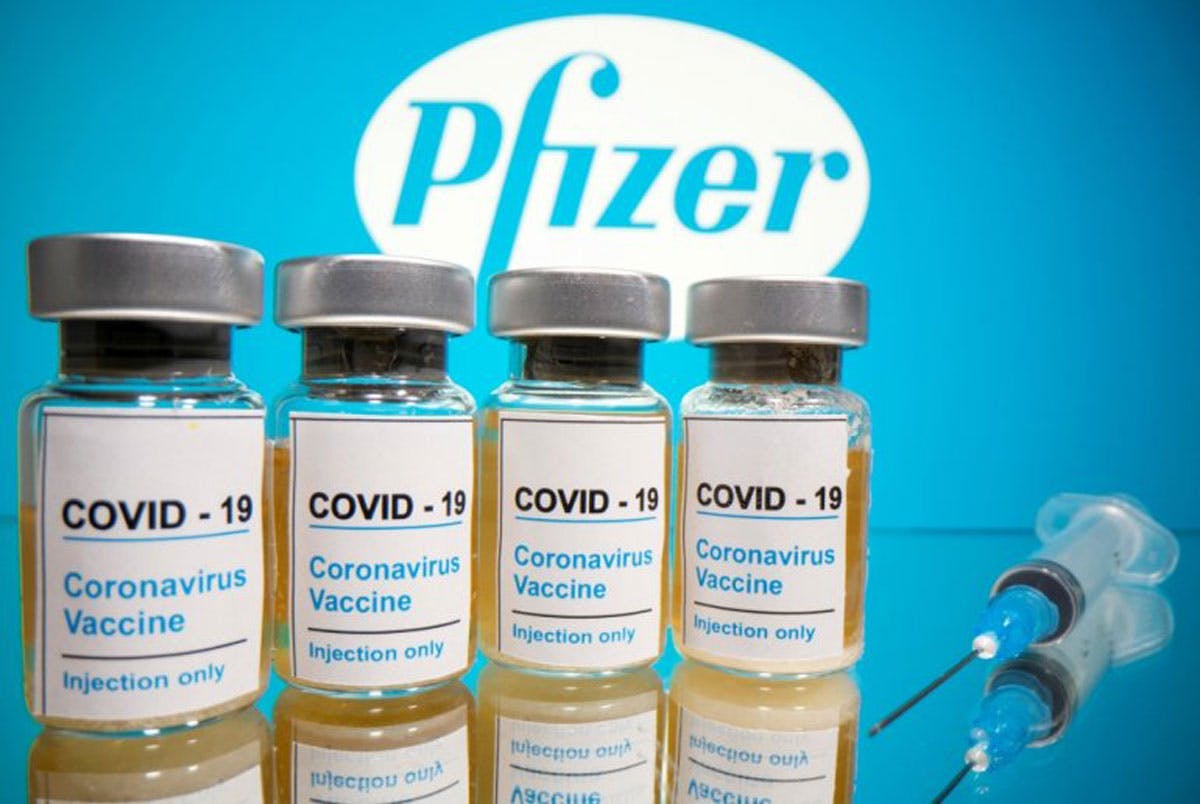
Pfizer Inc. said on Monday, Nov. 9, its experimental vaccine for coronavirus disease 2019 (COVID-19) was more than 90 percent effective, a major victory in the fight against a pandemic that has killed more than a million people, battered the world's economy and upended daily life.
Pfizer and German partner BioNTech SE are the first drugmakers to release successful data from a large-scale clinical trial of a coronavirus vaccine. The companies said they have so far found no serious safety concerns and expect to seek United States authorization this month for emergency use of the vaccine.
Health experts said Pfizer’s results were positive for all COVID-19 vaccines currently in development since they show the shots are going after the right target and are a proof of concept that the disease can be halted with vaccination.
“Today is a great day for science and humanity,” Albert Bourla, Pfizer’s chairman and chief executive, said.
“We are reaching this critical milestone in our vaccine development program at a time when the world needs it most with infection rates setting new records, hospitals nearing over-capacity and economies struggling to reopen.”
If Pfizer’s vaccine is authorized, the number of doses will initially be limited and many questions remain, including how long the vaccine will provide protection.
BioNTech chief executive officer Ugur Sahin told Reuters he was optimistic the immunization effect of the vaccine would last for a year although that was not certain yet.
“This news made me smile from ear to ear. It is a relief to see such positive results on this vaccine and bodes well for COVID-19 vaccines in general,” said Peter Horby, professor of emerging infectious diseases at the University of Oxford.
Markets surge
The prospect of a vaccine electrified world markets with S&P 500 futures hitting a record high and tourism and travel shares surging. Shares of companies that have benefited from pandemic-related lockdowns dropped including conferencing platform Zoom Video Communications, which was down 12 percent in premarket trading.
Pfizer shares were indicated 14.2 percent higher in pre-market trading in New York, while BioNTech’s stock was up nearly 23 percent in Frankfurt.
“Light at the end of the tunnel. Let’s just hope the vaccine deniers won’t get in the way, but 2021 just got a lot brighter,” said Neil Wilson, chief market analyst at Markets.com
Shares of other vaccine developers in the final stage of testing also rose with Johnson & Johnson up four percent in pre-market trading and Moderna 7.4 percent stronger. Britain's AstraZeneca was down 0.5 percent.
“The efficacy data are really impressive. This is better than most of us anticipated,” said William Schaffner, infectious diseases expert at Vanderbilt University School of Medicine, Nashville, Tennessee. “The study isn’t completed yet, but nonetheless the data look very solid.”
US President Donald Trump welcomed the test results, and the market boost: “STOCK MARKET UP BIG, VACCINE COMING SOON. REPORT 90% EFFECTIVE. SUCH GREAT NEWS!” he said on Twitter.
President-elect Joe Biden said the news was excellent but did not change the fact that face masks, social distancing and other health measures would be needed well into next year.
1.3 billion doses
Pfizer expects to seek broad US authorization for emergency use of the vaccine for people aged 16 to 85. To do so, it will need two months of safety data from about half the study’s 44,000 participants, which is expected late this month.
“I’m near ecstatic,” Bill Gruber, one of Pfizer’s top vaccine scientists, said in an interview. “This is a great day for public health and for the potential to get us all out of the circumstances we’re now in.”
Pfizer and BioNTech have a $1.95 billion contract with the US government to deliver 100 million vaccine doses beginning this year. They have also reached supply agreements with the European Union, the United Kingdom, Canada and Japan.
To save time, the companies began manufacturing the vaccine before they knew whether it would be effective. They now expect to produce up to 50 million doses, or enough to protect 25 million people this year.
Pfizer said it expects to produce up to 1.3 billion doses of the vaccine in 2021.
The US pharmaceutical giant said the interim analysis was conducted after 94 participants in the trial developed COVID-19, examining how many of them had received the vaccine versus a placebo.
The company did not break down exactly how many of those who fell ill received the vaccine. Still, over 90 percent effectiveness implies that no more than eight of the 94 people who caught COVID-19 had been given the vaccine, which was administered in two shots about three weeks apart.
The efficacy rate is well above the 50 percent effectiveness required by the US Food and Drug Administration for a coronavirus vaccine.
More data needed
To confirm the efficacy rate, Pfizer said it would continue the trial until there are 164 COVID-19 cases among participants. Bourla told CNBC on Monday that based on rising infection rates, the trial could be completed before the end of November.
The data have yet to be peer-reviewed or published in a medical journal. Pfizer said it would do so once it has results from the entire trial.
“These are interesting first signals, but again they are only communicated in press releases,” said Marylyn Addo, head of tropical medicine at the University Medical Center Hamburg-Eppendorf in Germany.
“Primary data are not yet available and a peer-reviewed publication is still pending. We still have to wait for the exact data before we can make a final assessment.”
The global race for a vaccine has seen wealthier countries forge multibillion-dollar supply deals with drugmakers like Pfizer, AstraZeneca Plc and Johnson & Johnson, raising questions over when middle income and poorer nations will get access to inoculations.
The US quest for a vaccine has been the Trump administration’s central response to the pandemic. The US has the world’s highest known number of COVID-19 cases and deaths with more than 10 million infections and over 237,000 fatalities.
Trump repeatedly assured the public that his administration would likely identify a successful vaccine in time for the presidential election, held last Tuesday. On Saturday, Democratic rival Biden was declared the winner.
Essential tools
Vaccines are seen as essential tools to help end the health crisis that has shuttered businesses and left millions out of work. Millions of children whose schools were closed in March remain in remote learning programs.
Dozens of drugmakers and research groups around the globe have been racing to develop vaccines against COVID-19, which on Sunday, Nov. 8, exceeded 50 million infections since the new coronavirus first emerged late last year in China.
The Pfizer and BioNTech vaccine uses messenger RNA (mRNA) technology, which relies on synthetic genes that can be generated and manufactured in weeks, and produced at scale more rapidly than conventional vaccines.
Moderna Inc., whose vaccine candidate employs similar technology, is expected to report results from its large-scale trial later this month.
The mRNA technology is designed to trigger an immune response without using pathogens, such as actual virus particles.
Pfizer alone will not have the capacity to immediately provide enough vaccines for the United States. The Trump administration has said it will have enough supply for all of the 330 million U.S. residents who wish to be vaccinated by the middle of 2021.
The US government has said the vaccines will be provided free to Americans, including the insured, uninsured and those in government health programs such as Medicare.
Behind Pfizer's vaccine, an understated husband-and-wife ‘dream team’
FRANKFURT – Positive data on Pfizer and BioNTech’s COVID-19 vaccine is an unlikely success for the married couple behind the German biotech firm, who have devoted their lives to harnessing the immune system against cancer.
From humble roots as the son of a Turkish immigrant working at a Ford factory in Cologne, Sahin, 55, now figures among the 100 richest Germans, together with his wife and fellow board member Oezlem Tuereci, 53, according to weekly Welt am Sonntag.
The market value of Nasdaq-listed BioNTech, which the pair co-founded, had ballooned to $21 billion as of Friday’s close from $4.6 billion a year ago, with the firm set to play a major role in mass immunization against the coronavirus.
“Despite his achievements, he never changed from being incredibly humble and personable,” said Matthias Kromayer, board member of venture capital firm MIG AG, whose funds have backed BioNTech since its inception in 2008.
He added Sahin would typically walk into business meetings wearing jeans and carrying his signature bicycle helmet and backpack with him.
Doggedly pursuing his childhood dream of studying medicine and becoming a physician, Sahin worked at teaching hospitals in Cologne and the southwestern city of Homburg, where he met Tuereci during his early academic career.
Medical research and oncology became a shared passion.
Tuereci, the daughter of a Turkish physician who had migrated to Germany, said in a media interview that even on the day of their wedding, both made time for laboratory work.
Together they honed in on the immune system as a potential ally in the fight against cancer and tried to address the unique genetic makeup of each tumor.
Life as entrepreneurs started in 2001 when they set up Ganymed Pharmaceuticals to develop cancer-fighting antibodies, but Sahin – by then a professor at Mainz university – never gave up academic research and teaching.
They won funding from MIG AG as well as from Thomas and Andreas Struengmann, who sold their generic drugs business Hexal to Novartis in 2005.
That venture was sold to Japan’s Astellas in 2016 for up to $1.4 billion. By then, the team behind Ganymed was already busy building BioNTech, founded in 2008, to pursue a much broader range of cancer immunotherapy tools.
That included mRNA, a versatile messenger substance to send genetic instructions into cells.
Dream team
For MIG’s Kromayer, Tuereci and Sahin are a “dream team” in that they reconciled their visions with the constraints of reality.
The BioNTech story took a twist when Sahin in January came across a scientific paper on a new coronavirus outbreak in the Chinese city of Wuhan and it struck him how small the step was from anti-cancer mRNA drugs to mRNA-based viral vaccines.
BioNTech quickly assigned about 500 staff to project “light speed” to work on several possible compounds, winning pharmaceutical giant Pfizer and Chinese drugmaker Fosun as partners in March.
Matthias Theobald, a fellow oncology professor at Mainz university who has worked with Sahin for 20 years, said his tendency towards understatement belies a relentless ambition to transform medicine, exemplified by the leap of faith to a COVID-19 vaccine.
“He is a very modest and humble person. Appearances mean little to him. But he wants to create the structures that allow him to realize his visions and that’s where is aspirations are far from modest,” Theobald said.
Sahin told Reuters on Monday the read-out amounted to an “extraordinary success rate” but that he did not know earlier in the year how difficult the task overall would be.
“It’s certainly not something that you would easily voice as a serious scientist, but it was within the realms of possibility from the beginning.”