



Farewell, Noynoy
“No words can express how broken our hearts are and how long it will take for us to accept the reality that he is gone. Mission accomplished ka, Noy, be happy now with Dad and Mom,” the sisters of the late president Benigno “Noynoy” Aquino III said.
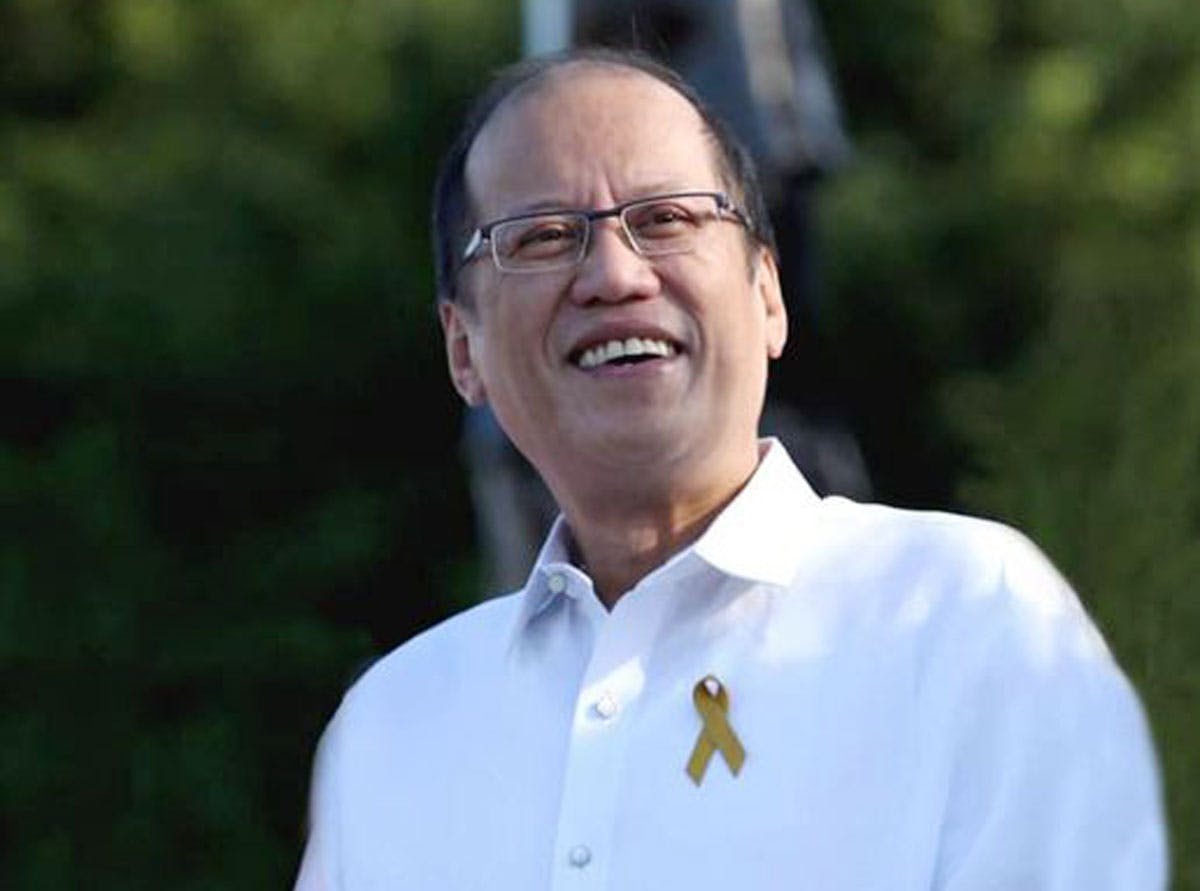
“Mission accomplished ka, Noy.”
With that tearful cheer, the Aquino sisters bade farewell on Thursday, June 24, to their only brother, former president Benigno Simeon “Noynoy” Aquino III, whom they fondly called “Noy.”
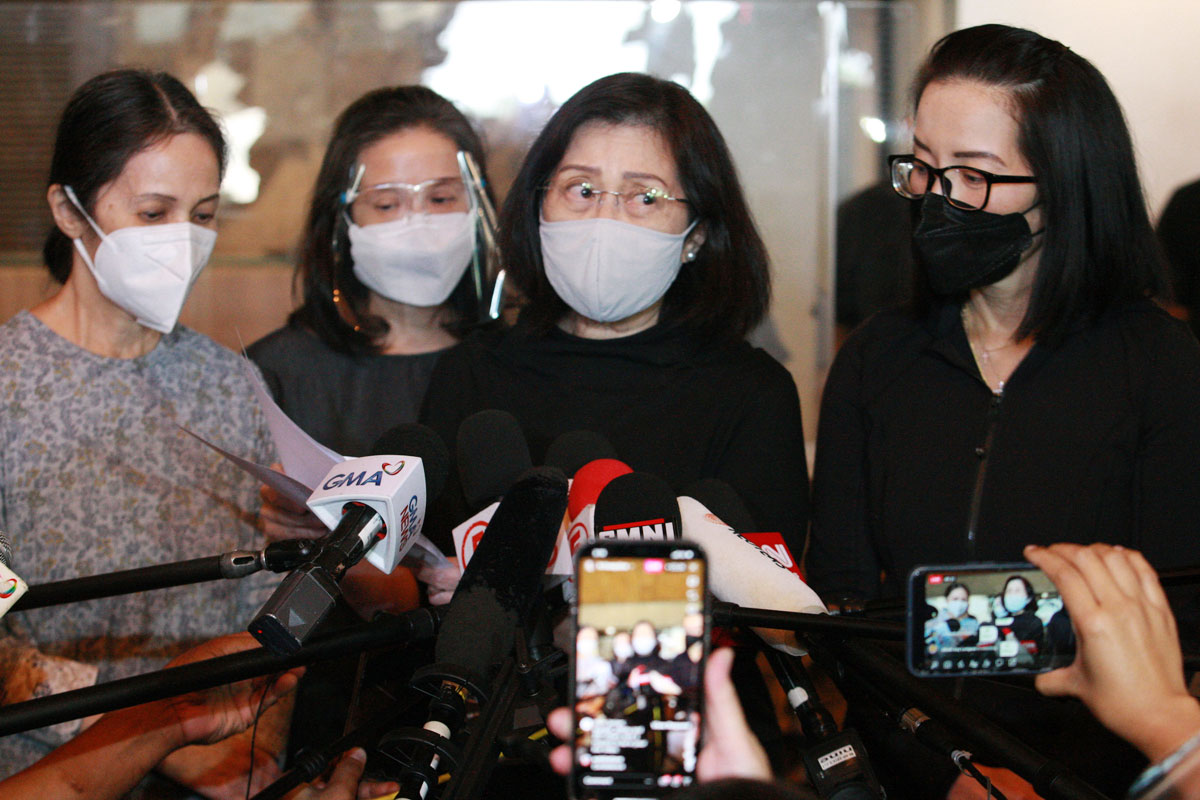
The sisters, in a statement read by Pinky Aquino-Abellada, said the former president “died peacefully in his sleep.”
“Be happy with Dad and Mom,” added Abellada, who read the family’s statement Thursday afternoon in front of the Heritage Memorial Park in Taguig, where their brother lay in state. He was pronounced dead at 6:30 a.m. due to “renal disease secondary to diabetes.”
With Abellada were sisters Ballsy Aquino-Cruz, Viel Aquino-Dee and Kris Aquino.
“My brother is in a happier place now,” Viel Dee, for her part, said in a text message.
The late former president, a bachelor, was the son of the late democracy icons senator Benigno Aquino Jr. and former president Corazon Aquino. He had been undergoing dialysis and was reportedly being prepared for a kidney transplant.
Sources close to the family said he had died at home before he was rushed to the hospital, in the modest Times Street house where he lived after his presidency and where his father lay in repose after being assassinated on Aug. 21, 1983.
As Noynoy Aquino had chosen to bear his detractors’ allegations, so did he choose to battle his illness – quietly.
“Kagaya ng serbisyong binigay niya sa bayan, hindi maingay, trabahong galing sa puso, dahil alam niyang kayo ang ‘boss’ niya, kaya nga nakilala sya bilang si PNoy (President Noy). Ayaw nyang maramdaman na kailangan siyang bigyan ng kakaibang pansin (Like the kind of service he gave the nation – devoid of noise, service from the heart – because he knew you were his ‘boss,’ and that is why he was known as PNoy. He never felt he deserved extra attention,” Abellada said on behalf of her family.
Abellada said it hurt the family to see their only brother quietly bear the criticisms against him after his presidency. They often urged him to fight back, she added.
But their brother’s response was simple and solid: “‘Kaya pa niyang matulog sa gabi (He could still sleep soundly at night).”
The former president was diagnosed with diabetes in December 2019. At the time, news spread that he had a heart attack and was in the intensive care unit of the Makati Medical Center in Makati City. He indeed found himself inside the ICU because he passed out in one of the days he was confined as the doctors tried to determine what really ailed him.
He was discharged from the hospital on Dec. 17, 2019.
Last March, an information again circulated that Noynoy was in the ICU anew. Asked about it through text, he replied: “Sa bahay lang (I’m just at home).”
On April 26, Noynoy said he was also at home when asked how he was. But this time, he admitted he was resting because he just had his dialysis or kidney treatment.
“Kakatapos ng dialysis at nagpapahinga,” he texted. He disclosed that he had been undergoing dialysis for four weeks already. “Mga 4 na linggo na. Naapektuhan ang kidney ng diabetes,” Noynoy said.
He battled his ailments quietly and would only say, “Thank you” for the prayers for him.
On May 17, former deputy presidential spokesperson Abigail Valte disclosed that Noynoy underwent angioplasty – a medical procedure that opens up a blocked or narrowed artery around the heart – and had to stay in the hospital for almost two weeks. This was in preparation for his kidney transplant.
Aquino’s ailments came out only recently. When he was president, Aquino was always declared physically fit to fulfill his duties though he had maintenance medicines, including one for his nerves.
“No words can express how broken our hearts are and how long it will take for us to accept the reality that he is gone. Mission accomplished ka, Noy, be happy now with Dad and Mom. We love you and we are so blessed to have had the privilege to have had you as our brother. We will miss you forever,” the Aquino sisters said.
They expressed gratitude to the voters of the second district of Tarlac, where her brother’s life in public service began in 1998; the 14.3 million Filipinos who voted him senator in 2007 and the 15.2 million Filipinos “na nagtiwala sa kaniya noong 2010 at binigay ang pinakamalaking karangalan na pwedeng ipagkaloob sa kahit na sinong Filipino (who trusted him in 2010 and gave him the highest honor ever to be given to any Filipino.)
Aquino, the Philippines’ 15th president, was credited by Bloomberg for leading the Philippines in a growth “spurt” during his term (2010 to 2016), the fastest six-year gross domestic product growth since the ’70s, confirmed former trade secretary Gregory Domingo and former finance secretary Cesar Purisma.
Destiny’s child
Aquino, then a senator, claimed his destiny in 2009 and yielded to the clamor for him to run for president after his mother’s death in August of that year.
After a retreat, he told his sisters, “I would not be able to look myself in the mirror if I knew there was something I could have done for the country, and I turned my back on it.”
On the 40th day after his mother’s death, he announced his decision to run for president under the Liberal party, with Mar Roxas, also a senator at the time, as his running mate.
“You know, I have done everything that I can. I have already seen a momentum in the people that will go on even if I’m no longer in the picture. And that momentum will take them to the next step,” he told this writer in May 2010. All surveys showed he was a winner.
“Going into the presidency, I knew the price I had to pay,” he confided after he stepped down in 2016. “If you do not want to rock the boat, then chances are, you’ll have an easy time, especially after it (your presidency). At the same time, if you don’t rock the boat and you don’t change anything, what was the whole point of getting into it? So, when we started out, I knew that this would be a logical consequence after the term and even during the term, when we had all of the frivolous impeachment motions that were filed.”
When asked if it was fair, Aquino, simply said: “Again I go back, if you were posed a question that said you would be given an opportunity to change everything and this is the cost, or you could shirk and refuse that challenge and not be able to effect this change. If things don’t change, stagnate and eventually deteriorate at some point in time, I’ll have to ask myself, ‘What if I could have done something that stopped that or reversed it?’ And through cowardice or whatever weakness in the knees, I did not? I also thought, if you’re not part of the solution, then you’re part of the problem. I guess again we recognize that we live in an imperfect world. We’re all given a chance to do something about it. It’s just a question at the end of the day – even my faith says that – what did you do for the least of your brothers?”
The son also rises
Aquino was the much-awaited baby boy, coming into his parents’ lives when his father’s star was ascending fast in the Philippine political firmament.
He was born at the Far Eastern University Hospital in Manila to then Tarlac vice governor Ninoy Aquino Jr. and his wife Cory. He was the third child of the prominent Tarlac couple.
“Dad and Mom were so happy because they were already hoping for a boy when I was born, so more so with the third child,” said Pinky, Ninoy and Cory’s second child.
Little did anyone know that on this third Aquino child’s shoulders would fall the honor and the burden of carrying on the torch of two democracy icons, which his parents would turn out to be two decades later.
Ninoy would constantly tell his only son as he was growing up that Noynoy bore not only his name, but his grandfather’s name as well and he would do well to cherish it.
“The only valuable asset I can bequeath to you now is the name you carry,” Ninoy wrote his son in August 1973. “I have tried my best during my years of public service to keep that name untarnished and respected, unmarked by sorry compromises for expediency. I now pass it on to you, as good, I pray, as when my father, your grandfather passed it on to me.”
Noynoy always did well in school, placing at the top 10 of his class at the Ateneo de Manila.
It was while Noynoy was in the third grade that he realized his father was no ordinary man when his teacher, a Miss Libele, congratulated him.
“What for, Ma’am?” he asked.
“Your father just won his underage case in the Supreme Court. He can take his oath as senator!”
At the time, Noynoy recalled, all he could think about was, “Sino naman kaya ang may ayaw sa Daddy at kakalabanin pa siya?’”
Later on, he would ask himself that same question when his father was jailed, and then assassinated.
His life changed completely when Ninoy was arrested after the declaration of martial law in 1972. He saw old friends abandoning them, one by one, but he also witnessed how some would remain true, like the mayor of his dad’s hometown, Concepcion.
Noynoy could not forget, too, how his classmates and their parents gave him rousing applause when he received his high school diploma in 1977. Ninoy was in jail and Noynoy knew the applause was meant for his father. In fact, Noynoy never had his father present in any of his graduations – grade school, high school or college.
Most traumatic was when Ninoy was thrown into a military camp in Laur, Nueva Ecija in 1973. “He and senator Pepe Diokno were blindfolded, handcuffed and taken in separate helicopters to a place they didn’t know about. Dad timed the flight and thought they were in Camp Capinpin in Rizal, but he was mistaken. At the time, the family didn’t even know where Dad was – just that they surrendered all that was in his cell to us, even his toothbrush.”
He says his encounter with his emaciated father through the barbed wires of Fort Magsaysay was “the start of truly growing up.”
“Son, bahala ka na sa Mommy mo at sa mga kapatid mo (Son, it’s up to you now to take care of your Mommy and sisters),” his father told him. He was only 13 years old.
Why us?
Noynoy was in Tarlac one day in 1981 when he received a call from his mother. “Umuwi ka na (Come home.”)
“I said goodbye to my cousins in Tarlac and the next thing they knew I was boarding a plane for America,” recalled Noynoy. Ninoy was allowed by Marcos to leave for the US for a heart operation, and the family packed their bags overnight and left on a Philippine Airlines flight.
When Ninoy told Cory and the children in 1983 that he wanted to return home for a possible dialogue with Marcos for the restoration of democratic institutions in the Philippines, Noynoy told them he was against the homecoming.
It was through CNN that Noynoy found out that his father was assassinated upon his arrival at the Manila International Airport tarmac. As he listened to the CNN anchor describe how his father was “lying in a pool of blood,” shock overcame him.
“Time and space ceased. What brought me back was when the phone rang. I jumped because I didn’t want my mother to answer it, I wanted to spare her the news, but someone beat me to the phone.”
“‘Pag nakikita ko umiyak ang nanay at kapatid ko, doon ako pinaka-vulnerable (It is when I see my mother and sisters in tears that I am most vulnerable),” Noynoy admitted.
He confided he also thought of revenge.
“In all honesty, after I had completed my filial duties, convinced my mother and sisters to leave the Philippines after the funeral, I had thought of exacting vengeance. But when I saw the millions, in Sto. Domingo during the wake and during the funeral march to the Manila Memorial Park, I realized I owed Dad to try his way of peace.”
In June 2010, Noynoy Aquino took on the torch lit by both his parents.
When he turned 50, he told The Philippine STAR in an interview, “When I saw the people during Mom’s funeral, I said, “Hindi ko na iaasa sa iba. Ako na (I will not pass the buck. I’ll be the one).” – With Aurea Calica, Ghio Ong, Emmanuel Tupas


