



Documentary On Imelda Marcos To Be Shown Anew For EDSA People Power Anniversary
“The Kingmaker” explores the disturbing legacy of the Marcos regime and examines the Marcos family’s improbable return to power in the country, according to the Cultural Center of the Philippines.
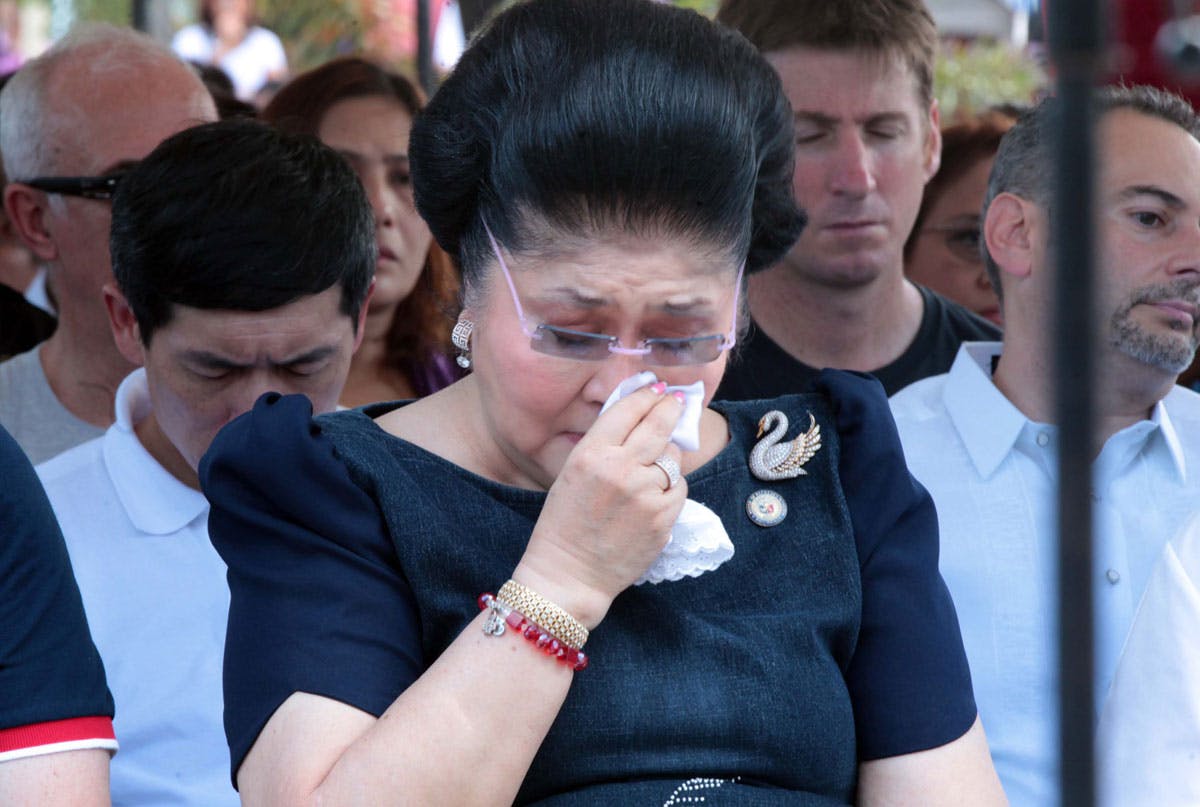
“The Kingmaker” by American artist and documentary photographer and filmmaker Lauren Greenfield begins with former first lady and now Ilocos Norte Rep. Imelda Marcos riding in what appears to be either a van or a coaster. When the vehicle stops at a red traffic signal, she opens the window and starts handing out money, apparently P20- or P50-bills to street kids. The kids swarm around the opening, grabbing the money.
The traffic light changes to green, and more kids try to grab the money as they know the vehicle-turned-ATM-on-wheels is about to speed off. We watch Imelda say in a louder yet still surprisingly calm voice, “’Yung mga bata lang! ‘Yung mga bata.” (Just the children! The children) because some grown-ups had begun to reach in and take peso bills for themselves. An assistant closes the window and the vehicle drives off.
Much later in the movie, Imelda visits the Philippine Children’s Medical Center, a facility she had ordered built and inaugurated on April 29, 1980. While there, Imelda gives away more money, this time around, an assistant fishes a bundle of P1,000-bills from Imelda’s handbag. “Madam Imelda” gives them away to the kids.
As she hands the P1,000-bills to the straw-thin, bony, dark-skinned kids, she says, “Pambili ng kendi” (For buying candy) to them.
Much interest
Inside the Cultural Center of the Philippines’ Tanghalang Aurelio Tolentino or Little Theater, the CCP, built by Imelda as the lead agency to allow the True, Good, and the Beautiful to thrive and bloom as an Eden for arts and culture — it was ironic to screen “The Kingmaker.”
The screening was held on Jan. 29 following a dinner hosted for Imelda on Jan. 15 as founding chairperson of the CCP. It was in line with CCP’s continuing celebration of its 50th anniversary that began in September 2019. UP also showed it on Jan. 29 at Cine Adarna.
In a Facebook post on Jan. 16, the CCP said “The Kingmaker” explores the disturbing legacy of the Marcos regime and examines the Marcos family’s improbable return to power in the Philippines.
The 100-minute documentary had its world premiere at the 2019 Venice Film Festival, followed by screenings at the 2019 Telluride Film Festival, Toronto, and London Film Festivals.
CCP vice president and artistic director Chris Millado said “the CCP as a government cultural institution has a contentious history and while it has Imelda as patron, “it cannot be denied that the Marcos regime had its excesses in terms of corruption, and its human rights record” and that the Marcoses have been convicted in courts for this.
“By screening this film, it’s a way of making artistic expression engage with issues that we feel are very important to tackle in this part of the political or social psyche of the Filipino,” Millado added.
In 1986, the CCP said in its post that it reinvented itself to become a people’s art center and part of its mission is to bring in rich and varied content from local and international filmmakers.
For Millado, “the CCP has always been a platform for artistic expressions and rational conversations” and “we are presenting a documentary tackling an issue that we are concerned about, as a Filipino people.”
On Feb. 19, “The Kingmaker” will be shown again at the Tanghalang Huseng Batute (Studio Theater) and Tanghalang Manuel Conde (Dream Theater) in commemoration of the first Edsa revolution that occurred on Feb. 22 to 25, 1986, the CCP announced on Facebook on Jan. 24.
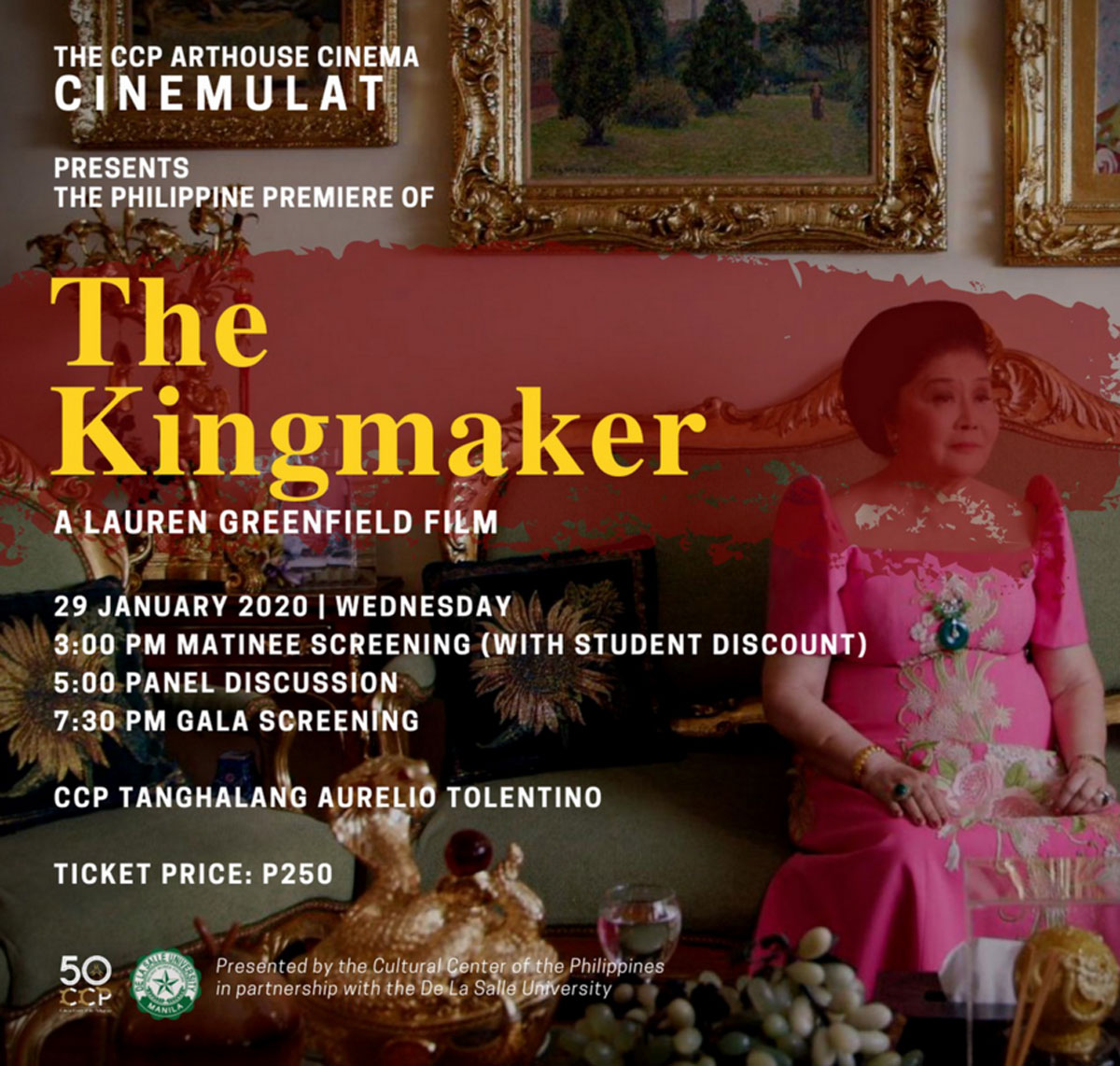

The UP Film Center also posted on Facebook last Feb. 8 that the documentary will have another screening at Cine Adarna on Feb. 25 to remember the bloodless people’s uprising that toppled the Marcoses 34 years ago.
William Mellor, consulting producer for the documentary, told The Philippine STAR in a phone and email interview that he was personally humbled by the way so many people (including businessmen), “have asked us to make the film available to as many Filipinos as possible and we are working on that with our distributors.”
Mellor, who is in Sydney, Australia, disclosed that there are ongoing negotiations to meet the “huge demand” for the documentary to be shown to more audiences due to its historical value, but he said he could not provide details yet.
The Calauit Safari
Greenfield began her documentary “The Kingmaker” originally with the intention of focusing only on Calauit Island. Calauit, which is part of Busuanga municipality in the province of Palawan, was then home to 254 families eking out a living on the island. Then in 1976, Imelda decided that she wanted a game reserve and safari, like the ones she saw in Africa.
So Imelda had the 254 families or 1,000 inhabitants removed from Calauit so that it could be a fitting abode for zebras, giraffes, impalas and other African wildlife. The residents hated her for it but what could they do? Fast forward to 2019, and we see Imelda lamenting to Greenfield, on camera, that Calauit has become tragically run down.
Then we cut to one elderly Calauit resident (because the humans of Calauit moved back into the island after the Marcoses were forced out of the country in 1986) who said that they live an uneasy life among the African animals on the island. You see, the animals, the zebras particularly, tend to break into their farms and eat their crops.
Imelda tells Greenfield that when she and her family finally came back to the Philippines in the early 1990s, she visited Calauit and the state of the game reserve and safari practically broke her heart. In the next scene, Greenfield asks the Filipino caretaker of the Calauit safari, who has not abandoned his post after four decades, if he saw Imelda return to the island. The caretaker said that Marcos had never returned to the island at all.
According to the CCP, the idea of creating a documentary on the Marcoses began when Greenfield read an article by Mellor in Bloomberg about one of the family’s least-known but most bizarre excesses, which was the menagerie of African animals shipped 6,000 miles from Kenya.
Mellor confirmed this and told The STAR that he knew about the Marcoses as a journalist who covered the region for many years for Bloomberg, including the coup attempts against former president Corazon Aquino in 1987 to 1988 following the EDSA revolution.
Mellor said he went to the safari, interviewed its gatekeeper and wrote about it in 2013. He described it as a “Jurassic Park,” or the science fiction turned into movies about attempts to create a theme park of cloned dinosaurs that became disastrous.
Greenfield contacted him upon learning about it and asked to “collaborate,” Mellor recounted. It took five years to finish the documentary.
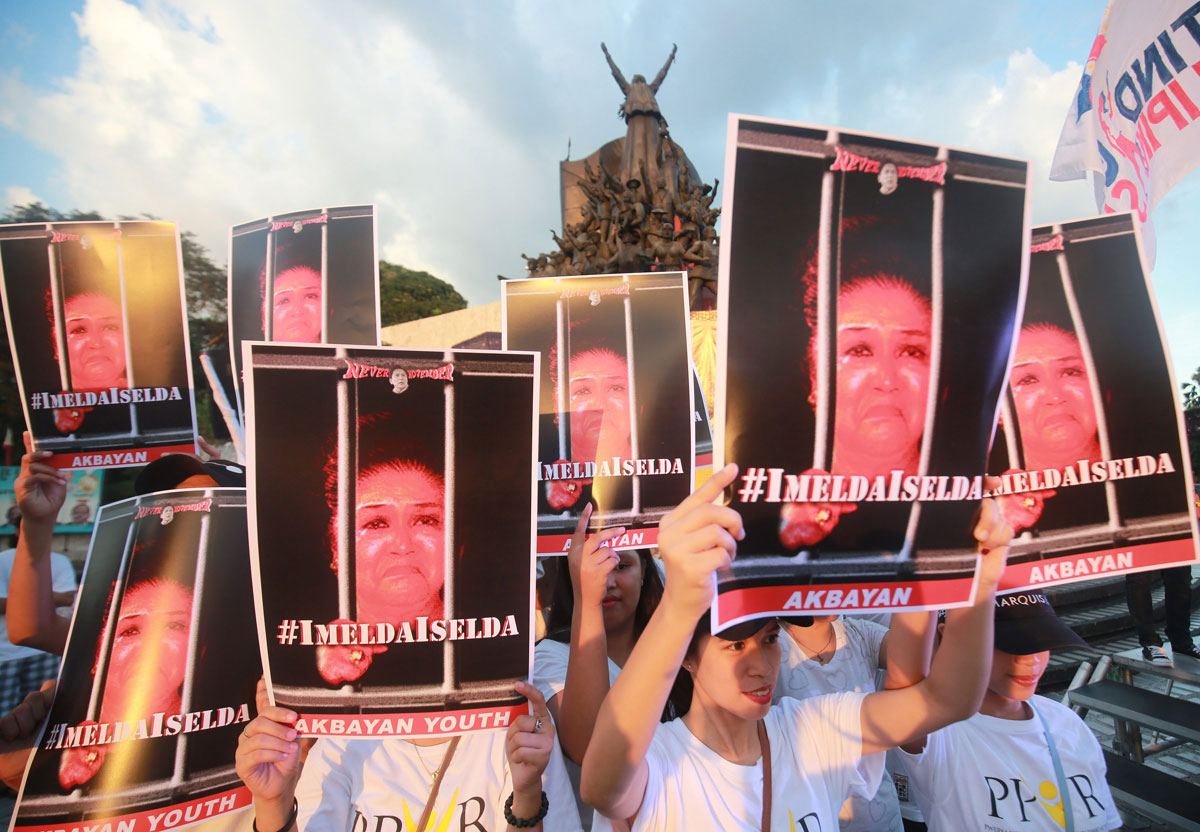
“The Kingmaker” focuses on the charm offensive that Imelda is capable of. Imelda tells Greenfield about the time she met a young senator named Ferdinand — back then, Imelda was already an aspiring beauty queen. She was not crowned as Miss Manila 1953 but she was one of the top contenders for the title.
After only 11 days, Imelda and Ferdinand were married. Early on, even as a 24-year-old, Imelda was already aware of the power of her charms. Looking at old footage of her as first lady, we can see why Ferdinand and so many others, including Filipinos, were smitten by her. She was simply gorgeous and enchanting. Her sense of dress and style was (and still is) impeccable.
Imelda told Greenfield, however, that she was not always up to her task as a senator’s wife. With Marcos eyeing the presidency, Imelda had to bring her charm offensive to political campaigns across the country. She revealed that these duties took their toll on her mental health. She began to get sick of politics.
On the brink of a nervous breakdown, Imelda was flown to the US and treated by a psychologist. According to Imelda, Ferdinand was told by the psychologist that she was being harmed by politics. Imelda said that Ferdinand told the doctor, “Well, if politics is making her sick, then I will give up politics.”
Upon learning this, Imelda gave herself a pep talk and resolved to overcome her weakness. With the help of a psychologist, Imelda convinced herself that she was strong enough to be the political wife that her husband, a potential president of the Philippines, needed. And the rest is history.
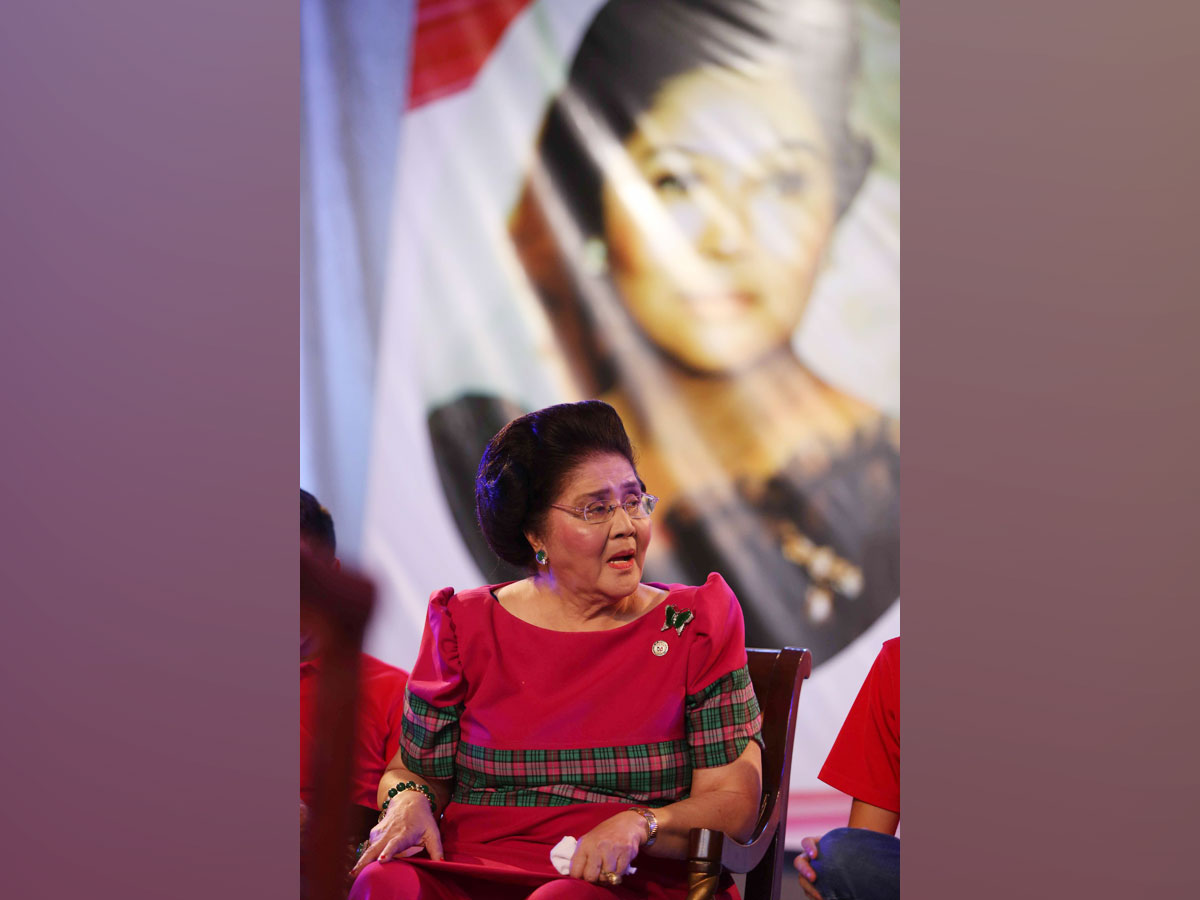
The CCP said Greenfield gained intimate access to Imelda and other members of the Marcos clan as she filmed in Imelda’s “extravagantly-furnished city apartment and the family mansions in Manila,” Ilocos Norte and Leyte, her bailiwicks. Imelda is from Leyte while her husband, the late dictator Ferdinand Marcos hailed from Ilocos Norte.
“Imelda Marcos, the former first lady of the Philippines, famed for her addiction to excess, has been an iconic reference in my long-term investigation of wealth through my photography and films. Astonished that she had managed to re-enter Philippine politics after being ousted by a popular uprising, I began filming her and discovered that, at age 85, she remained a skilled 'political animal,' as her son Bongbong (former Ilocos Norte governor and senator Ferdinand Marcos Jr.) describes her,” Greenfield said in her artist’s statement.
The CCP said Greenfield’s cameras also followed the “lavishly funded” vice presidential campaign of Imelda’s son, former Ilocos Norte governor and senator Ferdinand “Bongbong” Marcos Jr. from its launch in 2015 through to the election night drama and aftermath. During this time, Greenfield also conducted moving interviews with victims of the Marcos years, ranging from women activists who had been raped and tortured to an elder Calauit islander who had been evicted from her home to make way for the Marcos’ menagerie.
Soon, Greenfield realized she was onto an unfolding story that would be as topical as today’s headlines, the CCP said.
“In an age when fake news impacts elections, Imelda’s comeback story is a cautionary tale,” Greenfield, for her part, noted.


