



Youth Ask Governments To Respect Children’s Rights To Legal Identity
The Philippine Statistics Authority estimates that there are 1.3 million children aged zero to 14 in the country who are not registered.
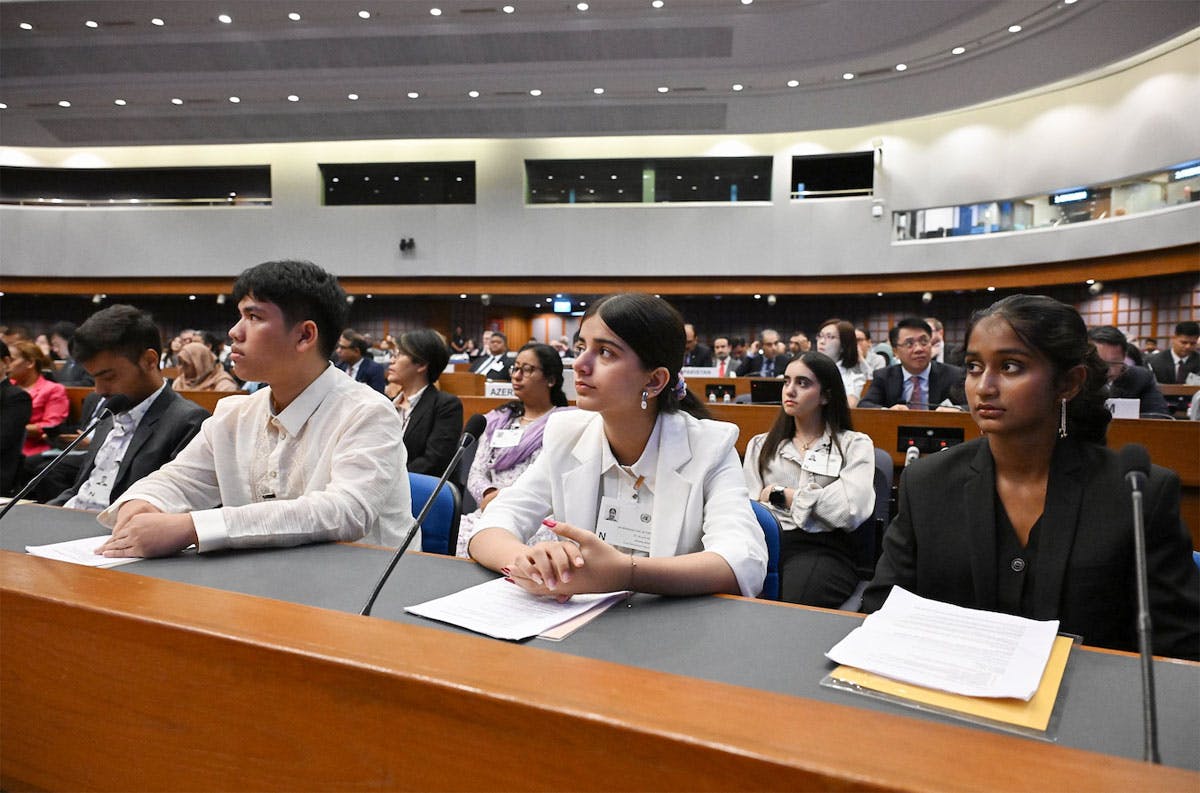
BANGKOK – Student Adornado “Ador” Cabalbag stood before ministers and state officials in a United Nations conference here last June 26 to ask governments in Asia Pacific to address unregistered births and provide legal identifies to stateless children.
Along with three other youth from the region, Cabalbag appealed for improved and more inclusive civil registration systems to cover all children and youth so that they can enjoy their rights as they grow up and live happily.
“Without registration, many of us don't officially exist – not in records, and not in rights,” said Cabalbag, 19, an information technology student leader of Bicol University who was the Philippine youth representative in the Third Ministerial Conference on Civil Registration and Vital Statistics (CRVS) in Asia and the Pacific held from June 24 to 26, 2025 at the United Nations Conference Centre (UNCC) in Bangkok, Thailand.
The conference, organized by UN Economic and Social Commission for Asia and the Pacific (ESCAP), gathered ministers and government officials across Asia Pacific countries who are at the helm of health, statistics, civil registration, planning, justice, finance, national ID systems, and information and communication technology.
In 2014, the ESCAP proclaimed the Asia and Pacific CRVS Decade (2015 to 2024) and called on its 53 members and nine associate members to commit to a goal that by 2024, all governments in the region must have universal and responsive CRVS systems that ease their citizen’s rights to health, education and good governance.
Apart from assessing the progress and celebrating achievements, the conference formally extended the Decade to 2030 to align with the 2030 UN Agenda for Sustainable Development and Sustainable Development Goals (SDGs), a set of 17 goals set by 193 UN member states that aim for prosperity, peace and equality.
Count every child
In an interview on the sidelines of the conference, Cabalbag, who was supported by World Vision Philippines, said, “It’s sad that many children, youth and even adults and whole families are not registered. This is not just the case in remote and difficult areas in the Philippines but in the urban centers as well.”
Prior to his travel to Bangkok, the young student said he and other Filipino youth were immersed in the situation of families and localities, including in national consultations, dialogues and exchanges that discussed CRVS such as the Young People and Civil Society Forum on Civil Registration and Vital Statistics in March, also in Bangkok.
“In many communities, the issue is inter-generational – families and adults don’t know or are not aware of the process and the system,” Cabalbag said.
“For others, the process is not accessible or affordable even and therefore, they don’t know that there are civil registrars in their communities.”
The Philippine Statistics Authority (PSA) estimates that there are 1.3 million children aged zero to 14 in the country who are not registered.
Additionally, there are also 3.7 million Filipinos have no official birth certificates. The five provinces of the Bangsamoro Autonomous Region in Muslim Mindanao have the lowest unregistered births in the country.
Besides children who do not have prior legal identities such as birth certificates, Cabalbag said there are also stateless children in the Philippines who were displaced and driven away from their families due to violence or conflict.
“Without their legal identities, these children cannot avail themselves of education and healthcare,” he said.
“If you are not registered, you are invisible to government services and the many other aspects of social development.”
Children’s call to action
In a side event to the global conference titled "Children and Youth in the Picture: Barriers and Solutions to Future-Proofing CRVS Systems," Cabalbag participated and co-hosted a gathering of children and youth that aimed to strengthen the voices of the youngest citizens of the region.
The event that resembled a birthday party, started with the singing of “Happy birthday,” with gifts and balloons on the kids’ tables, to signify that every child must be counted and given an identity to be able to live a life that has access to essential services.
Cabalbag described the discussions as wide-ranging and insightful, with children and youth from other countries citing the difficulties, inaccessibility and costs of getting registered.
The young people gave recommendations to their respective governments to help ensure that all children, everywhere, can have their necessary birth documents that will be needed for their healthcare, schooling, safety and protection.
“We may be young, but we know what's right, and we won't be silent until every child is counted, recognized and protected," Cabalbag said.
Later during the ministerial conference, Cabalbag stood with three other youth to reads their powerful statement to an audience of government authorities.
Phl a global model with more to do
Undersecretary Claire Dennis Mapa, National Statistician and Civil Registrar General of the PSA, led the Philippine delegation and was voted vice chairperson of the ministerial segment of the conference, along with vice chairs from Vanuatu and Vietnam, and headed Fiji.
The Philippines was cited, along with Bangladesh, Cambodia, Maldives, Papua New Guinea, Sri Lanka, Solomon Islands, Thailand and Vietnam, as models for achieving more than 90 percent coverage on birth and death registration.
Other “best practices” of the Philippines, such as the Birth Registration Assistance Project that provides free civil registration services to vulnerable groups, was cited in the 2025 ESCAP report, “Progress made on Civil Registration and Vital Statistics in Asia and the Pacific after a Decade of Getting Every One in the Picture” that was launched before an audience that included journalists from Asia Pacific who were invited to a parallel media training program on the effective use of data in public health journalism.
“We have data and we know where the vulnerable population are, so we will do our best to register them – the senior citizens, persons in the geographically isolated and disadvantaged areas, Muslims and indigenous peoples (IPs),” Mapa said an interview.
The report also cited the Philippines, for improving its cause-of-death data recording through the the training of medical doctors in certifying causes of death and reviewing the legal framework for medico legal death investigations.
Another citation is the pending Omnibus CRVS Law that seeks to change the outdated CRVS Law in 2015 will digitalized and streamline the system. The bill, approved on third and final reading on June 4, 2025 by the House of Representatives, will be filed in the next Congress.
The conference adopted a Ministerial Declaration that reaffirms the shared vision that all people in Asia and the Pacific will benefit from universal and responsive CRVS systems, essential for ensuring legal identity, protecting human rights, enabling good governance, strengthening public health and driving sustainable development.


