



WHO Rejects Mass COVID Testing
Testing asymptomatic people will artificially drive up COVID-19 positivity and testing capacity should be used to identify where the transmission is and suppress it, according to World Health Organization country representative Rabindra Abeyasinghe.
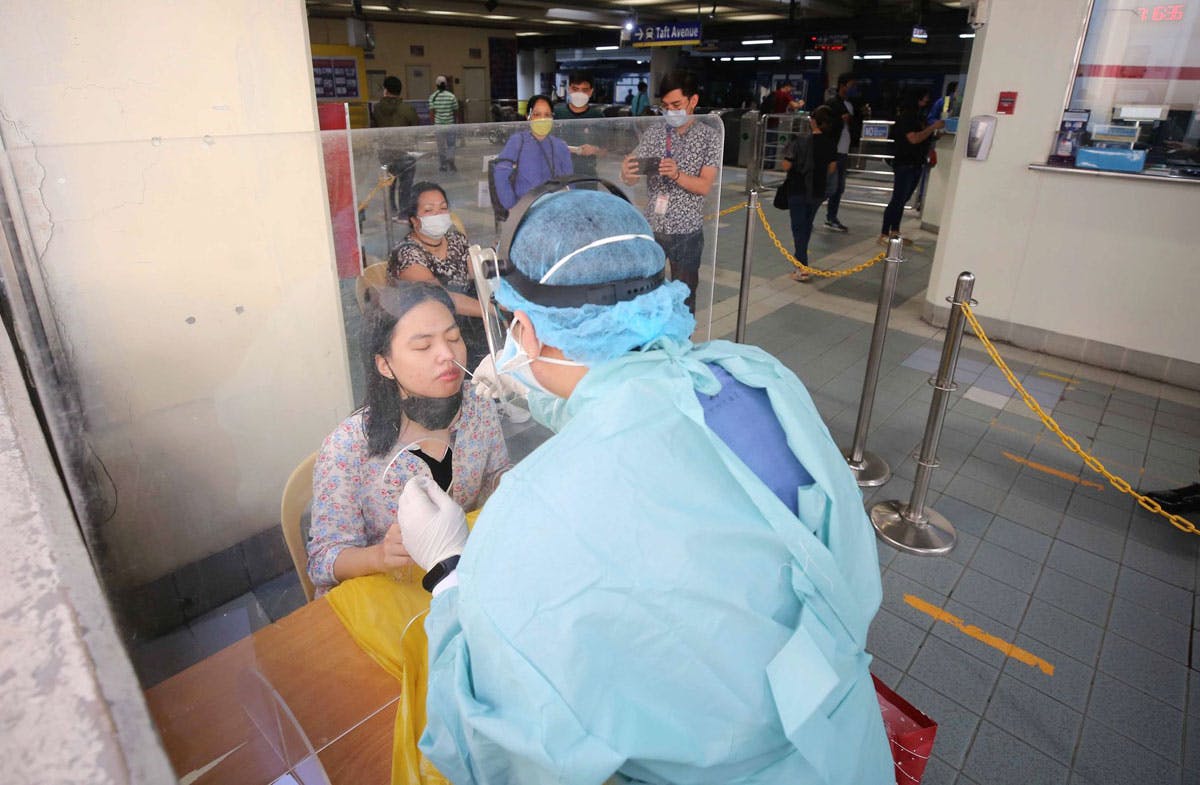
The World Health Organization (WHO) thumbed down calls for mass testing amid the exponential rise of COVID-19 cases in the country.
“(W)hat we are seeing now in the NCR (National Capital Region) and adjoining regions is this kind of exponential increase that we have seen in several other countries. And in those circumstances, given the higher transmissibility of Omicron (variant), it would be prudent to reserve the testing capacity to test symptomatic people, especially symptomatic elderly and vulnerable people,” WHO country representative Rabindra Abeyasinghe said during the “Laging Handa” public briefing on Wednesday, Jan. 12.
Testing asymptomatic people will artificially drive up positivity and testing capacity should be used to identify where the transmission is and suppress it, according to Abeyasinghe.
“So I think targeted testing is a better use of the resources spent on (reverse transcription polymerase chain reaction) RT-PCR tests,” he said, adding that it is prudent to just isolate and quarantine milder cases.
The WHO official further stressed the need to ramp up vaccination efforts to protect people from hospitalization, severe disease and death.
At the same briefing, Abeyasinghe noted that the new IHU variant has not shown the capacity to predominate in transmission.
“It doesn’t seem to have the capacity to be displacing Delta or Omicron,” he said.
He added that at this time, it does not warrant to declare IHU as a variant of concern.
The WHO is still studying the reported “Deltacron” variant – a combination of Delta and Omicron variants – detected in Cyprus, according to Abeyasinghe.
“We are trying to understand it. There’s some speculation that there’s laboratory contamination,” he said.
Omicron, he added, is expected to replace Delta as the predominant variant in the Philippines as it has done in several other countries.
‘Allow online selling of antigen kits’
As this developed, Camarines Sur Rep. LRay Villafuerte called on the government on Wednesday to allow businesses to sell self-testing kits amid the current surge in COVID-19 cases.
Villafuerte specifically urged the Department of Trade and Industry (DTI) to suspend its crackdown on retailers of antigen test kits amid the limited testing capacity of the government and the difficulty that people encounter in getting official RT-PCR testing.
“The IATF (Inter-Agency Task Force for the Management of Emerging Infectious Diseases) and NTF (National Task Force Against COVID-19) have been saddled with contact tracing and quarantine woes partly because of problems related to the supply and pricing of RT-PCR tests along with official antigen and other rapid tests,” he said.
“So how will the IATF and NTF solve these contact tracing and quarantine setbacks if the DTI will, in effect, threaten people to stop using the more accessible and relatively cheaper anti-gen self-test kits that allow them to test themselves easily at home and with immediate positive or negative findings?” he added.
While he is aware of the DTI’s warning that the Food and Drug Administration (FDA) has yet to officially allow the sale of self-test kits available locally, “the use of rapid testers like antigen kits is the most feasible and practical option for people at this point if they want to know right away if they have been infected and need to quarantine themselves right away and avoid human contact for the duration of their home isolation,” according to the lawmaker.
Villafuerte emphasized that the FDA should instead fast-track its study on these self-test kits now being sold online.
He said the authorities would be in a position to tell retailers to stop selling self-test kits and for people to stop buying them only when the government has managed to further slash the cost of RT-PCR tests, which is the gold standard in checking coronavirus infections, and do something about the recent delays in the turnaround time of testing.
“There have been anecdotal reports of people who get their PCR test results in a day or two even if they paid extra for tests whose results were supposed to be released in 12 hours,” he added.
Even the NTF has publicly admitted the delays in PCR test turnaround time because of the high demand for swab testing, especially now with the resurgent virus suspected of emanating from the more transmissible Omicron variant, according to Villafuerte.
He said there have also been anecdotal reports that people who chose to have themselves tested at drive-through antigen test centers in malls have been confronted by long queues.
“So what else will most people do if they are warned against patronizing online sellers of self-test kits, given the limited access to and delayed turnaround time of RT-PCR tests or the queues attending sites offering rapid tests?” he added.
Villafuerte issued this statement after DTI Assistant Secretary Ann Claire Cabochan said at a Laging Handa briefing this week that online retailers should refrain from selling self-test kits as these have yet to be approved by the government for local sale and distribution.
The standard retail price set for RT-PCR tests is P2,450 at public hospitals and P2,940 at private hospitals while the SRP for antigen tests is P960, according to media reports.
Use of 2022 lab network funds urged
Meanwhile, the P7.92-billion fund in the 2022 national budget for the government’s COVID-19 Laboratory Network should be immediate “released and dispersed” so that the current surge in the demand for testing could be met, according to Sen. Joel Villanueva.
Villanueva said the amount should be “downloaded without delay” to public health facilities so they can cope with the spike in testing requests amid the explosion of Omicron variant cases.
He added that to be able to do this, public hospitals and clinics need to buy and stock up on testing kits and laboratory commodities.
For the senator, the testing fund should be treated like vaccines.
“It’s like a vaccine. Please distribute it immediately. It should be wrapped with ‘Do not delay’ markings,” he said,
Villanueva, who chairs the Senate labor committee, warned that delaying the release of the P7.92-billion fund lodged with the Department of Health “would be a case of underspending that leads to under testing, which then leads to undercounting of cases.” – With Edu Punay, Cecille Suerte Felipe


