


Remulla: ICC Drug War Probe A Disservice To Phl
Justice Secretary Jesus Crispin Remulla insisted that the Philippines is a “functioning democracy” and the International Criminal Court cannot have any compulsory process in the country.
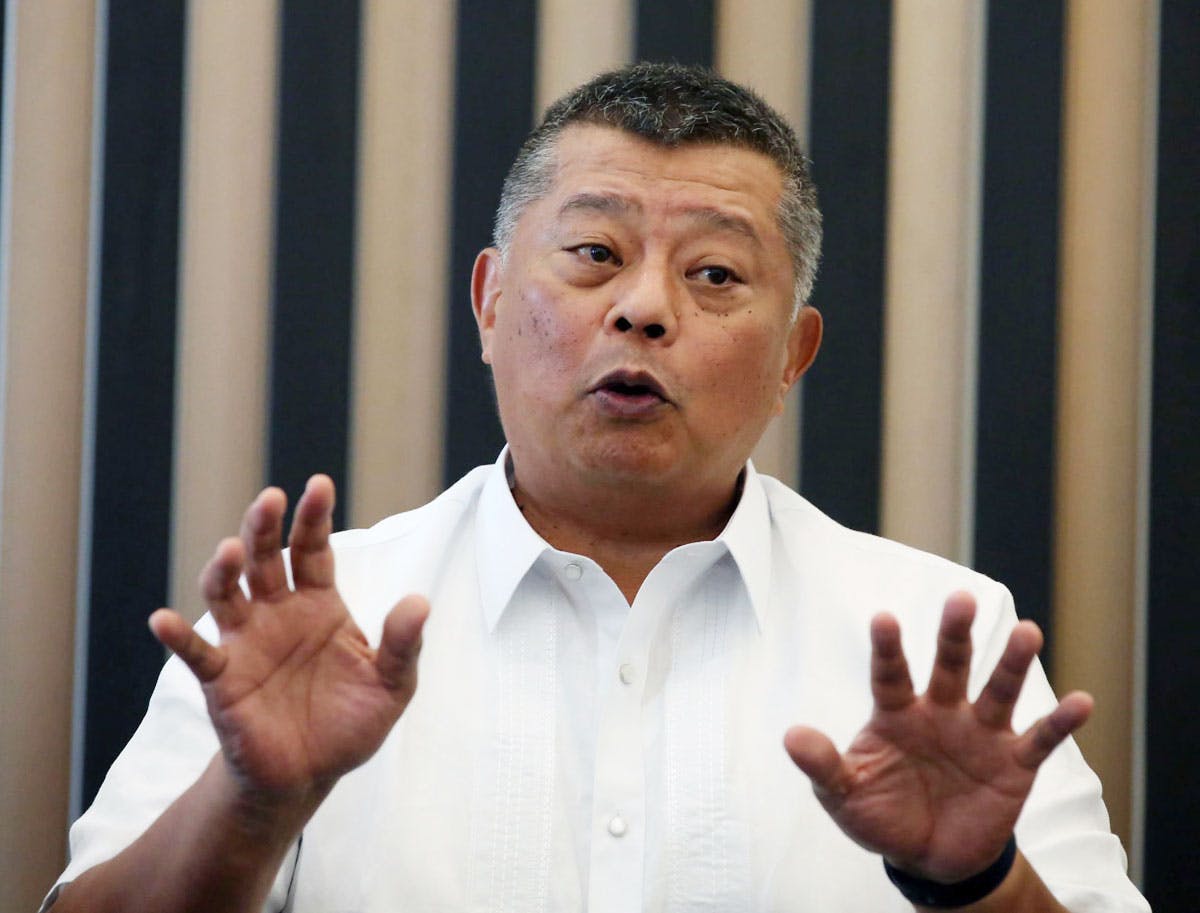
The insistence of International Criminal Court prosecutors to proceed with the ICC’s investigation into the government’s bloody war on drugs in the last six years is a “disservice” to the Philippines, Justice Secretary Jesus Crispin Remulla said on Wednesday, Sept. 28.
The latest development on the case was ICC prosecutor Karim Khan’s response, rejecting all the arguments raised by the Philippine government in seeking to discontinue the investigation.
On Wednesday, the Department of Justice (DOJ) refused to comment further on Khan’s questioning of the Philippine government’s capability to investigate alleged extrajudicial killings (EJKs) associated with the Duterte administration’s drug war.
“No more… no need (to comment),” Remulla said.
“We are a functioning democracy. Our judicial system is functioning… as far as we’re concerned, we’re not members of the ICC anymore. And we cannot have any compulsory process in our country if we have to investigate what he wants to investigate,” Remulla told reporters.
Last Sept. 22, the ICC prosecutors led by Khan opposed the Philippine government’s submission to the ICC Pre-trial Chamber (PTC), which argued the ICC’s lack of jurisdiction over the Philippines, the drug war’s inadmissibility to account of the Rome Statute’s Article 17 and the complementarity principle in international law.
In response, Khan – an international criminal law expert – said the Philippines’ submission, which was penned by the Office of the Solicitor General (OSG) and supplied with evidence by the DOJ, fell short of providing strong arguments to stop the ICC prosecutors’ investigation.
Khan said the arguments raised were not backed by strong evidence that could boost the ICC’s confidence that the Philippines can resolve the alleged crimes against humanity on its own.
He said the Philippine government and its investigating agencies failed to demonstrate in its Sept. 8 submission “past or ongoing national proceedings that could match” the looming ICC investigation.
Visibly irked when confronted by reporters with Khan’s contention, Remulla said: “Mr. Khan is doing them (ICC) a great disservice by putting a challenge to our system… They cannot run roughshod over our system and say you’re a lousy country and you cannot do what we want you to do.”
Remulla, confident that no consequences would befall the government for not responding to Khan’s counter-arguments, said ICC prosecutors cannot force their way into the country.
“We’re not a party to this case. We’re not a member of the ICC after all. Will they take over our country? Are they gonna send peacekeeping forces here and take over our military and our police and start running our show for us? Are they gonna take over a justice system? I don’t think anybody here will allow that,” he said.
In 2018, then president Rodrigo Duterte withdrew the Philippines from the Rome Statute, the treaty that formed the ICC, after the ICC announced that it would conduct a preliminary examination on his drug crackdown.
Upon his election, President Marcos decided to stay out of the ICC and allowed the submission opposing the investigation into his predecessor’s war on drugs.
“The Prosecution respectfully submits that none of those arguments have merit,” Khan said in a 21-page response. “The GovPH (Philippine government) has not demonstrated – even with its additional submissions – that it has conducted or is conducting national investigations or prosecutions that sufficiently mirror the investigation authorized by the Chamber.”
While the Philippines was within its rights to question the ICC’s jurisdiction, the ICC prosecutors earlier said the Rome Statute’s Article 19 provides no authority for States in question “to challenge jurisdiction before there is a case before the Court,” countering the withdrawal argument of the Philippines.
Earlier, former ICC chief prosecutor Fatou Bensouda also said that while the Philippines’ withdrawal from the statute took effect on March 17, 2019, the ICC retains jurisdiction over crimes that are alleged to have occurred on the territory of that state during the period when it was a party to the agreement.
The pending investigation of the ICC is looking into the drug war killings from July 2016 to March 2019, including cases in the Davao region between 2011 and 2016 when Duterte was mayor of Davao City.
In Congress, Sen. Ronald dela Rosa, who was Duterte’s PNP chief at the start of the drug war, shunned the ICC’s insistence of jurisdiction.
“Is he (Khan) nuts? Why does he insist? Let me ask you, yourself, what is happening in this country: Do we have crimes against humanity here? Why does he insist on interfering in our problem here?” Dela Rosa said when asked for comment.
The senator said he sees a “deadlock as if it were a strategic stalemate” and believes the ICC prosecutors would not be able to pursue an “impartial and true investigation.
When a reporter asked him if no extrajudicial killings took place, Dela Rosa replied in Filipino: “Do you really want to put me in jail? Don’t try to put me in jail... our government doesn’t want to, so why should you look for that option?”
Probe continues
As
ICC prosecutors questioned how the Philippines has covered so few drug
cases relative to the sum to be capable of resolving the wave of alleged
crimes against humanity, Remulla said the government’s multi-agency
task force led by the DOJ would still continue investigating EJKs.
“We will be continuing our inquiries, we will continue our investigation, we are not stopping and we are hoping that there will be more witnesses to come forward. That’s what we need here. If we don’t have witnesses, what of the cases? Do you think we should convict anybody based on a case that has no witnesses and no evidence?” Remulla said.
“The unfortunate thing here is here comes a foreigner who thinks that he knows the Philippines more than we do. It’s very frustrating sometimes but we cannot be frustrated. We cannot make this a reason for us to stop working. We come here every day to work because it is what we do. It is what we do for the country,” he added.
Meanwhile, Solicitor General Menardo Guevarra, who previously served as Duterte’s justice secretary, said the Marcos administration would be exhausting all domestic and international legal remedies no matter how the ICC rules on the case.
“Regardless of the pre-trial chamber’s ruling, however, the Philippine government will avail itself of all legal remedies, both domestic and international, even as it vigorously pursues its own investigation and prosecution of crimes committed in relation to the government’s so-called war on drugs, all within the framework of our own legal and judicial system,” Guevarra told reporters.
Duterte’s controversial crackdown on drugs has resulted in the arrest of over 300,000 drug suspects since June 2016.
Latest government data claim there had been 6,235 drug suspects killed in reported shootouts with police, but activists and human rights bodies believe thousands more have been killed execution-style by unidentified gunmen.
Drug war under Marcos
Heeding the orders of Marcos, the Philippine National Police (PNP) is now set on adopting a holistic approach in solving the problem of illegal drugs in the country.
Lt. Gen. Jose Chiquito Malayo, PNP officer-in-charge, said on Wednesday they acknowledge Marcos’ directive for lawmen to go after key drug players to be able to make an actual difference.
“While we ensure that there are extensive operations against major drug dealers, we also would like to look at this approach in a holistic manner,” Malayo said in a statement.
The PNP also took note of Marcos’ other goal of rehabilitating drug dependents.
Malayo said they are closely working with other agencies in the rehabilitation of identified drug users in every community.
The PNP also reported that they recorded 2,569 crimes from Sept. 18 to 23, which is lower compared to 5,084 incidents in the previous week, a decrease of 49.47 percent.
Malayo said index crimes such as murder, homicide and theft went down by 29.20 percent from 524 to 371.
Non-index crimes, or violations of special laws, dropped by 51.80 percent from 4,560 to 2,198.
Malayo said the crime situation for the period in review is peaceful and manageable. – With Pia Lee-Brago, Cecille Suerte Felipe, Emmanuel Tupas