



Pinoy Nurse-Vlogger In UK Thankful He Received AstraZeneca Vaccine Before Contracting COVID-19
John Steven Soriano, popularly known as “Nurse Even” in social media, said the AstraZeneca vaccine prevented him from experiencing severe infection even if he had just received the first dose.

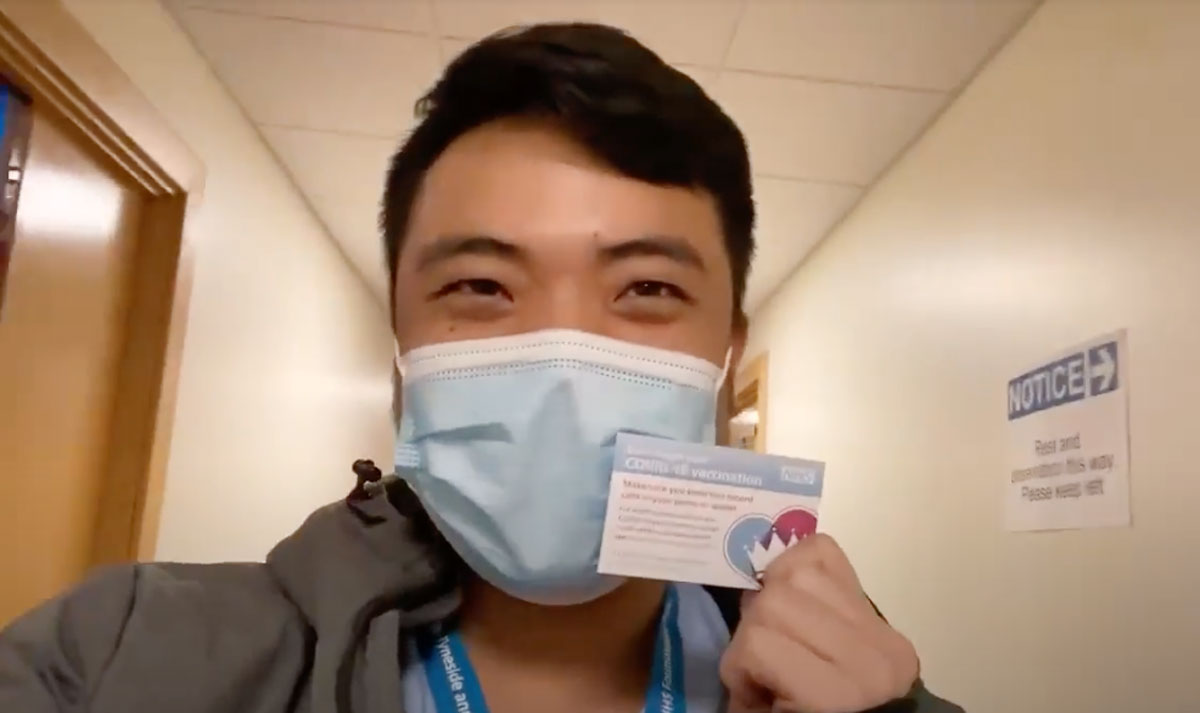
United Kingdom-based Filipino nurse John Steven Soriano contracted coronavirus disease 2019 (COVID-19) eight days after getting his first dose of the vaccine developed by AstraZeneca plc and the University of Oxford last Jan. 14.
The 29-year old Sunderland Royal Hospital nurse – popularly known in social media as “Nurse Even” – stressed the vaccine did not cause him to test positive for the virus. He expressed belief he got the infection after an outbreak at the ward where he is working.
Soriano credited the jab for protecting him from experiencing severe COVID-19 and from having to be hospitalized.
He said that overall, he was “settled and feeling great” although he contracted COVID-19 because he also did not have the worst symptoms.
“I’m still grateful po kasi imagine, kung hindi ko nakuha 'yung first shot ko tapos nakuha ko 'yung virus, baka malala po 'yung mga symptoms na na-experience ko (I’m still grateful because imagine, if I was not able to get my first shot then I got the virus, I may have experienced more serious symptoms),” Soriano disclosed.
“So I know, I really know that the first dose of the COVID-19 vaccine helped me to fight the symptoms I experienced when I got the virus,” he said in a mix of English and Filipino.
What he felt after vaccination
Soriano shared how he felt when he got the vaccine. He did experience some initial side effects: a lightheaded feeling immediately after the shot, fever, body pain and numbness in the arm five hours later.
“Pero after 72 hours, wala na po. Normal na po ang lahat. Malakas na po ako, feeling great, feeling energetic na po ulit ako after three days no'ng nakuha ko 'yung bakuna (But after 72 hours, it was gone. Everything was normal. I was strong, feeling great, feeling energetic again after three days of getting the vaccine),” Soriano stated.
The vaccine gave Soriano peace of mind as he was assured that he won’t end up under critical healthcare if ever he contracts the virus given his high exposure to the due to his frontline work.
“‘Pag nakuha mo, na-acquire mo 'yung virus, ma-le-lessen or makakatulong 'yung bakuna sa paglaban nu’ng virus sa katawan mo. Hindi po ibig sabihin no'n na puwede ka nang maglala-labas dahil protektado ka na against the virus. Hindi po (If you get or acquire the virus, the vaccine will lessen or help your body fight the virus. It does not mean you can just go out because you are protected against the virus. That’s not it),” he said.
Soriano said his cases serves as a reminder that people, especially frontliners, need to keep observing minimum health and safety standards because COVID-19 vaccines do not guarantee that a recipient will never be infected with the virus.
Testing positive before getting his second shot
Soriano recalled having a cough and experiencing an itchy throat, but thought it was just because he drank sweet coffee that day. However, his rapid test turned out to be positive and he immediately isolated himself at home. The reverse transcription polymerase chain reaction (RT -PCR) swab test confirmed that he got infected.
He said he also experienced mild fever, body pain, and a clogged nose. On the sixth day, he lost his sense of smell and taste.
But that was it. He did not experience the severe symptoms that would require hospitalization: shortness of breath, chest pain, or loss of speech or movement.
“Hindi ako bothered kasi alam ko 'yung atake ng virus sa akin, ang alam ko kung pa'no ko siya lalabanan (I was not bothered, because I knew how the virus attacks me and I know how to fight it),” he said.
Soriano was even able to vlog as a distraction during his two-week quarantine.
“Kailangan ko ring gumalaw para ma-regain 'yung energy ko. I-update ko po kayo sa progress ko 'no, sa proseso ng katawan ko, ng status ko para hindi naman kayo worried (I need to move somehow to regain my energy. I will update you on my progress, on my body’s processes, on my status so you are not worried),” Soriano said.
“And just to let you know, hindi ko pa po sinasabi sa parents ko na I have contracted the virus kasi ayoko naman silang mag-alala kaya shh, secret lang (I have not told my parents that I have contracted the virus because I do not want them to worry, so, shh, keep it secret),” he even joked.
On Feb. 18, he said he finally tested negative for the virus after almost two weeks of isolating himself at home.
Outbreak, not vaccine, to blame for infection
Soriano stressed that getting the Oxford-AstraZeneca vaccine did not cause him to test positive for the virus.
He emphasized that inoculation does not completely remove the possibility of still contracting the virus, especially since only a small portion of the world’s population have received the shots.
“ I did not get the virus from the vaccine. I have read many misconceptions that if you have been vaccinated when the rest of the world has no COVID-19 vaccine yet, you will still be protected against the virus,” Soriano said.
“Hindi ka na daw magkaka-COVID-19, which is hindi po. Marami pong variants ang COVID-19 na hindi pa, clear ko lang po nadidiskubre sa buong mundo (They say you will not get COVID-19 anymore, which is not true. There are many variants of COVID-19 which, I have to make clear, are not yet discovered worldwide),” he added.
Soriano also pointed out since he only got the first dose of the AstraZeneca vaccine, “you have some protection if you got the first dose, but it is not 100 percent.”
According to the US Centers for Disease Control and Prevention or CDC, it typically takes a few weeks after vaccination for the body to build immunity against the virus that causes COVID-19. As a result, it is possible for a person to still get COVID-19 just after vaccination.
The CDC said reports of death following vaccination do not necessarily mean the vaccine caused it. At present, there are no detected patterns in the cause of death that would indicate a safety problem with COVID-19 vaccines.
Part of history
Despite all the challenges he faced, Soriano said he felt blessed to be vaccinated with the AstraZeneca jab and thought that he was part of history as a pioneer overseas Filipino worker.
“I am so grateful po that this vaccine gives me small glimpse of a light. Eto na po 'no, meron na po tayong bakuna (This is it, we have a vaccine) finally in a span of one year. I believe in science. I believe in vaccines and I am so blessed and happy to be part of the first batch na nabakunahan dito sa UK (who got vaccinated here in the UK),” Soriano said.
“Overall experience, amazing po talaga kasi part po tayo ng history. Isang overseas Filipino worker ang nakatanggap ng bakuna sa, you know, sa isang bansa na kauna-unahang nakaimbento ng bakuna. Kaya sobrang blessed and thankful po ako (Overall experience, it was really amazing because we are part of history. An overseas Filipino worker received the vaccine in, you know, the country that was the first to invent the vaccine. Which is why I am so blessed and thankful),” he noted.
On Thursday, March 4, the Philippines received 487,200 doses of AstraZeneca vaccine from the first round of allocated doses from the World Health Organization-led COVAX Facility. Another 38,400 doses were scheduled to arrive on Sunday night, March 7.
Various local government units (LGUs) in Metro Manila have signed a deal with the UK-based drug company for their respective constituents.
UK Ambassador to the Philippines Daniel Pruce annonced that “you'll see a steady stream of consignment arriving throughout the rest of the year.”
“By the end of the year we'll have something in the order of 22 to 23 million shots of the AstraZeneca vaccine in the Philippines,” Pruce said. This includes not just the doses coming from the COVAX Facility but also those procedure by the LGUs.
Philippine Ambassador to the United States Jose Manuel Romualdez said 20 million doses of Moderna vaccine were expected to reach the country by late May or early June. Other expected shipments include 117,000 doses of Pfizer-BioNTech vaccine and six million doses of Johnson and Johnson’s one-shot vaccine. These were the three vaccines authorized by the US Food and Drug Administration (FDA) for emergency use there.
Health Secretary Francisco Duque III opted to receive the Oxford-AstraZeneca vaccine, which enjoys better trust among health care workers than the Sinovac Biotech vaccine preferred by the Duterte administration. Duque cited his age of 64, above the 18 to 59 range for which the Philippine FDA recommended the use of the Sinovac jab.
As the Philippines started its vaccination drive, Soriano encouraged the public to believe in the “wonders of science” and get vaccinated against COVID-19.
“I respect and I understand kung saan kayo nanggagaling. Siyempre bago po ito sa ating lahat kaya may mga hesitations talaga (I respect and I understand where we are coming from. Of course, this is all new to us, so there are really hesitations),” Soriano said.
“Pero for me, give the vaccine a chance,” he emphasized, saying the goal of the vaccine is to help people get back to how it used to be. “So there, just believe in the wonders of science).”
As of writing, Soriano is awaiting the schedule for his second dose of AstraZeneca vaccine. – With Helen Flores, Sheila Crisostomo


