



P10 Minimum Fare, Fuel Tax Suspension Pressed
A transport group said the government’s decision to allow the P10 minimum fare in 2018, when diesel prices was only P40 per liter, enabled jeepney drivers and operators to “survive” what was considered then an unbearable fuel cost.
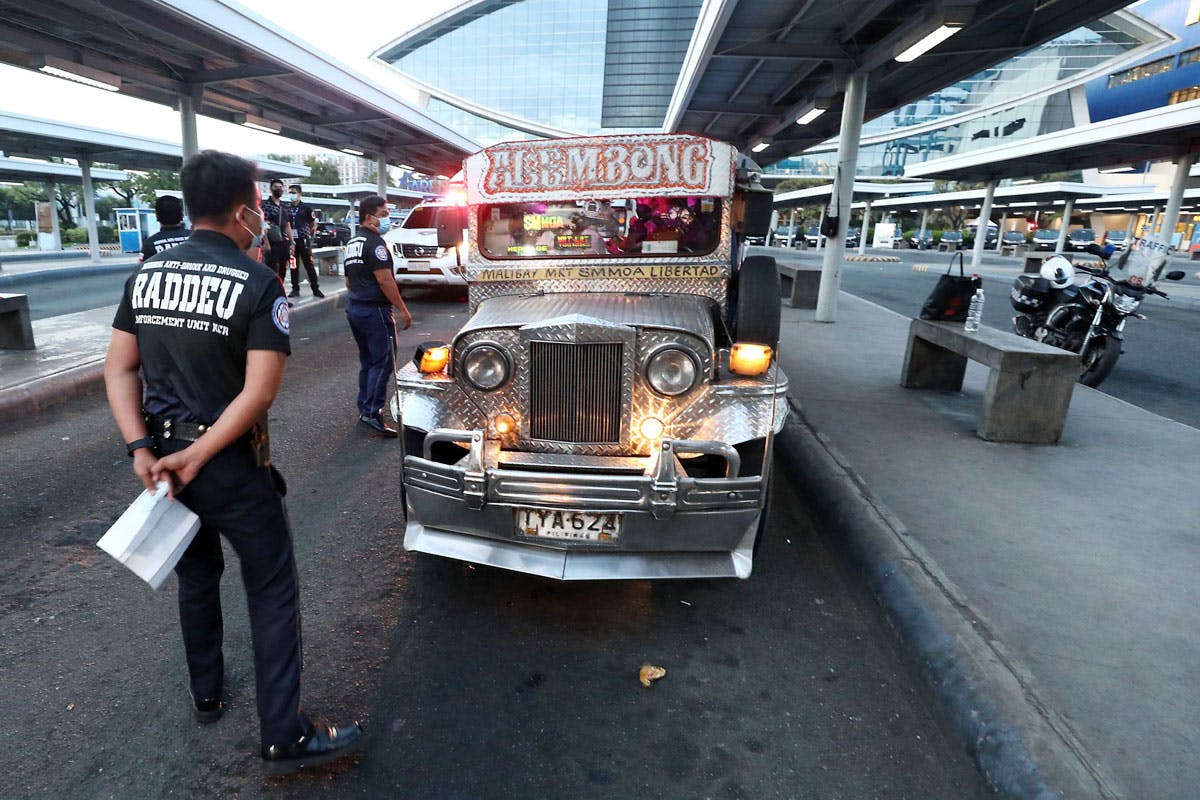
As fuel prices continue to skyrocket, transport groups are renewing their call for the reimposition of the P10 minimum fare, months after the Land Transportation Franchising and Regulatory Board (LTFRB) rejected their petition for a fare hike.
The Kilusang Mayo Uno, meanwhile, has asked President Duterte to suspend fuel excise tax before he steps down from office. Incoming finance chief Benjamin Diokno has flatly rejected the idea.
The latest fuel price hikes took effect on Tuesday, June 7, – P2.70 per liter for gasoline, P6.55 for diesel and P5.45 per liter for kerosene.
LTFRB’s decision to allow the P10 minimum fare in 2018, when diesel prices was only P40 per liter, enabled jeepney drivers and operators to “survive” what was considered then an unbearable fuel cost, Pasang Masda president Roberto Martin said.
But now that diesel price is as high as P90 per liter, transport groups like Pasang Masda, the Federation of Jeepney Operators and Drivers Association of the Philippines (Fejodap) and Piston are “bothered” that the LTFRB is refusing to give them some reprieve.
“When diesel was P40 per liter in 2018, we were able to enjoy the P10 fare hike for two months. But come December 2018, when diesel prices fell, we willingly submitted to the LTFRB’s request for a provisional rollback in minimum fare to P9,” Martin said in an interview aired over dzBB.
Fuel prices – not including today’s figures – have registered a net increase P23.85 per liter for gasoline, P30.30 per liter for diesel and P27.65 per liter for kerosene since the start of the year.
Piston’s members staged a protest in Quezon City on Tuesday to denounce the inability of the government to address the plight of jeepney drivers. They called for the return of the P10 minimum fare to help drivers earn more and survive the soaring prices of fuel and basic commodities.
“Our call last October 2021 was the return to a P10 minimum fare. If there are 200 passengers (a day), there would be an additional P200 in the earnings of the driver,” Piston president Modesto Floranda said in a dzBB interview.
“We want the government to address our concerns by giving us our wish for a P1 fare increase. In 2018, that was given to us. The government approved that and operators paid for that fare matrix that’s why it is legal and it needs to be enforced,” Fejodap president Ricardo Rebaño said.
LTOP, 1-UTAK, Pasang Masda, ALTODAP and ACTO earlier asked for a provisional increase of P1 until the LTFRB heard their main petitions – P5 increase in the minimum fare or 66 percent more than the current P9.
The LTFRB decided last week to reject the petitions to raise the minimum fare to P10, explaining that “while the board recognizes present clamor of stakeholders in public land transportation services for necessary action relative fare rates, we cannot be insensitive to the plight of Filipinos … every time an increase on the prices of commodities occur.”
Not the solution
While some transport groups have threatened to stop their daily operations to stave off further losses, Fejodap said its members don’t see this as a solution.
“The immediate solution we are asking for is the temporary suspension of excise tax collection on fuel. If they can’t give us that, at least cut the collection by 50 percent while we are facing this crisis,” Rebaño said.
“Stopping operations is not a solution because it’s not only the drivers who will suffer but also the whole Filipino community. This is not our agenda and we have never dreamed of doing this,” he added.
A significant number of jeepney drivers within the ranks of Piston is expected to stop operations this week.
Some jeepney drivers belonging to other transport groups, meanwhile, have started looking for other means of livelihood to cut their losses.
The militant Bagong Alyansang Makabayan (Bayan) said the government should immediately do something about rising inflation triggered by surging fuel prices.
“The latest inflation figure of 5.4 percent for May 2022 is acknowledged to be the result of runaway fuel prices. There is a need to arrest inflation by bringing down the cost of fuel through the reduction of fuel taxes,” Bayan secretary-general Renato Reyes said.
“The outgoing administration and the incoming regime should do something, and act on proposals to suspend the excise tax or VAT on oil products. People are being taxed to death. The needs of the people should come before the need for debt servicing,” he added.
For Sen. Imee Marcos, increasing the bioethanol content of gasoline and diesel may be key to bringing down fuel prices amid Western restrictions on Russian oil exports.
“While lawmakers are stuck in a debate over a fuel excise tax suspension, increasing bioethanol content is a clear way forward to give some relief to consumers,” Marcos said.
Marcos, chairman of the Senate committee on economic affairs, said more and steeper fuel price hikes are expected possibly until early next year as oil exports from Russia are stymied and Middle East output is limited.
The Biofuels Act of 2006 requires oil companies to produce a gasoline blend with at least 10 percent bioethanol, but Marcos said the National Biofuels Board can recommend an increase in the minimum requirement, subject to approval by the Department of Energy secretary.
Based on fuel costs before the latest price hike, Marcos estimated that the price of gasoline can be brought down by about P3.60 per liter if bioethanol content is increased from 15 percent to 20 percent – the level deemed safe for vehicles of model years 2001 or later.
Marcos also called on the Department of Agriculture to promote farming of crops that can be used for bioethanol production to address not just the local shortage but to expand rural employment and the use of green energy as well.
Local production of bioethanol satisfied only about half of the demand in 2019 before the COVID-19 pandemic slowed down investment in facilities for bioethanol production.
While sugarcane, sorghum, corn and cassava can be grown in the country to produce bioethanol, the local supply deficit is covered by imports from the US, Australia and South Korea.
“So much government land remains idle but can be used to increase bioethanol production. The goal is to become more competitive with cheaper imports and ensure our self-sufficiency,” Marcos said.
Cash aid will do – Diokno
Reacting to calls for the suspension of excise tax on fuel to temper price hikes, Diokno said a better scheme would be to distribute cash assistance to targeted sectors.
“To me, I agree with the present administration’s position that it is not appropriate to cut tax on petroleum,” Diokno said in an interview with CNN Philippines.
The incoming head of the Department of Finance (DOF) said excise tax on petroleum products in the Philippines is quite low compared to that in other countries.
The finance department earlier warned that the government stands to lose at least P105.9 billion in revenue, comprising P94.6 billion in excise taxes and P11.3 billion in value-added tax, from the suspension of fuel taxes enforced under Republic Act No. 10963 or the Tax Reform for Acceleration and Inclusion (TRAIN) Law.
The DOF is pushing for the distribution of unconditional cash transfer to the poorest 50 percent of the population to mitigate the impact of fuel price surges. This includes the assistance to drivers and farmers.
“So they decided that instead of cutting taxes, they will just provide targeted assistance to those who are in need, such as the fuel and transport subsidy program and the fuel discount program for farmers and fisherfolks. That is superior to a proposed tax cut on oil products,” Diokno said.
“What I’m saying is a targeted assistance to jeepney drivers, farmers, fisherfolk is more efficient and a better approach than cutting taxes. We will continue that approach,” Diokno said.
He stressed that cutting taxes on oil prices would largely benefit the rich.
Diokno also pointed out that the government would have a hard time asking Congress to restore the excise tax on oil imports once the global price of oil normalizes.
“When there is a need to put it back or restore the cut because things have normalized, it’s very difficult. It is difficult to push such measures before Congress. So I think this is a wrong move to cut taxes at this time,” Diokno said.
Meanwhile, Malacañang said the government is monitoring the prices of goods and that steps are being taken to assist the sectors affected by the higher inflation.
Acting presidential spokesman Martin Andanar said the May inflation was caused by higher oil prices so the administration is providing fuel subsidies to the transport sector.
He added the government is implementing a service-contracting program to allow passengers to save on transport costs.
“The MRT-3 has also extended the giving of free rides until the end of the term of the President on June 30, 2022,” Andanar said at a press briefing on Tuesday.
Andanar also cited the decision of the Regional Tripartite Wage Board to raise the minimum wage in Metro Manila by P33 per day. – With Cecille Suerte-Felipe, Alexis Romero, Rhodina Villanueva, Mayen Jaymalin