Only 19% Of Basic Education Students Fully Vaccinated
The Department of Education expects the figure to increase once their Learner Information System reflects the latest enrollment data for the incoming school year.
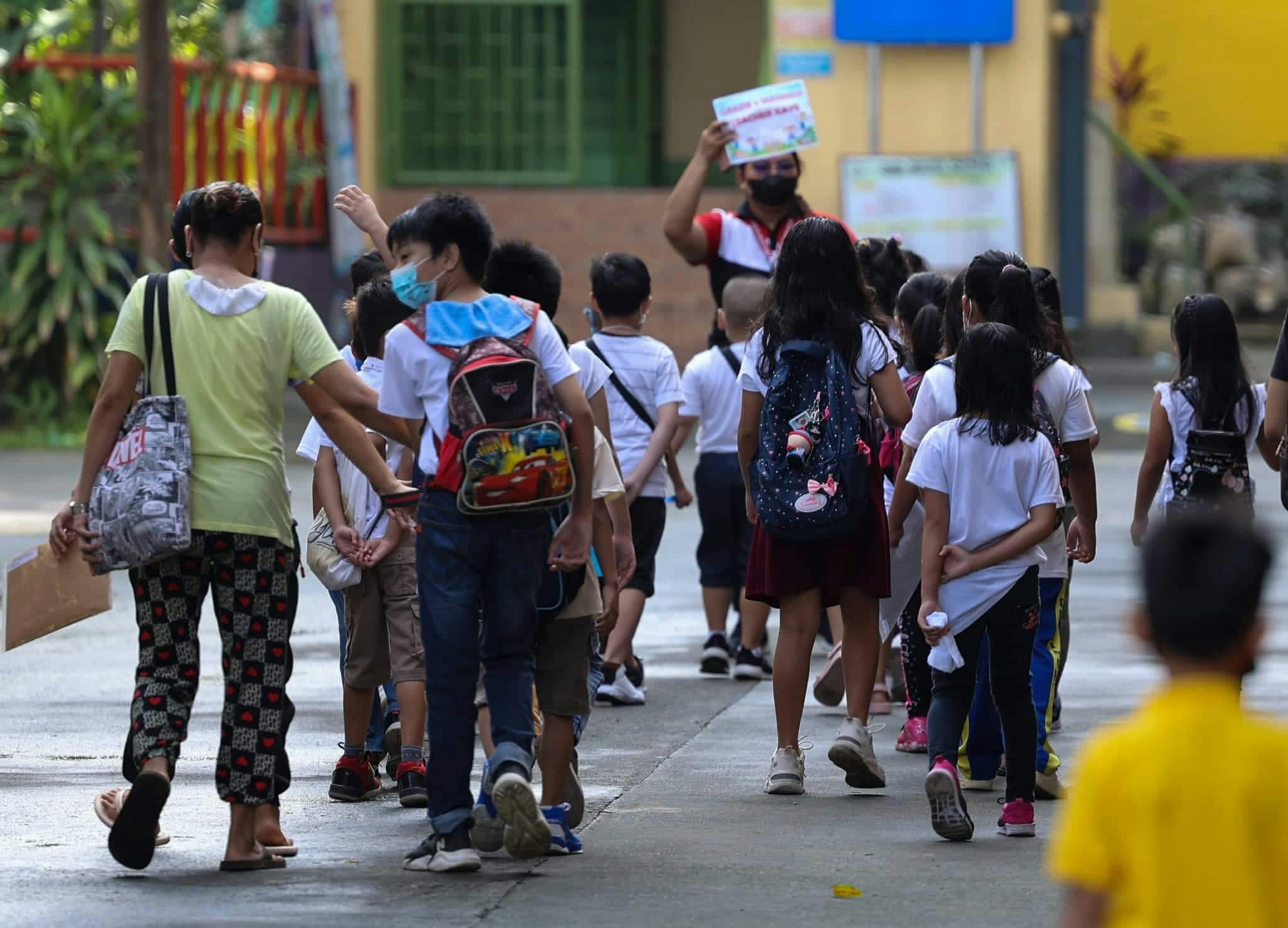
Only one in every five students in basic education is fully vaccinated against COVID-19, prompting renewed concerns over possible outbreaks that may happen once in-person classes are fully implemented.
Initial data released by the Department of Education (DepEd) showed that just 5,663,984 kindergarten, elementary and high school students have received at least one dose of COVID-19 vaccine, and only 5,285,437 received a second dose and are considered fully vaccinated.
This translates to 20.55 percent and 19.18 percent, respectively, of the total 27,560,661 students enrolled in basic education last school year.
DepEd spokesman Michael Poa, however, allayed concerns and said that figures may increase once their Learner Information System is updated.
He also reiterated that there would be no discrimination between vaccinated and non-vaccinated students when face-to-face classes resume.
At the hearing of the Senate committee on basic education on Friday, Aug. 19, Education Undersecretary Epimaco Densing said that as of Aug. 3, about 26.94 percent of five- to 11-year-olds have been fully-vaccinated, while 76.41 percent of those aged 12 to 17 years are fully-vaccinated.
He said that of the 883,000 public school teachers, 37,000 are not fully-vaccinated, with 20,000 listed as going to get their second dose.
“So what will be left is 17,000 who still refuse to be vaccinated,” Densing said.
He added that public schools would regularly hold vaccination-counseling sessions to convince unvaccinated or partially vaccinated students and parents to get or complete their jabs or have their booster shots.
Health protocols
Poa said the DepEd will also issue a separate memorandum focusing on health and safety protocols.
In addition to minimum health standards to be adopted during face-to-face classes, Poa said the memorandum will also address other related matters, such as the protocol when a teacher or student tests positive for COVID-19.
Poa reiterated that there will be discrimination between vaccinated and non-vaccinated students when face-to-face classes resume.
“Although we would have wanted the numbers to be higher – of course we would all like 100 percent vaccination rate – but the truth of the matter is, the vaccination program of the national government is not mandatory,” he said.
“We will not discriminate. We will just have to strictly observe our minimum health and safety standards for the security of our learners, as well as our teaching and non-teaching staff,” he added in a mix of English and Filipino.
Poa urged student and their parents, teachers and non-teaching staff to get vaccinated against COVID-19.
Non-negotiables
The Department of Health (DOH) has listed strict reminders, which it referred to as “non-negotiables,” once schools open.
First on the list, DOH officer-in-charge Maria Rosario Vergeire said, is for school authorities to ensure good ventilation and the wearing of masks.
Aside from that, Vergeire said there should be safety officers assigned for every school, as well as health protocols put in place.
The DOH earlier said it already set up 3,131 vaccination sites in schools nationwide.
All systems go
The country’s public schools are ready to conduct face-to-face classes starting Monday, Vice President and Education Secretary Sara Duterte told the Senate committee on basic education.
“Despite the long standing issues that DepEd faces, especially on the shortage of classrooms and teachers and the effects of calamities such as typhoons and recent earthquakes, we are do-ing everything to address these within our means, together with your support and the entire Filipino community,” Duterte told the panel chaired by Sen. Sherwin Gatchalian.
She said blended learning shall still be implemented while they are studying its “implementation as a permanent mode of instruction for basic education.”
The full implementation of in-person classes, five days a week, is still set on Nov. 2 for all public and private schools, some of which have already started since July, Duterte said.
Duterte will visit a school in Bataan on Monday, Aug. 22, to observe the first day of the school year.
During a separate press briefing, Poa said their regional directors are confident that there are enough facilities and learning materials to accommodate the students.
“In areas where there is a shortage of classrooms and chairs, that’s where we will implement strategies such as shifting and blended learning… to reduce the shortage,” he said in a mix of English and Filipino.
“The regional directors have said that our schools are ready. We are all systems go for Monday,” he added.
Challenges
But groups have challenged DepEd’s position, citing numerous issues faced by stakeholders on the ground as they prepare for the safe return to full face-to-face classes this school year.
The Alliance of Concerned Teachers (ACT) said Poa’s statement is an “outright dismissal” of the problems encountered by those on the ground, including shortage of classrooms, chairs and learning materials.
“The fact that less than half of the schools are capable of implementing 100-percent face-to-face classes is proof that there are still a lot of gaps that have yet to be filled in and problems that have to be addressed,” ACT chairperson Vladimer Quetua said.
“The least DepEd can do is to be honest about the situation and own up to the deficiencies,” he added.
The ACT earlier bared issues involving unrepaired classrooms previously damaged by calamities, as well as shortage of chairs and learning materials for students.
The Teachers’ Dignity Coalition (TDC) also reiterated the issues that teachers encounter as they prepare for the school opening.
“We beg to disagree (to the DepEd’s statement). We are receiving consistent reports from the field, from our teachers. We really lack classrooms, chairs and learning materials. Not to mention the lack of personnel, teaching and non-teaching,” said TDC chairperson Benjo Basas.
“On the question of readiness to the opening of classes on Monday, our teachers are ready despite their reservations. But like in the past, it is the system that is not ready and it will be up to the teachers to fill in the gaps,” he added.
The TDC cited instances of class sizes reaching as many as 50 students, which would affect the implementation of physical distancing.
At Manuel Luis Quezon Elementary School in Caloocan City, its principal Moises Tamondong said they will have to implement three shifts to accommodate all students who enrolled.
There is also no room available for kindergarten students, while two Grade 1 classes will have to share a single room divided into two.
“This is the situation in my school. That is why I am calling on anyone who can help us have enough learning spaces for our children,” he said.
Strategies
Poa admitted that there are schools that face classroom and armchair shortage, which is why they are pushing for certain strategies to ensure that all students are accommodated.
These include adopting two – or in some cases even three – shifts or class schedules and implementing blended learning modalities, which are allowed until Oct. 31.
Hundreds of temporary learning spaces have also been set up in areas affected by recent calamities, including the July 27 earthquake in Northern Luzon and Typhoons Odette and Agaton.
“On the gaps in terms of infrastructure, that is something that we are looking at in the long term,” said the DepEd official. “But our regional offices are also adopting strategies to accommodate all learners.”
Poa urged the public to report school opening-related issues so they can immediately address them.
Enrollment
According to latest data from DepEd, some 27,167,349 students have enrolled for the incoming school year, or 96 percent of the 28.6 million target in both public and private schools.
Meanwhile, 24,175 private and public elementary and high schools – or 46 percent of schools that have already responded to the mapping being conducted by DepEd – will revert to full in-person classes at the start of the school year.
Another 29,721 or 51.8 percent will implement blended learning or a combination of in-person and distance learning. Only 1,004 schools will still implement full distance learning. – With Paolo Romero, Rhodina Villanueva