



NEWS IN CONTEXT | The Solar ‘Superstorm’ That Can ‘Wipe Out’ The Internet For ‘Weeks Or Months’
Based on a report by Fox Weather on Nov. 8, a team in the United States is working to create an early warning system for dangerous solar activity that could damage critical technology.
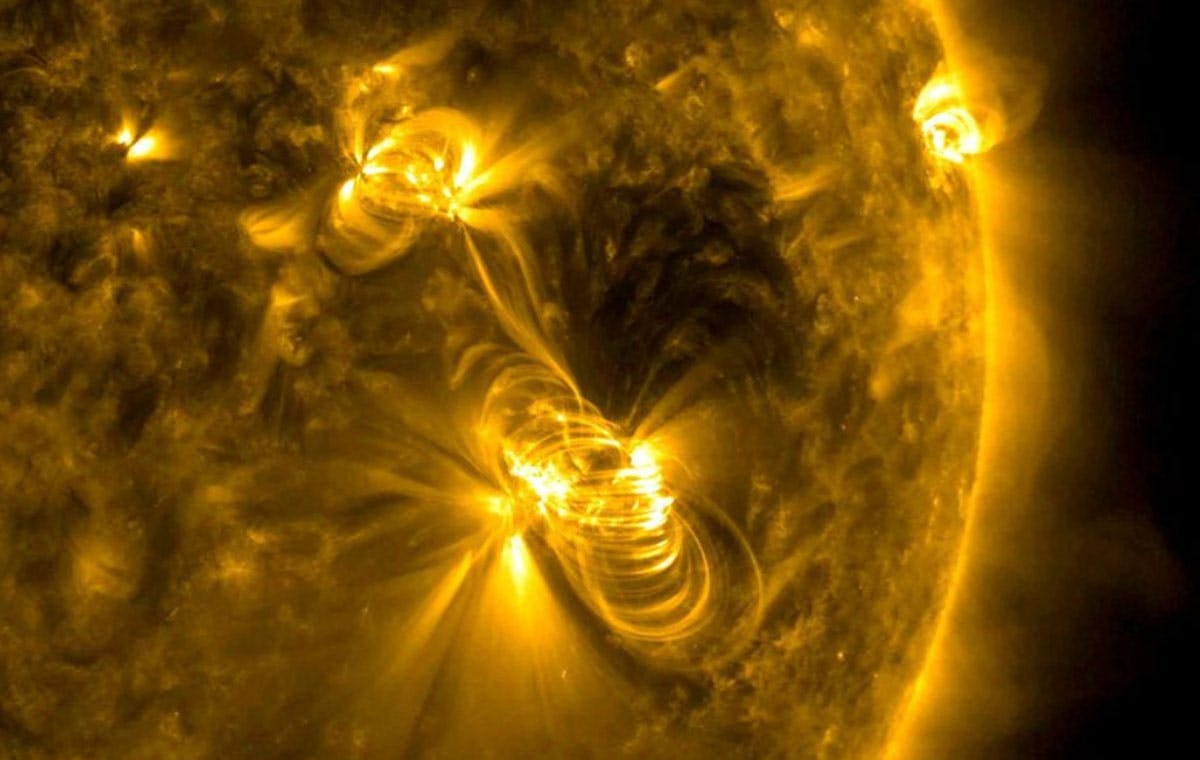
Several social media posts claim that a solar “superstorm” can lead to an internet apocalypse. Some use a Fox News art card, with the headline “Solar superstorm could ‘wipe out the internet’ for weeks or months, scientist says.”
TV5’s “Frontline Tonight”has also reported on the “superstorm” last week, noting scientists are creating an early warning system against increased solar activity. Like other social media posts, “Frontline Tonight” noted the solar superstorm can cripple the internet worldwide for months.
On Nov. 8, Fox Weather did run a story cited by social media posts where Peter Becker, a professor in George Mason University’s Department of Physics and Astronomy, was interviewed.
Becker is the principal investigator in the early warning system being developed, as mentioned in “Frontline Tonight.” He and his team are working with the United States’ Department of Navy on $13.6 million (P753.13 million) in federal grants to study and better understand increased solar activity that could potentially cause an “internet apocalypse” disrupting all electronic communications on Earth, including satellite communications.
In the interview, Becker acknowledged the increased coverage of US-based broadsheets on a potential “internet apocalypse.” According to him, the discussions could have been sparked by “an increase in [solar] flares.”
Becker also noted the concept of coronal mass ejections, a “cannon shot” in increased solar activity. CMEs are “large explosions plasma and magnetic fields from the Sun’s corona,” and can distort the planet’s magnetic field upon impact.
“But we can tell when they're actually going to head towards Earth. And that gives us about 18 hours of warning, maybe 24 hours of warning, before those particles actually get to Earth and start messing with Earth's magnetic field," Becker said of their early warning system.
Becker’s interview comes amid a nearing “solar maximum” phase, or a peak in the sun’s 11-year solar cycle. The National Aeronautics and Space Administration (NASA), said it is the time of “greatly increased solar activity,” which can lead to more solar flares and CMEs.
According to The US’ National Oceanic And Atmospheric Administration (NOAA) in October, the solar maximum for the current solar cycle would occur between January and October 2024.
Becker cited the Carrington Event of 1859, and the Halloween solar storms in 2003 as examples of how solar activities affected technology. The professor expounded on the Carrington Event, noting it was a CME which “totally wiped out the telegraph system,” which was “their internet of the day (in 1859).”
According to Becker, “sparks flew” off telegraph lines during the occurrence, and some operators were rumored to have been electrocuted. The telegraph system was also down for a matter of weeks, Becker said.
“And of course the telegraph system is very robust compared to the modern internet with all our little cables and fibers and things. So an event like that occurring now, is something the internet is not built to handle…so we’re not just talking the electrical grid, but huge economic consequences, especially because of the global, wired economy now,” Becker said, adding the US economy alone can lose $10 to 20 billion daily as a result.
With the early warning system, Becker says mitigation measures may be taken, like switching off infrastructures. For the long term, he said “hardening” the infrastructure may be needed.
In March, NASA bared aiding an international group of researchers at the Frontier Development Lab. According to the space agency, the team developed a computer model which combines artificial intelligence (AI) model, with NASA satellite data to predict impending solar storms 30 minutes in advance.
NASA did acknowledge past solar storms, such as one in 1989, which led to a 12-hour blackout in Quebec, Canada, and affected schools and businesses.
The Carrington Event was also mentioned. Should it happen today, NASA noted: “It would have even more severe impacts, such as widespread electrical disruptions, persistent blackouts, and interruptions to global communications. Such technological chaos could cripple economies and endanger the safety and livelihoods of people worldwide.”
“In addition, the risk of geomagnetic storms and devastating effects on our society is presently increasing as we approach the next ‘solar maximum’,” NASA stated.
NOAA noted general effects of “space weathers and hazards” through Mark Miesch, solar cycle lead of their Space Weather Prediction Center.
Miesch
noted that such phenomena can “interfere with the electrical grid,
degrade GPS signals, increase orbital drag on satellites, and pose
radiation hazards to airline crews and astronauts.” Stronger solar
cycles produce more solar storms with greater intensity and therefore
pose a larger hazard for these critical technologies and services, he
added.


