



#NeverAgain #NeverForget: Fight To Recover Plundered Funds During Martial Law Continues
Filipinos are criticized for having a short memory and not learning from the past, even if there is the martial law regime to remind them of the abuses committed by people in power and their duty to guard their rights and freedoms.
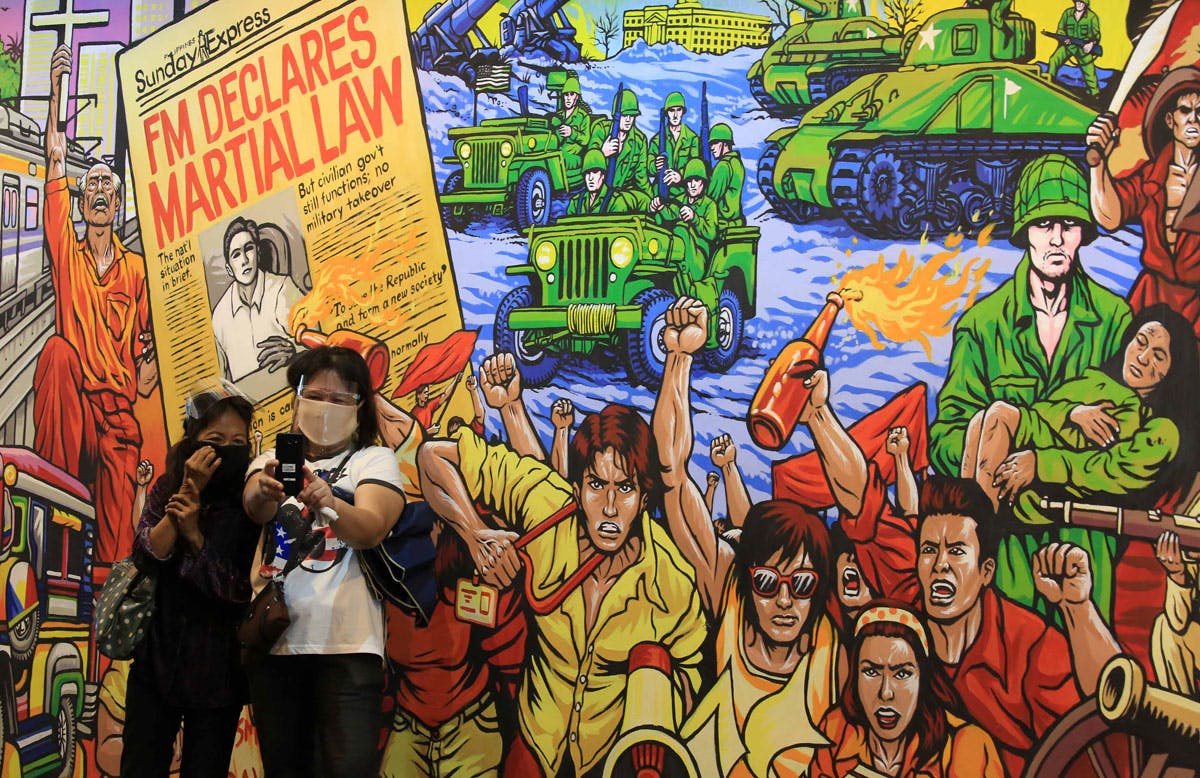
The government’s battle to recover the public funds plundered during the martial law regime still has a long way to go, following the setbacks caused by the dismissal of several civil forfeiture cases by the Sandiganbayan in 2019.
“For those who remember the Marcoses, martial law, and all the abuses committed during this period, these recent decisions [by the court] are very painful and serve as a reminder that the fight against abuse of power, graft and corruption is a long process, but justice must still be the goal,” University of the Philippines-Diliman Political Science professor Maria Ela Atienza said in an e-mail interview with The Philippine STAR.
Last year saw the dismissal of four civil forfeiture cases filed by the Presidential Commission on Good Government (PCGG) before the Sandiganbayan against the Marcos family and their alleged cronies following the 1986 people power revolt that led to the ouster of dictator Ferdinand Marcos.
Among those dismissed by the anti-graft court was Civil Case No. 0002, which sought to recover P200 billion in alleged ill-gotten wealth from the Marcos partriarch, his widow Imelda, their children Imee, Ferdinand Jr. or Bongbong and Irene Araneta as well as the former president’s alleged dummy, Constante Rubio.
Also junked last year were Civil Case Nos. 0007, 0008 and 0034, which sought to recover from the former first family alleged ill-gotten wealth amounting to P267.371 million, P1.052 billion and P102 billion, respectively.
In all of these dismissed cases, the Sandiganbayan had cited the “insufficiency of evidence” presented by the PCGG, represented in court by the Office of the Solicitor General (OSG).
The anti-graft court said that in the 30 years since the cases were filed, all that the PCGG was able to present were mere photocopied documents, with no proof of existence of the originals.
The anti-graft court said the PCGG also failed to present competent witnesses to testify on the execution or preparation of a few documents, which were already admitted by the defense as faithful reproductions of the originals. Thus, the court ruled that the documents could also not be given probative value as they are considered as “hearsay evidence.”
“It has been decades and the Philippine government has not completely recovered all ill-gotten wealth,” Atienza said. “It is likely that due to the long period that elapsed since the creation of PCGG, there have been a lot of turnovers in terms of personnel.”
“However, for an important government agency such as the PCGG, original documents and testimonies of credible witnesses should have been secured regardless of changes in officials and personnel through the years,” she added.
Atienza expressed belief that these recent decisions would reinforce the general public’s negative perceptions of the country’s judicial system.
“The long process within the legal system as well as the decisions on the four cases also unfortunately reinforce perceptions of certain sectors, not just the grassroots, that the justice system in the country is very slow and in many instances, wealthy, influential people have the advantage in the judicial system,” she said.
In a separate e-mail interview with The STAR, PCGG acting chairman Reynold Munsayac admitted that the agency had encountered difficulties in the gathering of documentary evidence as most of the originals remain in the possession of the defendants.
“As far as the PCGG is concerned, it was able to present all the available evidence in its possession to support the claims of the government,” Munsayac said.
“When the courts state in their decisions that the government merely presented photocopies, it does not mean that the government is in possession of the originals and they just chose to submit photocopies. Most of the time, the government can only acquire photocopies of certain documents from witnesses as the originals are in possession of the principal defendants themselves,” he pointed out.
Munsayac also maintained “that no single document or evidence was lost during the tenure of the present PCGG administration.”
“In fact, the cases recently decided by the Sandiganbayan were all filed and litigated by the past PCGG administrations as some of them were already submitted for decision as early as 2010. Simply put, the insinuations that the present officers of PCGG and/or OSG should be blamed for those cases are unfair as their participation in the cases recently decided was mostly limited to awaiting the Sandiganbayan’s rulings,” he said.
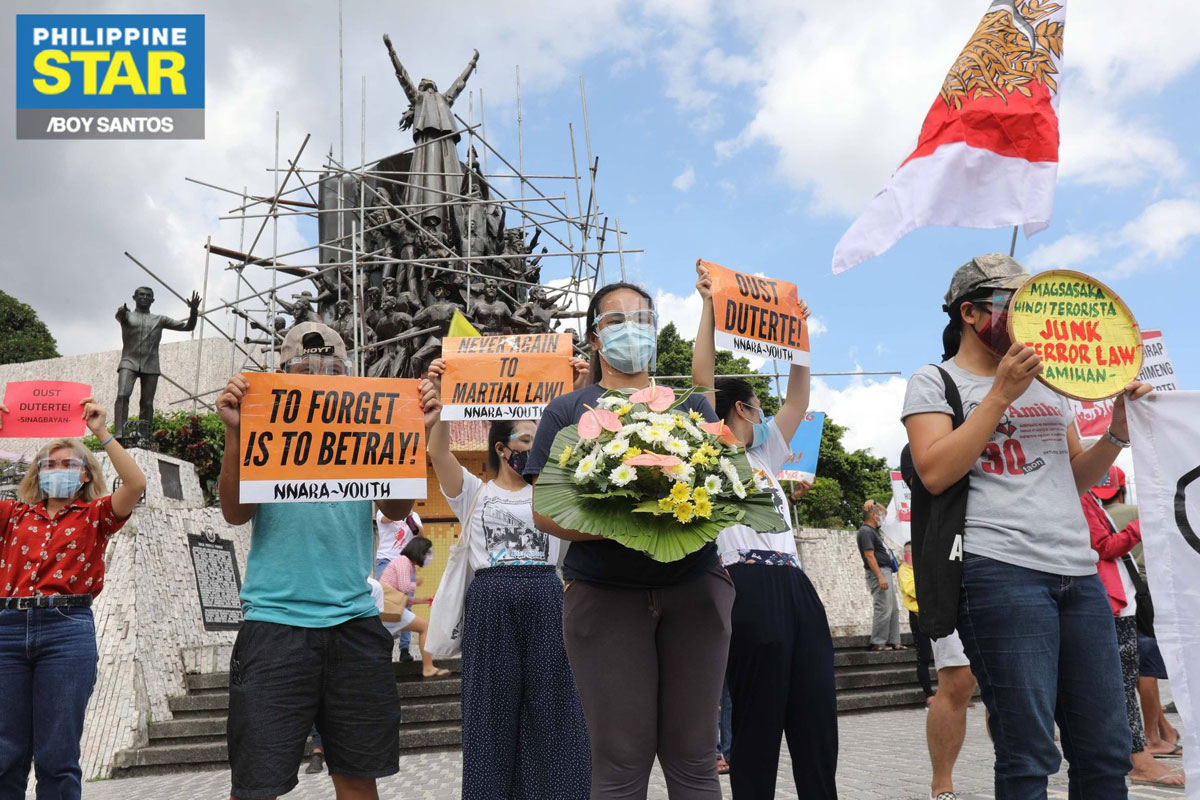
Silver linings
Still, not all is lost in the government’s legal battle to recover the Marcoses’ wealth.
The Sandiganbayan First Division, just a week before Christmas last year, promulgated a partial summary judgment awarding in favor of the government $24.325 million worth of paintings and other artwork amassed by the Marcos couple during their family’s 20-year reign.
The Special First Division had also awarded to the government in 2014 part of the jewelry collection of the Marcoses with an assessed value of $110,055 to $153,089.
Both the artworks and the jewelry were covered by Civil Case No. 0141.
The Sandiganbayan Third Division, on Dec. 5, 2019, meanwhile, ordered the forfeiture in favor of the government of the shares of stocks in three sequestered companies owned by the alleged cronies of Marcos.
The Third Division said the shares of Eastern Telecommunications Philippines Inc. in the names of Jose Africa and Manuel Nieto Jr., Polygon Investors and Managers Inc., and Aerocom Investors and Managers Inc. “are ill-gotten wealth of defendant Ferdinand Marcos; hence should be reverted/reconveyed to the Republic of the Philippines.”
The court did not specify in its decision the total amount of shares to be awarded to the government.
Nonetheless, Africa and Nieto were told to pay the government P1 million as exemplary damages while Aerocom Investors was ordered to pay P68.167 million.
Atienza said these court rulings in favor of the government could be considered as “silver linings” as these serve as proof that wrongdoing was committed by the Marcoses and their cronies during the martial law regime.
Munsayac, meanwhile, said that since its creation in 1986 up to June 30, 2019, the PCGG has recovered a total of P173.241 billion in ill-gotten wealth of the Marcoses and their cronies.
Of this amount, Munsayac said P78.6 billion was remitted to the Bureau of the Treasury (BTr) to finance the various agricultural programs and activities under the government’s Comprehensive Agrarian Reform Program or CARP.
Munsayac said $200 million, now equivalent to P10.533 billion, was also remitted to the BTr in 2004, sourced from the recovered Swiss deposits of the Marcos couple.
In accordance with Republic Act No. 10368 or the “Human Rights Victims Reparation and Recognition Act of 2013,” the funds shall be used as reparation for the victims of summary execution, torture, enforced or involuntary disappearance and other gross human rights violations during martial law, Munsayac noted.
He said the PCGG intends to recover an additional P100.7 billion in Marcos assets, which are still under litigation.
In 1987, the PCGG filed a total of 43 civil forfeiture cases at the Sandiganbayan against the Marcos family and their cronies. To date, 17 of these cases remain pending, 23 were dismissed and three were decided in favor of the government.
Gov’t loses P246 M from deterioration of Marcos wealth – COA
The government has lost P246.012 million in potential income due to the impairment of several assets seized from the Marcos family and their alleged cronies, a report by the Commission on Audit showed.
In its 2019 annual audit report on the PCGG, the COA noted that 57 assets seized from or surrendered by the Marcoses and their cronies with a total carrying amount of P506.543 million remain unsold by the commission after many years.
The assets have not been revalued or reappraised since their initial recording in the PCGG’s books under the account name “Abandoned/Surrendered Property/Assets.”
State auditors said this rendered the assets’ declared value under the PCGG’s account “unreliable,” considering that some of them have already deteriorated with the passage of time.
“After two decades, 50 of these properties remained unsold bearing the same carrying amounts since July 31, 2000,” the report read.
The same holds true for four other properties initially booked up on Dec. 31, 2005 based on a 2003 appraisal, and three properties booked up on Dec. 31, 2013 based on an appraisal on Sept. 20, 2013, the COA said.
Among the assets listed by the COA, which the PCGG failed to sell and reappraise, are land properties in Laoag City and Davao City under the International Broadcasting Corp.; land property in Roxas City under IBC-13’s radio station dyJJ-AM Radyo Budyong; three parcels of land in Bataan under Piedras Petroleum Corp. surrendered by the late Philippine ambassador to Japan Roberto Benedicto, and a land property in Cavite under the Banahaw Broadcasting Corp. that was also surrendered by Benedicto.
Also unsold and not yet reappraised are land properties in Tagaytay City and in Calapan and Puerto Galera in Oriental Mindoro recovered from the late Jolly Bugarin, who served as director of the National Bureau of Investigation during the martial law regime, as well as land properties in Bacoor, Cavite and Barangay Pala-Pala in Iloilo City, whose owners were not identifed in the COA’s records.
The COA said there were also unsold and still to be reappraised buildings, office equipment, furniture and fixtures.
The audit body reminded the PCGG that under Volume 3 of the Government Accounting Manual (GAM) for national government agencies, abandoned or surrendered assets shall be subjected to annual impairment testing “to assess whether there was an indication that an asset may be impaired such as physical damage, or if its carrying amount exceeds its recoverable amount.”
“The [PCGG] Management also did not conduct impairment testing on all its depreciable properties such as land improvements, buildings, office equipment, and furniture and fixtures. These types of assets gradually lose their ability to provide service over the course of time,” the COA said.
The state auditors said a “conservative” computation made by the audit team showed that some of the depreciable assets of the Marcoses and their alleged cronies, with carrying amount of P283.304 million, have already incurred impairment losses of P246.012 million, leaving a recoverable amount of only P37.292 million.

The COA explained that the computation is based on the prescribed estimated useful lives of depreciable assets based on Chapter 10 of the GAM.
Under the GAM, buildings and other structures have a useful life of 20 to 50 years; machinery and equipment, five to 15 years; and furniture and fixtures, two to 15 years.
“Using a conservative approach and excluding the period of service rendered by the properties prior to abandonment/surrender, the amount of impairment loss was estimated at P246,012,595.41 representing the decrease in value or physical decline in the condition of the properties due to wear and tear; thus, diminishing the potential income that could be derived from the sale of the properties which remained unsold for over 19 years,” the COA said.
COA told the PCGG to “regularly conduct impairment testing and revaluation of all abandoned/surrendered property/assets, and adjust the books accordingly.”
The COA also directed the PCGG to hasten the sale of the abandoned/surrendered assets, giving priority to the depreciable ones “to avoid further deterioration or loss and ultimately augment the budgetary requirement of the CARP.”
Lesson not learned
As the Philippines commemorated the imposition of martial law 48 years ago on Monday, Sept. 21, the police – who failed to regulate crowds at the Manila Bay white beach over the weekend – cited the coronavirus disease 2019 (COVID-19) as pretext for dispersing an all-women group about to file a petition against the Anti-Terrorism Act before the Supreme Court (SC).
The police stepped in after the group of petitioners led by lawyer Virginia Suarez chanted “Never again! Never again!” and called for the junking of the law. It treated the event as a mass gathering, and claimed the women held their picket in front of the SC without observing physical distancing.
Officers also claimed there was a blanket ban on holding rallies because passing around placards and chanting their demands can transmit the virus. They tried to confiscate a tarpaulin. The standoff was livestreamed on Facebook by Suarez’s group Kilusan Para sa Pambansang Demokrasya.
After a dialogue, police officers allowed the petitioners to proceed with the filing of the petition with them watching. It was the first time that the police had stepped in, out of the 35 times that legal challenges were brought to the SC since its enactment in July.
Suarez’s group questioned the constitutionality of the Anti-Terrorism Act on free speech grounds. Opponents of the law have flagged its provisions as vague and overbroad, giving abusive law enforcers a loophole to arrest protesters and government critics.
Although Section 4 states that terrorism “shall not include advocacy, protest, dissent, stoppage of work, industrial or mass action, and other similar exercises of civil and political rights,” it also contains a caveat that these acts should be “not intended to cause death or serious physical harm to a person, to endanger a person’s life, or to create a serious risk to public safety.”
Before the police interrupted, Suarez said the enactment of the Anti-Terrorism Act showed that “latag na latag na ang kundisyon ng diktadura ng martial law (the conditions for a martial law dictatorship have been really laid out).”
“Ang Anti-Terror Law, ’yan ang ultimong pagpapakita ng diktadura. Napakarami na nating karanasan dito sa diktadura. Hawakan natin ’yon para magsilbing aral at huwag nang payagan (The Anti-Terror Law is the ultimate show of dictatorship. We have had many experiences with dictatorship here. Let’s hold on to them and learn the lessons and never allow them again),” Suarez said.
“Naniniwala kami… na pinipilit tayong patahimikin ng Anti-Terror Law at hindi natin papayagan ’yun (We believe that we are being silenced by the Anti-Terror Law and we will not allow that), because silence breeds impunity and impunity breeds violence,” she added.
The women’s groups were able to stage a rally in the traditional protest ground of Mendiola before trooping to the SC on Padre Faura Street, as shown by pictures posted by The STAR.
Prior to the incident with Kilusan, humanitarian and faith-based groups Caritas Filipinas Foundation Inc., Philippine Misereor Partnership Inc. (PMPI), Disaster Risk Reduction Network Philippines and Caucus of Development NGOs Inc. or CODE-NGO also marked Sept. 21 with the filing of their petition.
Humanitarian groups, especially in Mindanao, have not been spared from “vilification.” They questioned the law’s criminalization of giving assistance to communities that may be labeled by the government as “terrorist,” as well as the provision for the freezing of the assets of organizations designated as “terrorist.”
In a statement, PMPI representative Yolanda Esguerra said the law “will legitimize these attacks against humanitarian and development organizations,” which is no different during the martial law era.
This was one of the apparent parallelisms seen by groups between Marcos and President Duterte, who counts the Marcos family as his political allies and allowed the burial of the dictator’s remains in the Libingan ng mga Bayani in 2016.
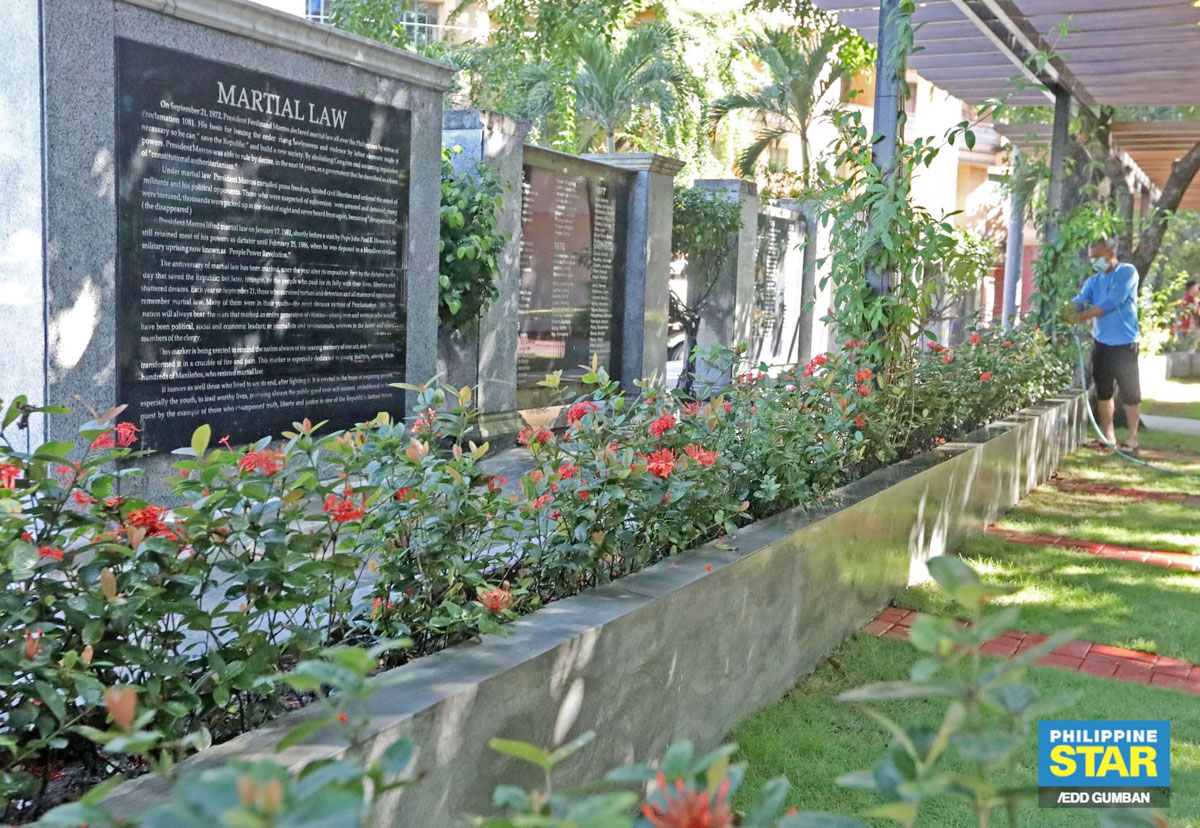
The Samahan ng Ex-Detainees Laban sa Detensyon at Aresto (SELDA), a group of martial law survivors, also said that the struggle continues 48 years since martial law was declared.
The group said Marcos “unleashing atrocities and injustices” against the Filipino people and that it was during his dictatorship that one of the biggest heist of the country's coffers was conducted.
“The Marcos regime blatantly violated civil liberties and people's rights and shut down Congress, the courts, and critical and independent media. Opposition leaders, critics, activists, church leaders, unionists, and organizers were illegally arrested and detained, abducted, tortured, killed or forcibly disappeared," SELDA recalled.
"We are among those who stood against and survived Marcos' tyrannical rule, and we remember this day with the memories of the lives of the people’s martyrs and victims of the Marcos dictatorship who fought for our rights and freedoms," the group said.
Even without the formal declaration of martial rule, the group alleged Duterte appointed former military and police generals in different government posts and agencies. “Under the guise of maintaining 'peace and order' and 'going after corruption and terrorism,' state forces have come after members of the political opposition, activists working for social change, human-rights defenders, and critics through vicious red-tagging, threats, illegal arrest, and killings."
Further, the group said "Duterte stretched his Marcosian delusions through the passage of draconian measures. Through Congress, he seeks to sow fear and amplify the culture of impunity through the Anti-Terror Law and the revival of the death penalty. The administration shut down the network giant ABS-CBN in an attempt to further suppress press freedom in the country."
Amid the global pandemic and the ballooning number of COVID-19 cases, the group assailed the administration for “prioritizing” projects such as the P389-million white beach along a portion of Manila Bay and extending lockdowns without substantially addressing the need for comprehensive and pro-people medical and socioeconomic policies and actions.
Malacañang disputed claims that the Philippines is under a "de-facto martial law," saying Duterte does not have the powers exercised by the late strongman.
"The context is very much different today. Before Congress can be shut down. The Supreme Court can be shut down. Now, the President does not have that power," presidential spokesman Harry Roque said in a press briefing in Cagayan de Oro City.
Roque noted that the President's decision to impose martial law can now be questioned before Congress and the judiciary.
"Dahil nga natuto na tayo sa mapait na karanasan sa martial law (It’s because we have learned from the painful experience during Martial Law)," the Palace spokesman said.
Push back against the lies
Vice President Leni Robredo also urged the country to “push back” against lies that seek to revise history and clean up Marcos’ image. She stressed the need “to hold firm to the truth of this painful chapter of our history, and through this, forge the determination to never again let our people fall into such despair.”
The people should “tell the stories of martial law and dictatorship over and over so that this generation, and the ones that come after, may be bound tighter through remembering,” said Robredo, who defeated the dictator’s son Ferdinand Jr. in the 2016 elections by a narrow margin of 263,473 votes.
“These truths know no political color, but come starkly in the black and white of our lived experience as a nation. Walang debate dito; nangyari ito (There’s no debate here; these things happened),” the Vice President said.
“And those who attempt to tell us otherwise are not only merely telling a supposed version of the story – they are lying to our faces, stealing our truths from us, stealing our stories. Because without these truths and stories, we will be further divided, at mas madaling magtatagumpay ang mga pagtatangkang abusuhin muli tayo (and it will be easier to succeed in attempts to abuse us again),” she added.
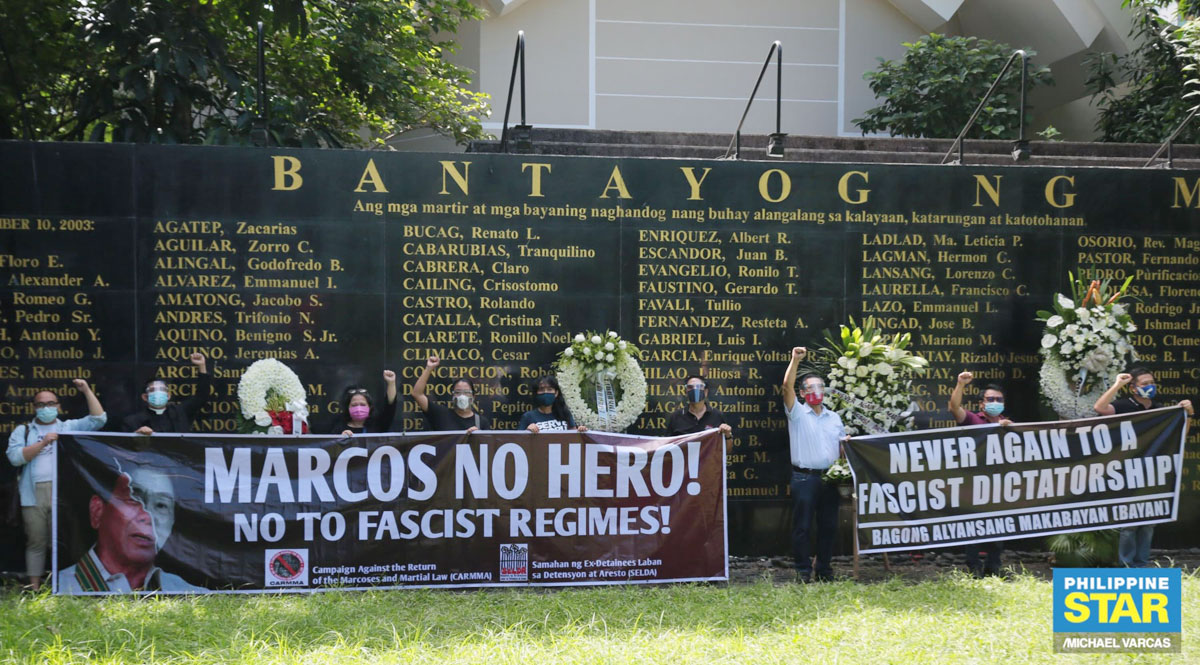
The Commission on Human Rights noted that too many have continued to wash their hands of the abuses and violence committed by the state against its people.
Recalling the CHR’s creation as a direct response to the atrocities of the Marcos regime, spokesperson Jacqueline Ann de Guia said: “Hindi nakasalalay sa mga institusyon lamang ang paggigiit ng karapatan at pagbabantay sa pagmamalabis sa kapangyarihan. Bawat isa sa atin ay kinakailangang maging kritikal at mapagmatyag sa mga ipinapalaganap na kasinungalingan ng mga mapagsamantala at walang tunay na malasakit sa masa (Asserting our rights and watching out against abuse of power does not rely on the institutions only. Each one of us needs to be critical and watchful of the lies propagated by the abusers and those who do not care for the people).”
De Guia wondered if the killing of thousands of people could be considered “prosperity,” as Marcos loyalists and apologists claimed existed during his rule.
She said there could be no healing from the pain of the past without a collective acknowledgment by everyone of the inhuman treatment of those who dared criticize the government.
“Hindi natin madidepensahan ang ating mga kalayaan at mga karapatan kung hindi natin isasabuhay ang mga aral na ipinakita na mismo sa atin ng kasaysayan (We cannot defend our freedoms and rights if we do not live the lessons shown to us by our history itself),” she said.
The University of the Philippines Institute also urged the “Filipino nation to resist the forces of revisionism, to remember this tragic history, and in so doing reject its unwelcomed repeat.” It posted on its Facebook page a series of photos depicting the atrocities committed during the Marcos regime and the accounts of persons who survived the abuse.
For his part, Roman Catholic Archdiocese of Manila apostolic administrator Bishop Broderick Pabillo declared that Filipinos have not learned their lessons from martial law.
“I think we have not learned our lessons. People are not vigilant and are not courageous enough to speak out. They do not vote seriously. They allow themselves to be bullied,” Pabillo said.
Similarly, Bishop Ruperto Santos of Balanga, Bataan said he was “sad to say we tend to forget and take it for granted.”
Sins of the Marcos regime
Marcos was called a dictator because he abolished Congress and his directives became the law. He also gave himself the power to order the arrest of individuals without warrant and keep them detained without charges for as long as a year.
Thousands of Filipinos, including dissidents and peasants, were imprisoned, tortured, murdered or involuntarily disappeared under Marcos’ two-decade rule. Private businesses and property were confiscated and the coconut levy was imposed upon impoverished farmers to enrich the dictator’s allies and cronies, who established virtual monopolies.
The Marcos family was also accused of amassing ill-gotten wealth estimated to have totaled $5 billion to $10 billion. The former dictator evaded criminal liability as he died after a three-year exile in Hawaii in 1989.
After the case crept slowly over two decades, Imelda – known for her lavish displays of wealth despite of her country’s abject poverty – was convicted of graft by the Sandiganbayan in 2018 for illegally setting up Swiss bank accounts to stash hundreds of millions of dollars.
She was also found guilty of participating in the management of foundations for the benefit of her children Imee and Ferdinand Jr., even when Cabinet members like her were prohibited from doing so by the 1973 Constitution.
Under the Human Rights Victims Reparation and Recognition Act of 2013, the state’s policy is to officially “recognize the heroism and sacrifices of all Filipinos who were victims of summary execution, torture, enforced or involuntary disappearance and other gross human rights violations committed” during the Marcos regime.
The state also acknowledges “the sufferings and damages inflicted upon persons whose properties or businesses were forcibly taken over, sequestered or used, or those whose professions were damaged and/or impaired, or those whose freedom of movement was restricted, and/or such other victims of the violations of the Bill of Rights.” – With Helen Flores, Rhodina Villanueva, Alexis Romero


