


Marcos: Phased Face-To-Face Classes Rolled Out In September
President Marcos said implementing full face-to-face classes would require discussions on COVID-19 vaccination “because there are going to be some issues that would be raised.”
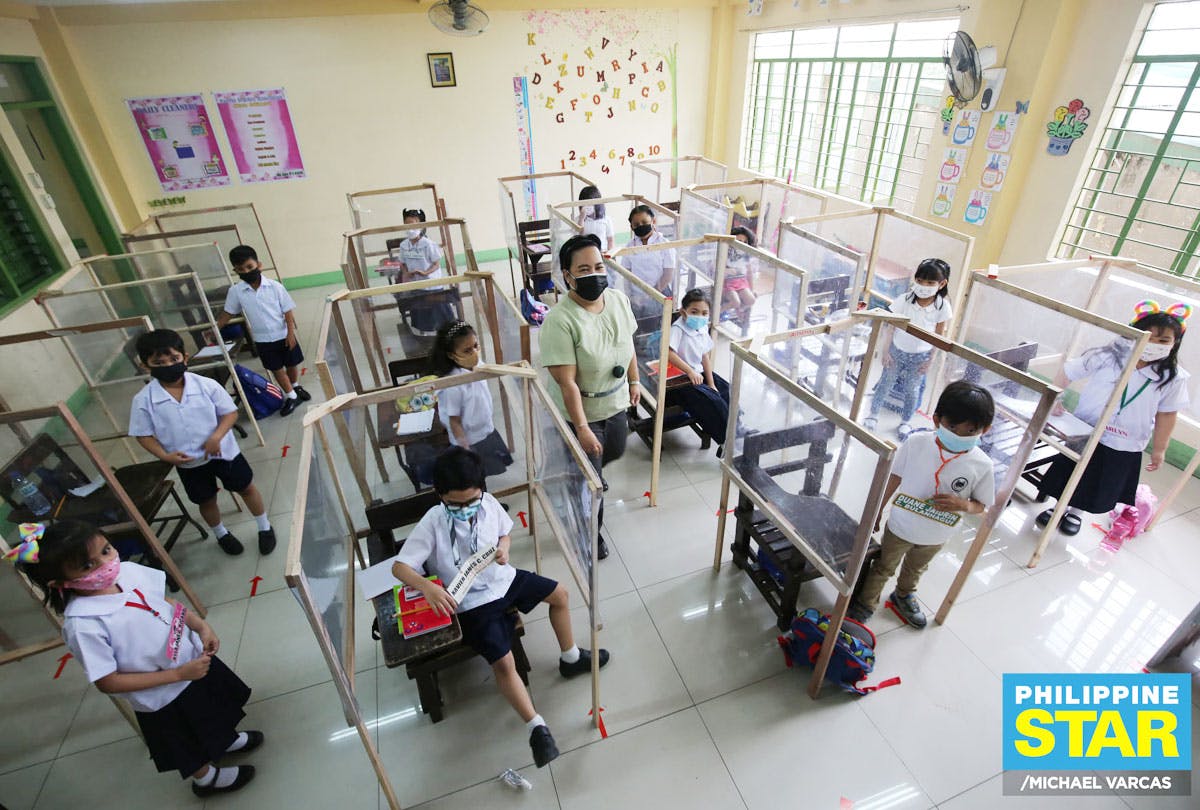
As the Philippines, especially Metro Manila, continues to record an uptick in COVID-19 cases, the government will roll out phased face-to-face classes in September before the conduct of full in-person learning, President Marcos announced on Tuesday, July 5.
“There are some things that are immediately accessible in the sense that we can start doing something about it already. The first thing that is an example of that was Vice President Sara Duterte’s announcement that we have a plan for full face-to-face learning by November of this year,” Marcos said at a press briefing.
“In September, we will start a phased face-to-face schooling. And that face-to-face will end up in early November,” he added.
Marcos said implementing full face-to-face classes would require discussions on COVID-19 vaccination “because there are going to be some issues that would be raised.”
According to Marcos, Duterte, who is also the education secretary, has proposed the conduct of full in-person classes in November.
Earlier, the National Economic and Development Authority (NEDA) expressed support for the resumption of face-to-face classes, saying it would enhance productivity and learning outcomes as well as create more business opportunities.
Former NEDA director general Karl Chua has said implementing in-person learning would increase economic activity by P12 billion per week because of the resumption of services around schools such as transport, dormitories, food stalls and school materials.
The holding of face-to-face classes, not just the easing of pandemic restrictions, is necessary to achieve full economic recovery, Chua said.
The education department previously said 34,238 schools have been nominated for the conduct of in-person classes as of May 26. Of the number, 33,000 are public schools while the rest are private learning institutions.
Online classes
The Coordinating Council of Private Educational Associations of the Philippines (COCOPEA) has asked the Department of Education (DepEd) to allow private schools to continue offering full online classes as an option for students in the upcoming academic year.
COCOPEA managing director Joseph Noel Estrada said they wrote a letter to former education secretary Leonor Briones after she pushed for the resumption of full face-to-face classes.
“We are appealing on behalf of parents who still prefer online classes – given the uncertainties of the pandemic surge,” Estrada said in a message to The Philippine STAR.
A full copy of the letter has yet to be released.
During a virtual meeting with private school associations on Monday, July 4, Duterte said the DepEd is considering the request.
She recognized the challenges faced by private schools amid the pandemic.
“I understand that many private schools across the country are suffering from losses. Some schools are facing closure and a number have in fact shut down,” Duterte said.
“As a community, there is an urgent need to build back stronger and better. The migration of students from private to public schools has put enormous strain on public schools,” she added.
The Vice President asked the private school groups for their indulgence and support as they explore appropriate measures to address challenges in the education sector.
“Now that we are finally ready to open the doors to face-to-face classes, we need the help of private schools in bringing our children back to school,” Duterte said.
“Our task here is to protect our children and ensure that quality education is made accessible for them – whether they are enrolled in private or public schools, whether they are in the cities or the countryside,” she added.
Meanwhile, the Kalayaan College (KC) in Quezon City announced on Tuesday its decision to end its operations due to continuing financial losses due to the impact of the COVID-19 pandemic.
“With no other options, the board of directors of Kalayaan College Inc. decided to end the operations of the school due to continuing financial losses brought by declining student population and exacerbated by challenges due to the pandemic,” school president Ma. Olivia Domingo said in an advisory.
“This decision will become final after ratification by the majority of the stockholders. KC has informed the Commission on Higher Education (CHED) of this decision and will abide by whatever requirements the regulatory body shall advise KC to comply with,” she added.
Established in 2000, KC was founded by professors from the University of the Philippines, including the late university president Jose Abueva.
It offers nine degree, one associate (computer technology) and one certificate (fine arts) programs administered by four academic divisions.
According to KC, it will continue to offer limited number of general education and major subjects in the upcoming school year to enable senior-level students with a few remaining courses to complete their respective degree programs.
Registration will start on the second week of August, with online classes scheduled to start on Aug. 15.
“Non-senior students who will enroll in the limited course offerings are welcome to do so without any guaranty that they will be able to complete their degree programs,” it added.
Senior students whose remaining courses will no longer be offered next school year will be allowed to cross-register in other schools to enable them to complete their degrees.
The college also committed to immediately process the transfer credentials of students who will file an application for transfer to other schools, provided they have settled their financial obligations in full.
“The board apologizes for this short notice and extends its gratitude to the students and parents who put their trust in Kalayaan College. We take this opportunity to thank our faculty and staff for their dedicated service,” Domingo said.
Sought for comment, CHED chairman J. Prospero De Vera III said the commission would require KC to provide an exit plan to make sure that the interests of affected students and faculty are protected.
He said students should be assisted to enable them to graduate or transfer to other schools to complete their degrees, while the faculty are paid based on labor laws.
Free rides, fuel subsidy
In another development, Marcos vowed on Tuesday to continue the government’s fuel subsidy program for transport workers and the free rides to students as various sectors call on the administration to soften the impact of oil price hikes.
Marcos said the government has funding to implement the fuel subsidy program, but needs to look for financial resources to sustain it beyond this year.
“We discussed that we are going to try not only to continue the fuel subsidies for the transport sector but to expand it to include the tricycles, which up to now have not been included,” he said.
Tricycles are already covered by the existing fuel subsidy program.
Under the transportation department’s fuel subsidy program, financial assistance worth P6,500 will be given to qualified drivers of jeepneys, UV express, mini buses, buses, shuttle services, taxis, tricycles and other full-time ride-hailing and delivery services nationwide. The program is expected to benefit more than 377,000 drivers.
The government is also implementing a fuel discount program for farmers and fisherfolk who own agricultural or fishery machinery. The beneficiaries can receive up to P3,000 fuel discount. The previous administration has allocated more than P6 billion for the fuel subsidy and discount programs.
Marcos said the free ride program would also continue under his watch to assist students who are returning to schools for the resumption of in-person classes.
“Libreng sakay continues, as is. But what we are going to do is we are going to do a program for the students. Because if they come in, we will fully subsidize first their fares,” the President said.
“We’ll phase it out because we cannot afford to keep that going. But students will ride for free on the LRT 2, which is going to the university belt,” he added.
Earlier, Marcos approved the extension of free EDSA carousel bus rides until the end of the year. – With Janvic Mateo