



Marcos On Oil Supply: No Need To Panic
“I do not think that there is a problem. In our analysis, we do not have a problem with the supply of petroleum and petroleum products,” President Marcos assured the public on Wednesday, March 25.
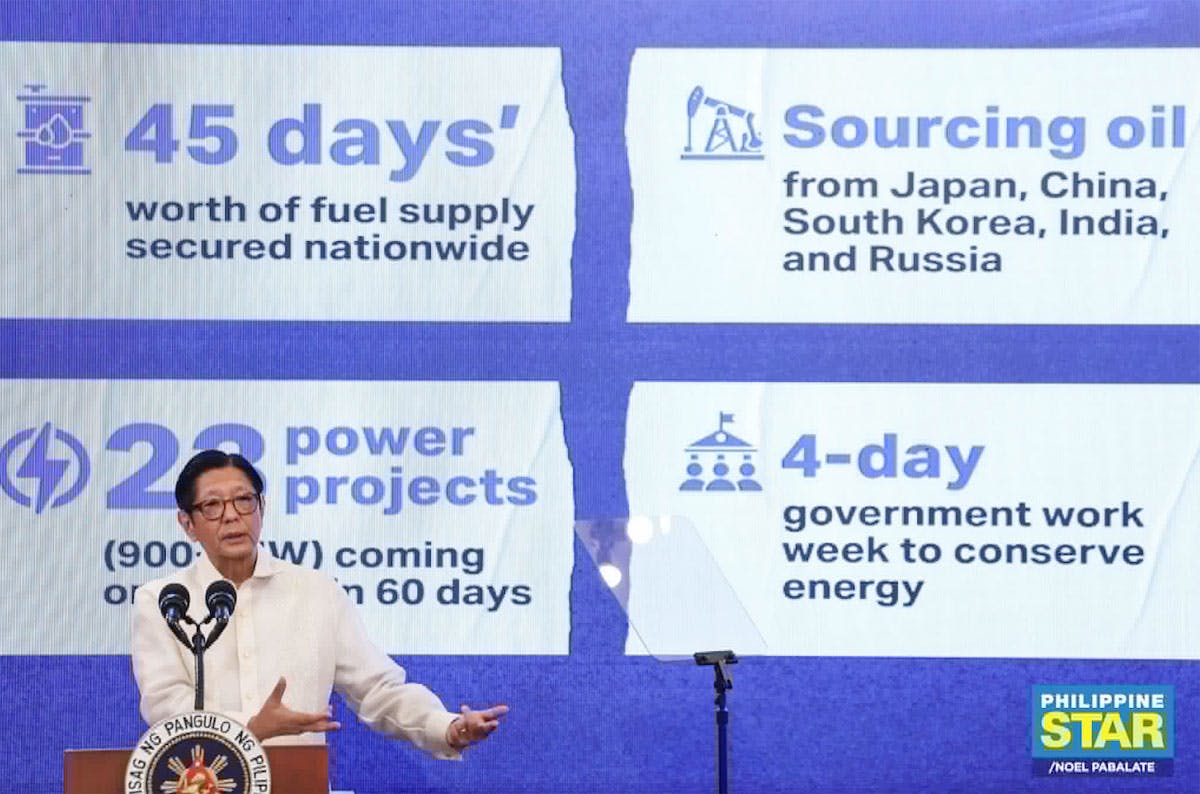
Allaying concerns over the country’s oil supply, President Marcos gave assurance on Wednesday, March 25, that there would be a “flow of oil” even after the 45-day supply is consumed, as the government looks for fuel sources to ease the price shocks caused by the Middle East war.
In an address delivered a day after declaring a state of national energy emergency, Marcos said the government won’t stop searching for new oil supply sources since nobody knows when the conflict would end.
“Although we cannot be assured right now of the supply, we can be sure that at least for 45 days we will be alright. I think that we can be fairly confident – we can be confident that after the 45 days, we still have (oil that) already arrived here in the Philippines,” the President said.
“We will (already have) a flow of oil, not just one delivery, not just two deliveries but a flow of petroleum and petroleum-related products,” he added.
Marcos said his administration has ensured that the oil contracts it signed are honored by the suppliers. The government came up with new systems to ensure that the country would have a steady oil supply, he added.
“We have not only gone to the oil suppliers, the traditional oil suppliers, we have tried to explore other sources that are not affected by the war that is ongoing in the Middle East,” the Chief Executive said, adding that the supply deals were made possible by the Philippines’ “good relations” with its partner countries.
“It would be premature to say that we have perfected contracts with them. But I think it's sufficient to say that things are beginning to open up.”
The President reiterated that there is no need to panic because of the Middle East developments and that the government is doing everything it can “to assess and to alleviate the situation.”
“And right now, I’m very confident in saying that we have sufficient supply. We will continue to source those supplies,” Marcos said.
“And I do not think that there is a problem. In our analysis, we do not have a problem with the supply of petroleum and petroleum products,” he added.
Government takeover?
Asked if the government would temporarily take over oil firms, Marcos replied: “We don't want to get into that discussion.”
The Downstream Oil Industry Deregulation Act of 1998 allows the Department of Energy (DOE) to temporarily take over or direct the operations of entities engaged in the downstream oil industry in times of national fuel emergency.
To lessen the effects of the Middle East war, Marcos issued on Monday Executive Order (EO) No. 110 declaring a state of national energy emergency and adopting a framework aimed at ensuring the stability of domestic energy supply, the uninterrupted delivery of key services, the continuity of economic activity and the welfare of vulnerable sectors.
The framework, dubbed as the Unified Package for Livelihoods, Industry, Food, and Transport or UPLIFT, involves response measures such as fuel and energy optimization plans; energy conservation efforts; actions against hoarding, profiteering and supply manipulation; and steps intended to ensure the stability of domestic fuel and energy supply. The EO also created the UPLIFT Committee led by the President and composed of the secretaries of energy, transportation, social welfare, agriculture, finance, economic planning and development and budget departments.
Marcos clarified that the declaration is not general and only covers the energy sector.
“I would like to stress the point that it is the energy sector that we need to declare as an emergency sector because of the war in the Middle East,” he added.
The Chief Executive acknowledged that no one has control over the global oil prices and that the government could only provide assistance to the affected sectors. However, the government may now step in on electricity supply and pricing to prevent price spikes.
“The government can now intervene in the supply and price of electricity so it will not be that costly. That's the authority that the EO, in its declaration of an energy emergency, provides the executive,” Marcos said.
Under the order, the DOE may recommend to the Energy Regulatory Commission, when warranted by extraordinary price volatility or risks to electricity supply reliability, the adoption of appropriate regulatory measures in the operation of the Wholesale Electricity Spot Market. They include the possible suspension of market operations or the declaration of a temporary market failure, in accordance with existing laws, market rules and regulatory procedures.
Marcos said the energy emergency declaration would also allow the DOE to acquire oil from other countries faster and intensify the actions against hoarding of primary commodities.
“I think we made that warning very early on not to engage in hoarding and price gouging. They should not take advantage of the situation. And we will enforce that rule very, very strongly,” he said.
“And again, to those who are thinking about it, you do not need to do it because we have a sufficient supply of oil, we have sufficient supply of food.”
Crisis committee
Earlier, Marcos has ordered the creation of a crisis committee to address the impact of the Middle East conflict, even as Malacañang maintained there is no oil crisis yet in the country as supply remains stable.
At a briefing on Monday, March 23, Presidential Communications Undersecretary Claire Castro stressed that the nation is experiencing only an oil “price disruption” and not a crisis, as she dismissed criticism that the administration is downplaying the situation.
“We are not downplaying anything – this is the real situation,” she pointed out.