



'Lawfare': When Legal Processes Are Used To Crack Down on Dissent
Experts from different fields and countries came together to discuss governments’ apparent misuse of the law to go after perceived enemies and critics.
The moves of autocratic regimes may be technically legal on the surface, but experts warn that the law has been wielded as a weapon in the war they wage against dissent – an emerging phenomenon called “lawfare.”
Experts from different fields and countries came together for the International Forum on Lawfare at the De La Salle University in Manila on Friday, Feb. 21, to discuss governments’ apparent misuse of the law to go after perceived enemies and critics.
Former University of the Philippines College of Law dean Pacifico Agabin stressed that “as a weapon, law is always double-bladed” because “it can be used for good, it can be used for evil.”
Agabin highlighted that one of the aspects of “lawfare” – which combines the words law and warfare – is the loss of an independent judiciary, with the courts being used to give the government’s actions some semblance of legitimacy.
“The rule of law would be meaningless without an independent judiciary, and the pattern, the playbook of democracies is always to capture the referee. In a democratic system, it is the judiciary that plays the referee,” he said during the forum.
Agabin said lawfare has been seen in countries that experience “democratic backsliding,” in which charismatic presidents channel popular support by promoting extremist ideas and programs.
“It is in the playbook of all dictators. Even in a democratic system, let us remember, law is a weapon used by dictators and it is also a weapon used by the majority to stifle dissent, especially political dissent,” he said.
He noted that American constitutional scholar Bruce Ackerman saw the rise of figures like US President Donald Trump a decade ago.
Agabin said Ackerman listed the following things presidents do that herald “democratic backsliding”: relying on media consultants to generate politics of unreason, increasing governance through their staff of “superloyalists,” engaging in an increasingly politicized military, invoking emergency powers to legitimize unilateral actions, and asserting the mandate of the people to evade congressional statutes.
Finally, such presidents “will depend on elite lawyers to write up learned opinions that vindicate the constitutionality of their blatant power grabs.”
“And if I may add to this phenomena enumerated by Ackerman, the president will suppress political dissent through the use of the rule of law,” Agabin said.
“The pertinent question is: rule of whose law? And the rule of law should not be taken out of its overarching purpose: to protect political speech or public political dissent,” he added.

France Insoumise Party general secretary Marine Mesure, whose group helped lead an international petition against “lawfare,” said this phenomenon is “much more insidious, much more sophisticated.”
Mesure said “lawfare” is marked by four characteristics. First, it “always starts with a denunciation and accusation without evidence.”
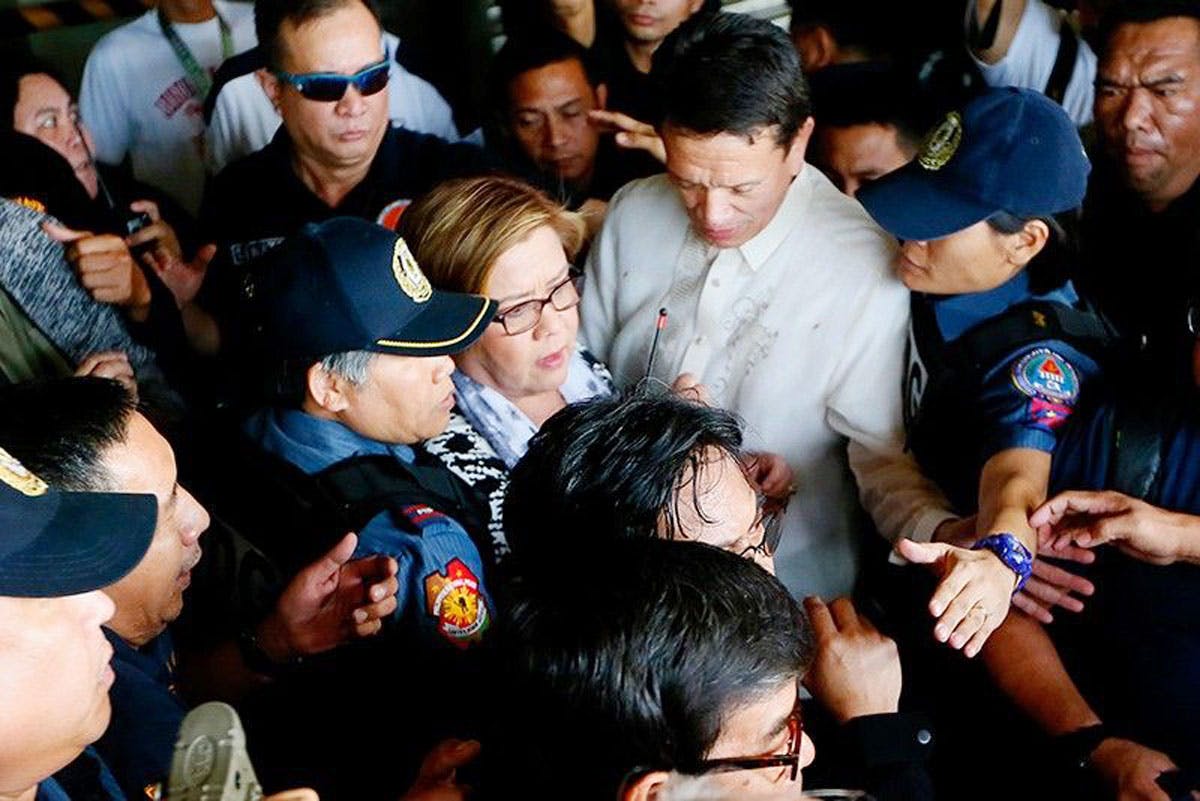
This she said she saw in the case of detained Sen. Leila de Lima, who is detained without bail on drug charges.
The Duterte administration has accused De Lima of raising campaign funds for her Senate bid from New Bilibid Prison inmates involved in drug trafficking when she was the secretary of justice, which has jurisdiction over the Bureau of Corrections. Among those who testified against De Lima were the convicts and her former personal driver. De Lima acknowledged that the driver was her former lover but denied involvement in drug deals; the Duterte administration has insisted that it has strong evidence against her.
Incidentally, it was three years ago today, Feb. 24, when De Lima surrendered to authorities after Muntinlupa Regional Trial Court (RTC) Branch 204 Judge Juanita Guerrero issued a warrant for her arrest.
De Lima, who remains a fierce critic of the President, first caught the ire of Duterte when she chaired the Commission on Human Rights during the Arroyo administration. She investigated him over reports about the alleged existence of a death squad in Davao when he was city mayor. When De Lima became senator, she also launched a probe into alleged extrajudicial killings under Duterte’s presidency.
Under Republic Act 9165 or the Comprehensive Dangerous Drugs Act, the offense for which De Lima has been indicted is non-bailable.
On Feb. 17, the RTC judge said there was probable cause to proceed with the charges filed by the Department of Justice (DOJ) against De Lima.
Read more: US Senate OKs resolution vs De Lima jailers
Mesure also cited the case of Ecuador’s former leftist president Rafael Correa, who was accused of orchestrating the attempted kidnapping of a former opposition lawmaker who fled to neighboring Colombia to avoid imprisonment for slander.
Secondly, Mesure pointed to a “politicized justice system.” In Brazil, she noted that months after convicting former president Luiz Inácio Lula da Silva of money laundering and passive corruption, judge Sérgio Moro joined the administration of Jair Bolsonaro as justice minister.
Thirdly, “lawfare” is marked by “multiplication of procedure… keeping people under pressure from the justice system” through the filing of multiple charges, Mesure said.
Lastly, she noted the maligning of certain politicians through the media, which would dig up old cases during the election campaign period.
Sen. Francis Pangilinan explained that “lawfare” thrives “within a system of justice and its institutions that are inherently weak and oftentimes inutile.” He lamented that the poor cannot afford to keep engaging the services of a lawyer for the many years that a case is expected to drag on.
“When a justice system is nearly nonexistent to an overwhelming majority of the people, it cannot hope to muster support and expect respect for the rule of law. A system of justice that is inherently weak serves to benefit the few and as such is vulnerable to manipulation and the machinations of the few to the detriment of the many,” Pangilinan said.
“When the levers of power are concentrated on a few, justice and the rule of law are not necessarily synonymous,” he added.
If the government is using the law as a weapon, Agabin said the oppressed should be able to turn to the Constitution.
“The Bill of Rights is a weapon. It’s a weapon against majority intolerance. It is a weapon precisely to preserve the democratic process, and the democratic process depends not only on the will of the majority but also the opinions of the dissenting minority,” he emphasized.
Agabin said the law should be wielded in accordance with “the primal values of the Constitution, and of course, our 1987 Constitution consists of a hierarchy of values, and on the top of these values is human dignity.”
Agabin quoted a passage by American judge Learned Hand: " Liberty lies in the hearts of men and women; when it dies there, no constitution, no law, no court can even do much to help it. While it lies there it needs no constitution, no law, no court to save it.
"Today, let not liberty die in the hearts of men and women," Agabin implored.


