



Decongesting Jails
The Supreme Court vows it is addressing jail congestion in the country as a result of the drug war.
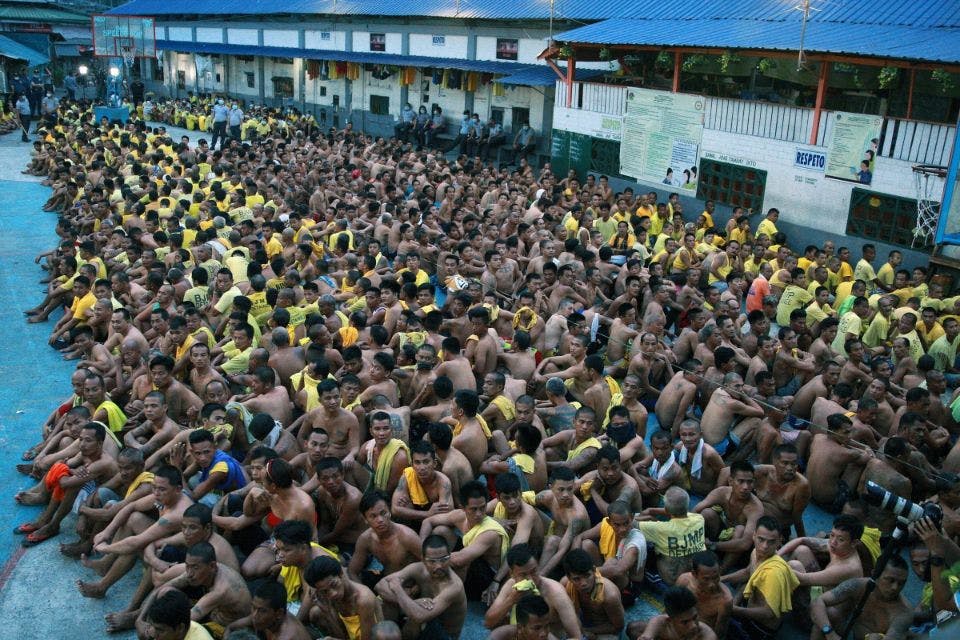
The Supreme Court is attributing the decrease in jail congestion to the measures it has undertaken since the drug war was launched by the Duterte administration in 2016.
Jail congestion in 2018 went down to 438 percent from 612 percent in the previous year or by 174 percent due to the continuous trial system and the plea bargaining rule on drug cases implemented in trial courts, according to Court Administrator Jose Midas Marquez.
The Commission on Audit (COA) recently said that while the congestion rate in the country’s jails decreased to 439.48 percent last year from 612 percent in 2017, the figure remains high, in violation of the Bureau of Jail Management and Penology (BJMP)’s own manual as well as the United Nations’ standards on the treatment of prisoners. (See BJMP: Jail congestion down by 34%)
At a forum in Club Filipino in San Juan City on July 25, Marquez explained that managing petty drug cases, which have clogged court dockets, has been among the priorities of the Supreme Court (SC) in addressing jail congestion.
Marquez explained that cases in regular courts grew from an average of about 300 in 2014 and 2015 to over 2,000 after May 2016 because of an “upsurge in newly filed drug cases.”
According to the BJMP, about 70 percent of the detainees’ cases are related to illegal drugs. About 180,000 drug suspects have been arrested since the start of the drug war.
“Drug cases clogged court dockets and congested jails. From jail congestion of 248 percent in 2014 and 411 percent in 2015, it surged to 612 percent in 2017,” Marquez noted.
He stressed that the SC immediately acted on the matter and promulgated rules to address the clogging of court dockets and jail congestion.
“Measures such as the plea bargaining in certain drug cases and the continuous trial system greatly reduced court dockets and decongested jails,” Marquez said. “With the implementation of these measures, the caseloads of regular courts went down from 2,000 to 3,000 cases to only 300 to 400 cases now.”
This development, he pointed out, also significantly reduced jail congestion to 438 percent last year.
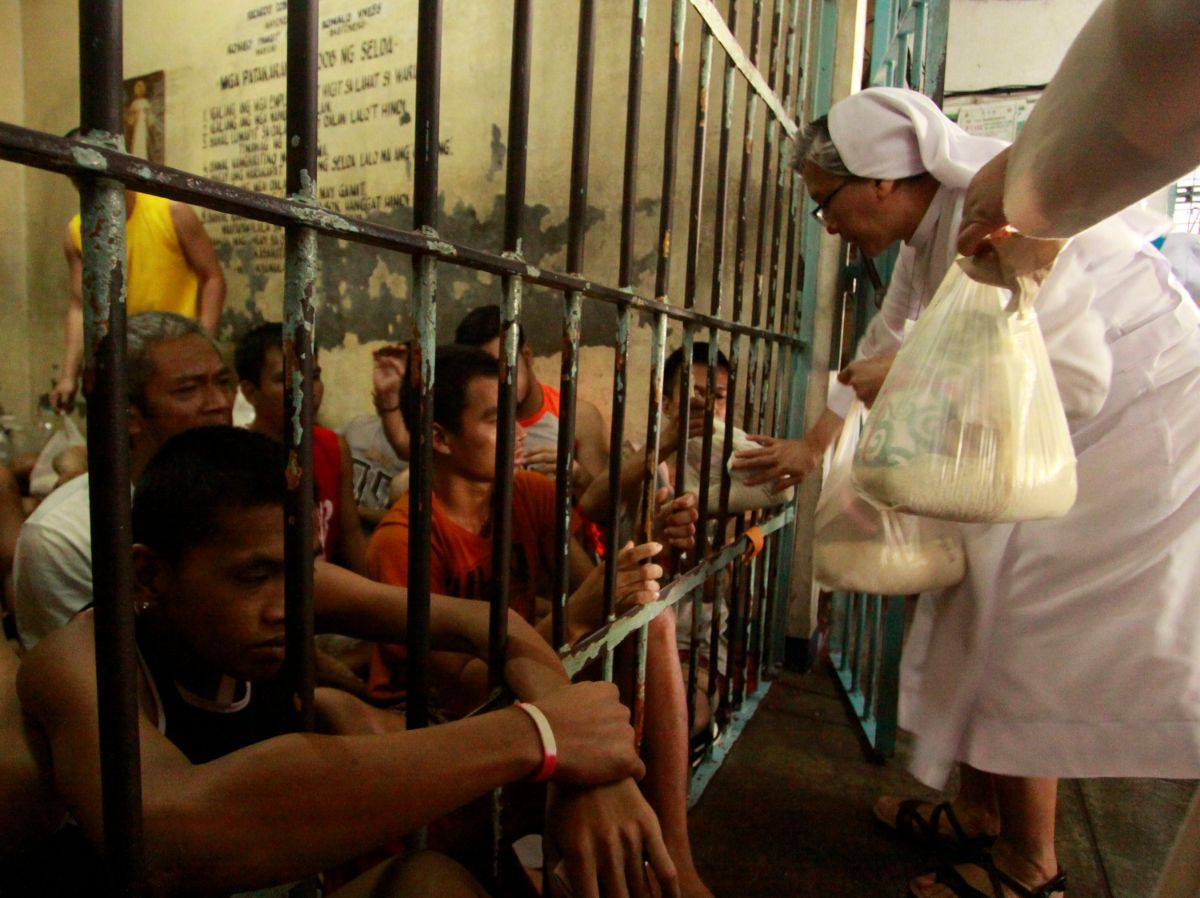
A nun distributes bags of goodies during a gift-giving activity at the Manila Police District headquarters jail in Manila on Dec. 15, 2018. Photo by Edd Gumban, The Philippine STAR
The SC authorized 240 more regional trial courts to try, hear and decide newly filed drug cases in addition to a total of 715 RTCs nationwide already doing this.
Marquez, who has administrative jurisdiction over trial courts, said he also directed these RTCs to closely monitor all branches handling drug cases and take measures to ensure efficient disposition and handling of cases.
He explained that the continuous trial system, which applies to other criminal cases, was formulated by the SC to expedite resolution of cases.
He said the court also issued Administrative Matter No. 18-03-16 last year allowing RTCs to approve plea bargain agreements in petty drug cases.
The rule specifically allows plea bargaining and probation in drug cases, but only when the charges involve possession of illegal drugs with less than five grams of shabu or less than 300 grams of marijuana, and the sale of less than one gram of shabu or less than 10 grams of marijuana.
Plea bargaining is also allowed when a defendant is charged with possession of five to 9.99 grams of shabu, or 300 to 499 grams of marijuana. However, probation of the defendant will not be allowed in such instances.
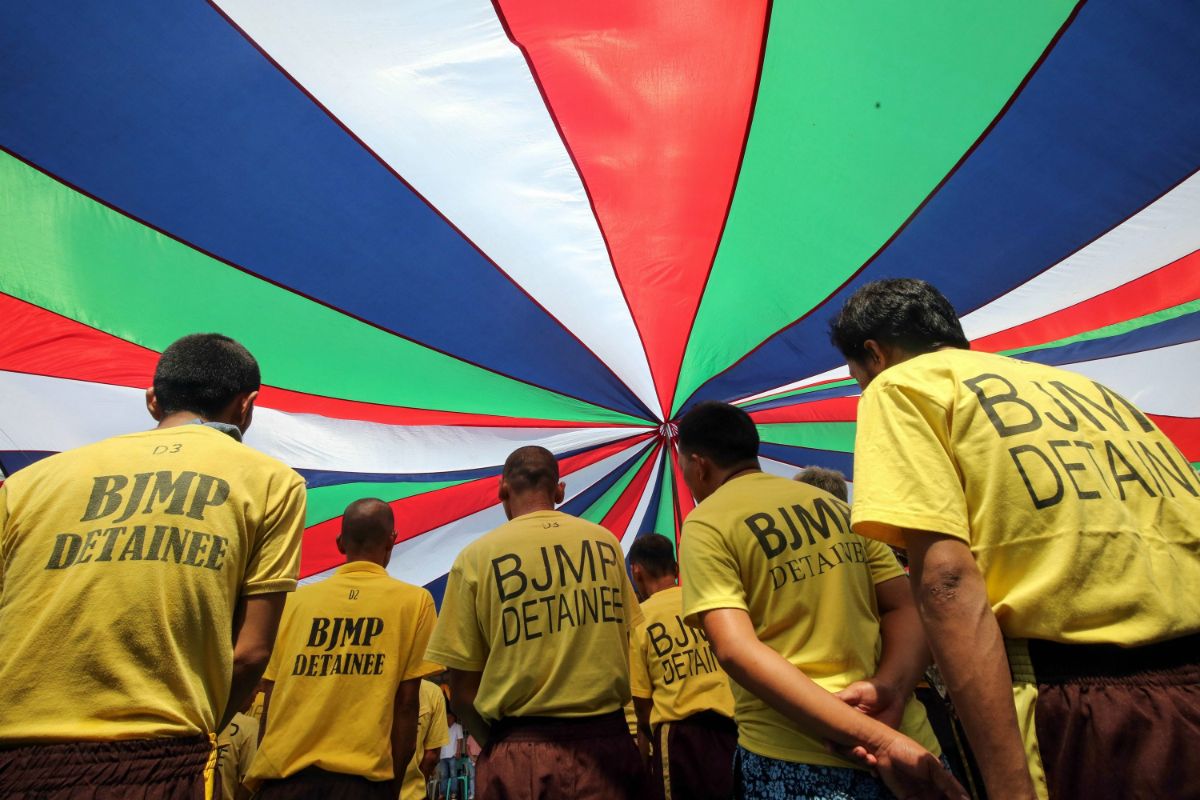
Inmates participate in the week long activity in celebration of the 223rd National Correctional Consciousness Week and Prison Awarenes Week at the Manila City Jail on Monday, Oct. 22, 2018. Photo by KJ Rosales, The Philippine STAR
Marquez reminded judges to be prudent in approving plea bargaining in drug cases. He directed judges under his administrative supervision to strictly follow the rules provided by the High Court, warning that judges who violate this rule face administrative cases.
He issued the statement in response to a recent warning by President Duterte on the approval of plea bargaining in drug cases.
Marquez revealed that the SC will continue to implement more measures to address docket and jail congestions, including remote testimony in criminal cases, which will be pilot-tested in Davao City trial courts in September.
The COA attributed the high population in jails to the increase in the number of drug-related cases in the country as well as the courts’ slow action on pending cases.
It said the lack of judges, postponement of hearings and slow disposition of cases that carry the penalty of life imprisonment were the causes of the courts’ inaction or slow action on pending cases. The other reason cited was the inability of impoverished detainees to post bail.
“Some cases were bailable, but detainees who are below the poverty line cannot afford to post bail so they were stuck in the jails,” the COA said.
In response, the BJMP informed the COA that it is now working with the SC on the possibility of early release of inmates facing drug-related charges through the proposed Katatagan Kontra Droga sa Komunidad or KKDK program.
Jail congestion leads not only to health and sanitation problems but also makes inmates vulnerable to joining criminal gangs, according to the COA.
It also noted that the continued overcrowding in the district, city, municipal and extension jails as well as female dormitories violates the BJMP’s “Manual on Habitat, Water, Sanitation and Kitchen in Jails” and the UN’s “Minimum Standard Rules for the Treatment of Prisoners.”
The COA noted that under the BJMP manual, the ideal habitable floor area for each inmate is 4.7 square meters and the ideal maximum number of inmates per cell should only be 10.


