



Davao City Placed Under MECQ; Shorter Quarantine For Returning Vaccinated Filipinos OK’d
The government has approved the request of Davao City Mayor Sara Duterte-Carpio to place the area under stricter modified enhanced community quarantine until June 20.
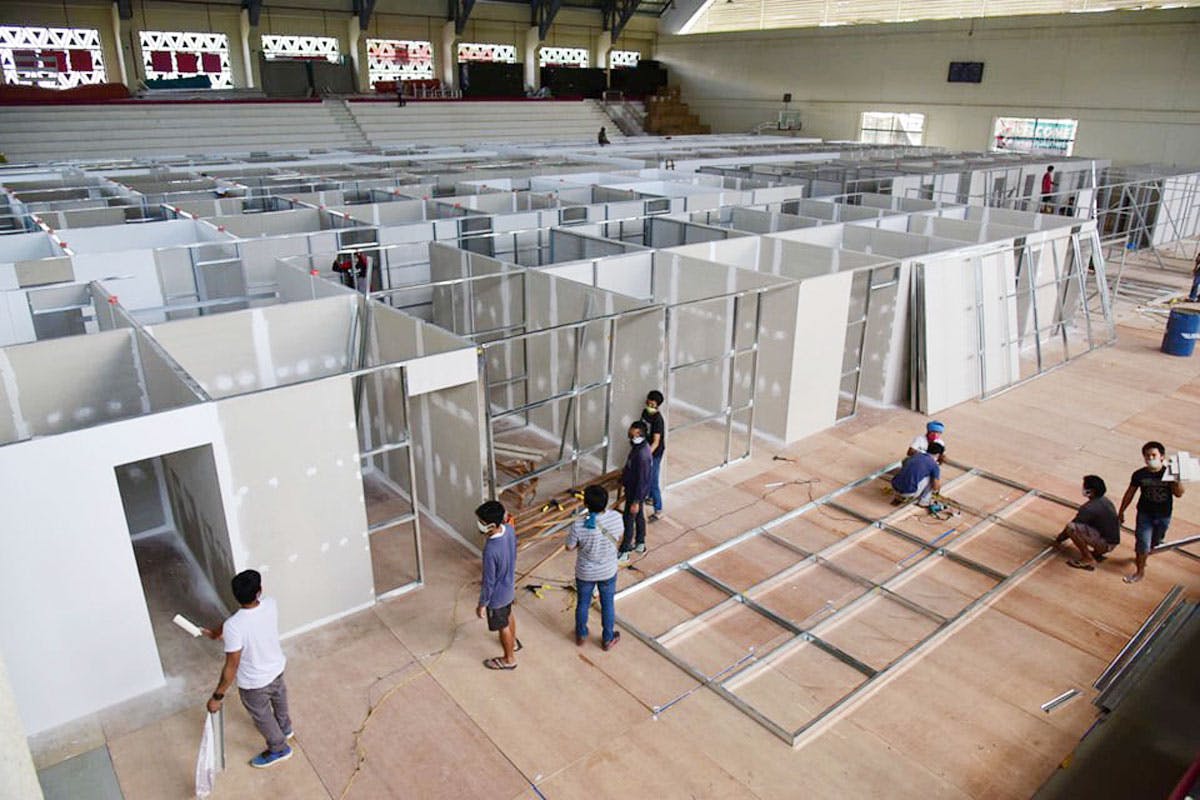
Following the surge in new COVID-19 cases, the Inter-Agency Task Force (IATF) for the Management of Emerging Infectious Diseases has placed Davao City under stricter modified enhanced community quarantine (MECQ) from June 5 to June 20.
The IATF made the decision following the request of Mayor Sara Duterte-Carpio and the recommendation of the task force’s Screening and Validation Committee for quarantine reclassification of provinces, highly urbanized cities and independent component cities.
Duterte-Carpio earlier requested the national government to place the city under MECQ until the end of the month, citing the active cases reaching 1,665 as of May 31.
But presidential spokesman Harry Roque said the IATF only imposed a 15-day MECQ or until June 20, with an extension subject to review within two weeks.
Aside from Davao City, the IATF also escalated the quarantine classification of General Santos City from modified general community quarantine (MGCQ) to GCQ until June 30.
Last month, the city has closed its borders to non-essential travel due to a surge in new cases COVID-19 cases.
The OCTA Research Group on Friday, June 4, urged local government officials in areas experiencing a surge to consider stricter quarantine guidelines to control the spread of COVID-19.
OCTA fellow Ranjit Rye also welcomed IATF decision approving Davao’s shift to MECQ.
“While the situation in NCR is normalizing, surges all over the country now exist and they threaten the health capacity of many regions,” he said during an online forum organized by the Cardinal Santos Medical Center.
“We’re exhorting other LGUs (local government units) to consider going to stricter quarantine to deal with these surges because these quarantine restrictions, these heightened restrictions do work especially when you are trying to slow down a surge,” he added.
During the same forum, OCTA fellow Guido David noted the continuing increase in new cases recorded in some areas outside the NCR.
Among those that recorded significant increases in daily new cases in the past week were Davao City with 193 (up 69% from 114), Cagayan de Oro with 138 (up 48% from 93), Iloilo City with 122 (up 108% from 59) and Bacolod with 104 (up 47% from 70).
Also posting significant increases were Tuguegarao with 84 new cases per day in the past seven days (up 144% from 34), General Santos with 66 (up 19% from 55) and Butuan with 54 (up 38% from 39).
In Metro Manila, David said some LGUs have recorded an increase in average daily new cases in the past week, most notably Caloocan with 103 (up 33% from 77) and Parañaque with 88 (up 74% from 50%).
The reproduction number in the region, which indicates the number of persons a positive individual can infect, is still below the ideal 1.0 but has increased from 0.59 to 0.71.
Shorter quarantine
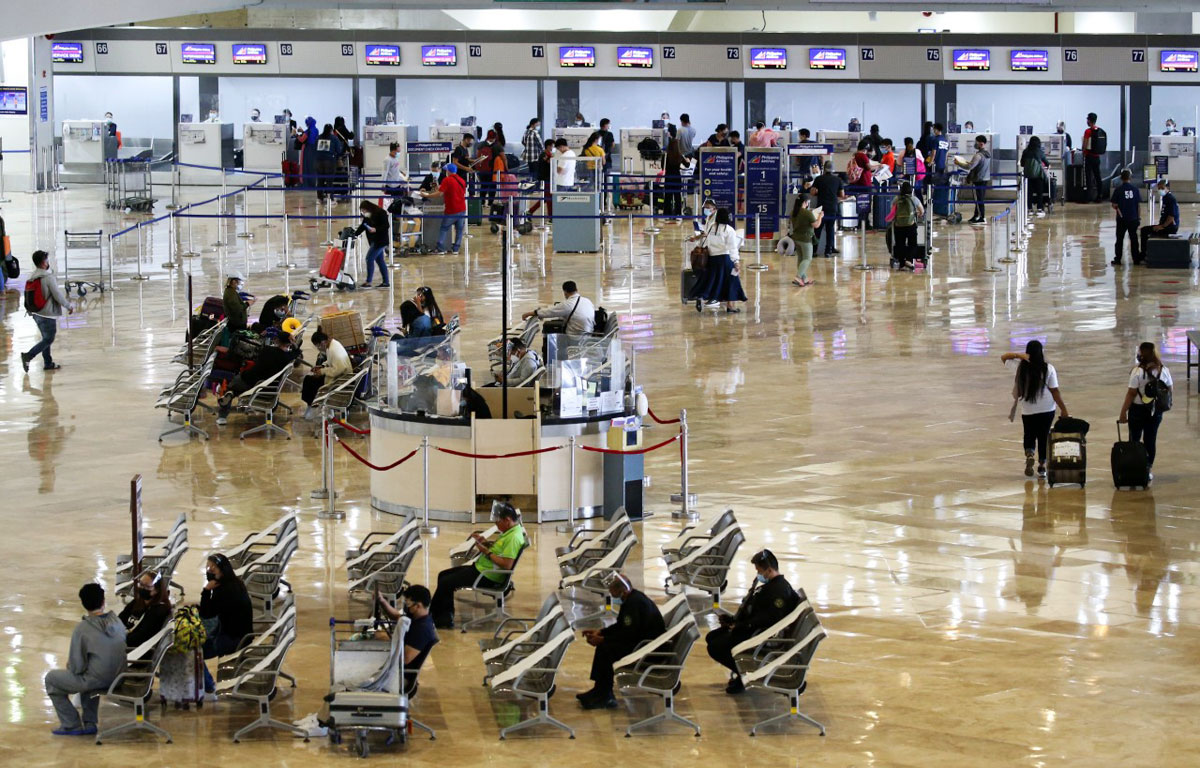
Returning Filipinos who got fully vaccinated in the Philippines still need to undergo quarantine procedures, but for a shorter period of seven days upon arrival in all ports of entry in the country, the IATF also said.
The IATF noted the COVID vaccines recognized in the Philippines are those that have been issued emergency use authorization (EUA) or approved for compassionate use by the country’s Food and Drug Administration (FDA).
“Vaccines administered to the individual are included either in the Philippine Food and Drug Administration Emergency Use Authorization list or through a Compassionate Special Permit,” the IATF said under Resolution No. 119.
These include Sinovac, Pfizer, AstraZeneca and Sputnik V, which have EUA, and Sinopharm, which enjoys a compassionate use permit from the FDA.
Citing the resolution, Roque said the task force resolved that all arriving fully vaccinated individuals, who have been inoculated in the Philippines, shall be required to undergo a seven-day facility-based quarantine upon arrival.
However, the latest order places on status quo the regulations for returning Filipinos and overseas Filipino workers (OFWs) who still need to comply with the 10-day mandatory quarantine in a facility.
“This does not cover foreign nationals, overseas Filipino workers and Filipinos who have been fully vaccinated abroad. They have to undergo the regular quarantine and testing protocols, which is, to complete a 10-day facility-based quarantine,” he added.
Under the resolution, Roque said that an individual shall be considered as fully vaccinated for COVID-19 if the person has been inoculated for more than a period of two weeks after getting the second dose in a two-dose series, or two or more weeks after receiving a single-dose vaccine.
The returning Filipino should be able to present his or her vaccination card to authorities, which must be verified prior to departure. The vaccination card must also be presented to a Bureau of Quarantine (BOQ) representative for re-verification at the Department of Transportation (DOTr) One-Stop Shop upon arrival in the Philippines.
All inbound fully vaccinated individuals shall be required to undergo a seven-day facility-based quarantine upon arrival. The BOQ shall ensure strict symptom monitoring while in the facility for seven days.
Reverse transcription polymerase chain reaction or RT-PCR test shall only be done when the individual manifests COVID-19 symptoms within the seven-day quarantine. After completing the week-long quarantine, the BOQ shall issue a Quarantine Certificate indicating the individual’s vaccination status.
Apart from the quarantine procedures, the IATF has implemented that returning Filipinos should be subject to quarantine regardless if they are vaccinated or not.
An individual is also subjected to mandatory RT-PCR swab test on the seventh day upon arrival in the country, in addition to other health protocols such as wearing of face masks, face shields and physical distancing.
New policy assailed
Sen. Joel Villanueva called for an “immediate review and reconsideration” of the latest IATF issuance for inbound international travelers.
“If you are a Filipino who's been vaccinated with Pfizer vaccine in the US, the order does not cover you. It is also not applicable to a returning OFW from Europe who has gotten two doses of Moderna,” Villanueva said.
“The IATF order does not honor a vaccine passport. Only those who have been vaccinated here will be exempted from certain aspects of quarantine,” he pointed out.
The policy also does not liberalize entry protocols for stranded OFWs, and balikbayan or returning Filipinos who have been wanting to be reunited with their families.
“In coming up with policies, such must be simple, practical, easily understandable, and most of all, helpful to our countrymen, especially OFWs,” Villanueva said.
Repatriates
Meanwhile, repatriated Filipinos from countries subject to the government’s travel restrictions due to the COVID-19 pandemic may be allowed to come home, but they need to undergo the strict 14-day quarantine upon arrival in the country.
“The IATF likewise required all repatriates from countries with travel restrictions in effect to be placed on a strict 14-day facility-based quarantine from date of arrival in the Philippines, with the date of arrival being the first day,” Roque said, further citing provisions of IATF Resolution No. 119.
He said the IATF has exempted non-Philippine government repatriation efforts to the entry restrictions imposed on travelers from India, Pakistan, Nepal, Sri Lanka, Bangladesh, Oman and the United Arab Emirates.
Executive Secretary Salvador Medialdea, in memos dated May 14 and May 31, had imposed the suspension of entry of travelers from the seven aforementioned countries.
Filipinos returning from these countries as part of repatriation efforts of the government are exempted from travel restrictions. The IATF earlier also provided protocols for reasonable exceptions.
In case of Philippine government-organized repatriation, Roque said the IATF has directed the Department of Foreign Affairs (DFA) and the Overseas Workers Welfare Administration to coordinate with each other at least 48 hours prior to departure from the country of origin.
The Department of Health-BOQ, DOTr and its One-Stop Shop and the Civil Aviation Authority of the Philippines and the National Task Force Against COVID-19 Task Group for the Management of Returning Overseas Filipinos shall also be part of the organizing team that will ensure the safe arrival of repatriated Filipinos.
For Filipinos whose repatriations are not sponsored by the Philippine government, Roque said all Filipino repatriates from the countries with travel restrictions must present a negative RT-PCR test result taken within 48 hours prior to boarding the aircraft or vessel. The airline or the shipping line is responsible to check on this requirement.
A copy of the negative RT-PCR test result of the repatriate shall be submitted to the BOQ upon arrival in the port of entry in the Philippines.
The IATF also mandates the prior approval from the BOQ for the entry of flight or vessel carrying Filipino repatriates prior to its movement from point of origin.
In case of seafarers, the concerned local manning agency shall submit an exemption request to the DOH-BOQ, the approval of which is tantamount to IATF’s approval on the repatriation effort.
The same rule goes for land-based workers to be handled by the Philippine recruitment agency or the sponsoring Philippine government agency.
Roque added the IATF allowed foreign nationals holding Special Resident Retiree’s Visa to enter the Philippines without the need of an entry exemption document.
In relation to this, Roque said the IATF directed the DOH, Department of Finance, Department of Trade and Industry, DFA and the National Economic and Development Authority to convene and provide recommendations to further relax testing and quarantine protocols for certain classes of travelers.
The IATF has allowed the Philippine Racing Commission two additional racing days beginning July 1, 2021, subject to approved health and safety protocols and the use of fully functional contact tracing applications of off-track betting stations.
Domestic seat sale
Airline Cebu Pacific (CEB) has launched a special all-domestic seat sale for immediate travel to welcome the government’s recent announcement allowing Filipinos to travel for leisure again.
In a statement, it said for as low as P88 one-way base fare, passengers can now book until June 11, 2021 to any domestic destination through March 26, 2022.
“We welcome this development and hope that this will continue as we all look forward to safely restart domestic tourism again. We are especially happy to resume our daily flights to Boracay, which solely cater to tourists,” said Candice Iyog, Cebu Pacific vice president for marketing and customer experience.
Starting Friday, CEB will begin flying twice daily between Manila and Boracay. Apart from this route, CEB also operates regular flights to Bacolod, Bohol, Cagayan de Oro, Cebu and more local destinations across its domestic network.
The airliner has also permanently removed change fees in March, allowing passengers to rebook whenever and as many times as they need to. – With Paolo Romero, Rudy Santos


