



COVID Phl’s 3rd Leading Cause Of Death In 2021
Registered deaths related to COVID-19 reached 105,723 from January to December 2021, representing 13.8 percent of the total.
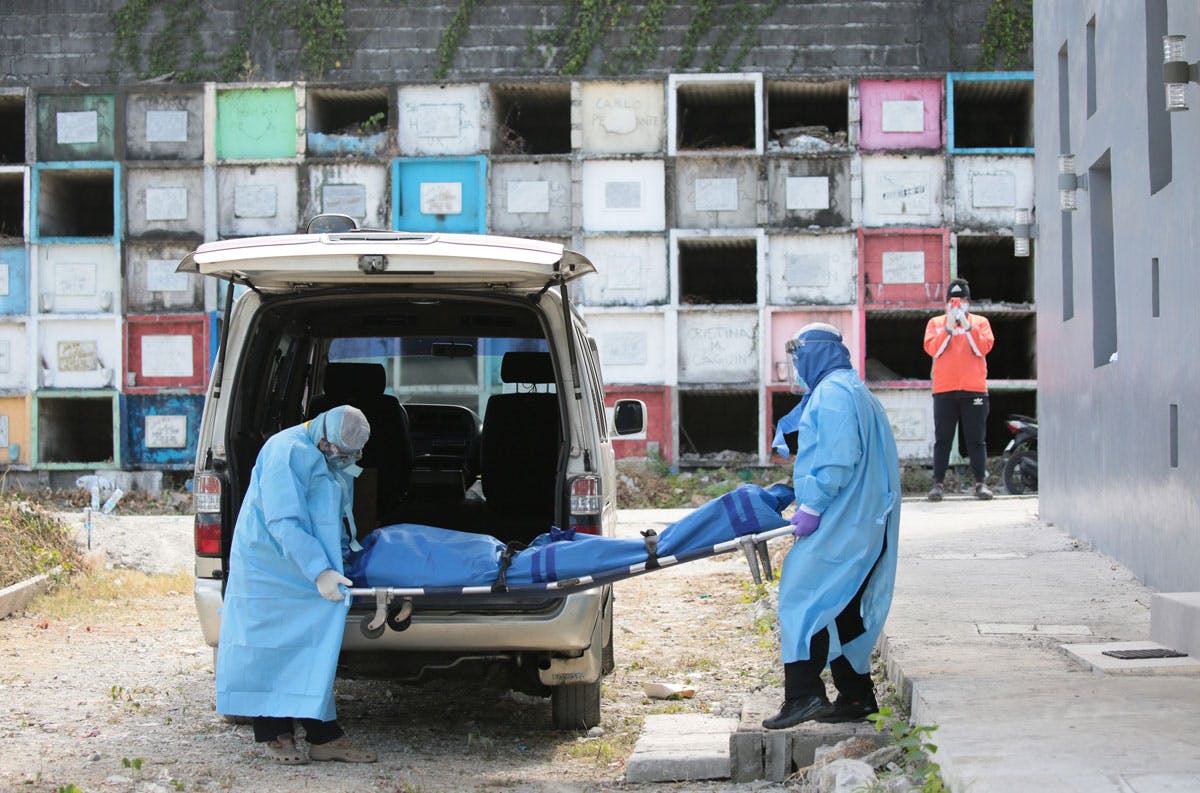
Deaths due to COVID-19 further increased last year, with the disease considered as the third leading cause of mortality in the country in 2021.
Data from the Philippine Statistics Authority (PSA) showed that the preliminary number of registered deaths for the entire 2021 reached 766,126 – 24.8 percent more than the 613,936 in 2020.
The top causes of deaths were ischaemic heart diseases (136,575) and cerebrovascular diseases (74,262).
Registered deaths related to COVID-19 reached 105,723 from January to December 2021, representing 13.8 percent of the total.
Deaths associated with COVID-19 are classified into “virus identified” and “not identified” at the time of death.
There were 74,008 deaths from COVID-19 “virus identified,” representing 9.7 percent of the total deaths, making it the third leading cause of death in the country last year.
When including those who died from COVID-19 “not identified” at the time of death — 31,715 cases — this would total 105,723, making it the second leading cause of death.
The Department of Health (DOH), however, recorded only 42,258 COVID deaths last year.
The discrepancy between the PSA and DOH data should be taken into consideration as data from the former are based on descriptions written on the medical certificate portion of all death certificates received as certified by local health officers, while data from the DOH were collected through a surveillance system.
COVID-19 deaths as per PSA data refer to both confirmed and probable cases as of registration, whereas figures released by DOH were deaths from confirmed cases only.
Still, COVID-19 deaths at 105,723 – both virus identified and not – registered a hefty 250 percent from the 30,188 in 2020.
The 74,008 deaths due to COVID-19 “virus identified” or 9.7 percent of the total is a whopping 700 percent increase from the 9,316 deaths in 2020. During that year, COVID-19 (due to SARS-CoV-2) was just the 14th leading cause of death in the country.
Last year, more deaths were registered amid the second wave in April and third wave in August due to the more transmissible Delta variant that resulted in more severe and critical cases.
Among the regions, Calabarzon recorded the highest number of deaths due to COVID-19 with 21,165 or 20 percent of the total. This was followed by Metro Manila with 19.8 percent and Central Luzon with 17.8 percent.
In the National Capital Region, Quezon City saw the biggest mortality figures due to the virus at 4,660 deaths or 22.3 percent of the total. Manila came in second with 14.2 percent, followed by Pasig with 9.9 percent.
Minimal risk?Days before the announcement of the updated alert level classifications, the DOH reported that the country remains at minimal risk for COVID-19 and the health care utilization rates remain low.
Health Secretary Francisco Duque III said the country recorded 2,651 new infections from March 23 to 29, lower than the 3,319 posted during the previous week. The latest figure translates to a daily average case of 378.
Only 14.5 percent of intensive care unit beds and 17.5 percent of non-ICU beds are in use while 11.6 percent or 752 out of the 6,509 total admissions are severe and critical cases.
“Overall, the good news is our risk classification remains at minimal risk while our health care utilization rates are at low risk,” Duque said during a meeting with President Duterte and other officials last Monday.
Metro Manila is still the top region in terms of new infections with 896 followed by Calabarzon with 368 and Western Visayas with 276.
Areas that contributed the highest number of new cases were Cavite with 178, Manila with 143 and Iloilo province with 134.
The government’s pandemic task force is expected to announce today the updated alert level classifications to cover the first half of April.
70 cases per day?By end of April, COVID-19 cases in the country are projected to drop to as low as 70 per day.
Citing the projections of FASSTER or Feasibility Analysis of Syndromic Surveillance using Spatio-Temporal Epidemiological Modeler, Health Undersecretary Maria Rosario Vergeire said the country may have daily cases of 70 to 268 cases by April 30.
She noted that this projection is based on several “assumptions,” including the Omicron variant being 2.05 times more transmissible than Delta variant and the mobility nationwide is at the “pre-pandemic level already.”
The other assumption is that there is a “status quo” in compliance with minimum public health standards (MPHS) and the COVID-19 vaccine coverage is at 75 percent for fully vaccinated nationwide and 15 percent for those boosted.
“If the compliance to MPHS decreased, for instance, to 20 percent, our daily national cases will reach 670 cases by April 30,” she said, adding that projections are “not cast in stone.”
“Anything can still happen. There are a lot of risk factors present right now that could lead to the rise in cases in the coming weeks or months,” she said.
The official added there are other risk factors that “may come into play” such as the emergence of a new variant.
Aside from this, the coverage of COVID-19 vaccination in an area may decrease, leading to the rise of cases there.?Positivity rate?At present, the country’s positivity rate for COVID-19 continues to go down, way below the five-percent recommendation of the World Health Organization (WHO).
Vergeire said the positivity rate from March 21 to 27 was pegged at 2.1 percent, lower than the 2.7 percent in the previous week.
She said a total of 147,927 swab samples were tested but only 3,145 of them yielded SARS-CoV-2, representing a 2.1 percent positivity rate.?She said this downward trend was observed across all regions of the country due to continued compliance with safety protocols and vaccination. – With Sheila Crisostomo, Alexis Romero?


