



‘Beyond Gov’t Interventions, Education Still Best To Ensure Motorcycle Riders’ Safety’
An official of a motorcycle federation recalled administering a “simple” test about road signs, road marks and other motorcycle related laws, with only 10 percent obtaining a passing score.
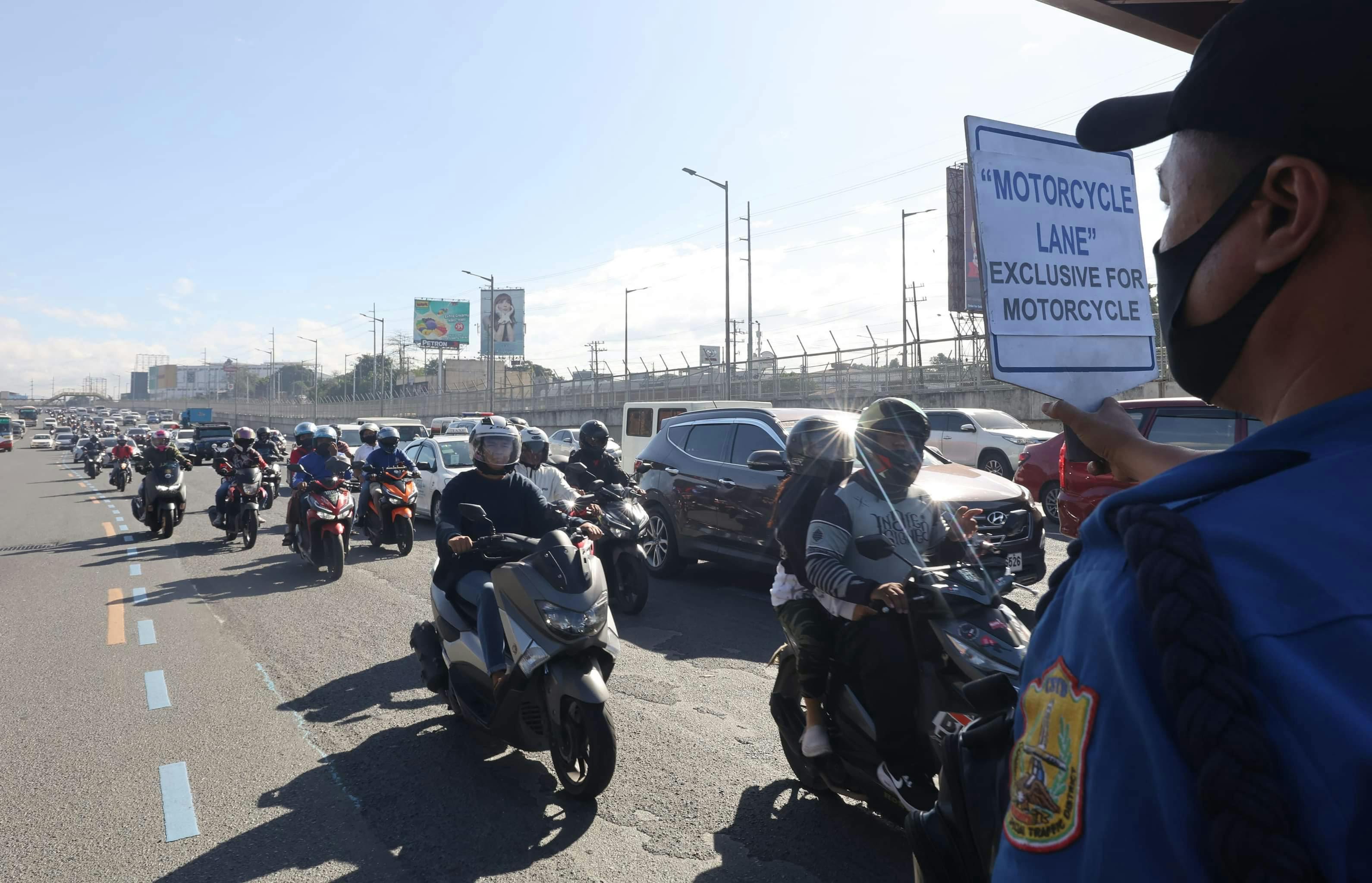
While motorcycle lanes and other forms of government intervention work, the head of a motorcycle federation said proper education will best ensure rider safety in the Philippines.
During an interview on “Agenda” over One News last Wednesday, June 21, Motorcycle Philippines Federation director for administration Atoy Sta. Cruz cited data showing the effectiveness of motorcycle lanes during the time of Sen. Francis Tolentino as chairman of the Metropolitan Manila Development Authority (MMDA).
Tolentino, who served in the MMDA from 2010 to 2015, supported the establishment of motorcycle lanes along EDSA, Commonwealth Avenue and Diosdado Macapagal Boulevard.
Despite its effectiveness, Sta. Cruz said many riders, especially those from the provinces, lacked knowledge on how to use these lanes.
He stressed the need for the riders to be educated on these interventions, along with the most basic things that they need to learn when on the road.
Sta. Cruz said they regularly conduct seminars with the Land Transportation Office so that riders would understand better if enforcers explain to them their violations.
“Five years ago, when I was talking to Senators Bong Revilla and Loren Legarda… they thought and said that riders are stubborn, but I told them that there are lots of studies to prove that we have to educate them,” he explained.
He recalled administering a “simple” test about road signs, road marks and other motorcycle related laws before starting a seminar in 2018. Out of 10,000 rider-examinees, only 10 percent obtained a passing score of at least 40 percent.
“When you get 40 items right, you will not be apprehended nor be in an accident. If you get 30, there’s a possibility you still get apprehended because you do not know road signs or even cause an accident,” Sta. Cruz said.
“But when you get 20 items or even lower right, get in touch with an orthopedic as well as Saint Peter,” he added, referring to a funeral home.
Sta. Cruz noted that it unlikely that riders underwent driving school, saying exams and recitation would expose their lack of knowledge about basic rules and road safety guidelines.
“A lot of these riders pretend to be smart, but when it comes to our exams and questions, that’s when you see that there are a lot of things they do not know,” Sta. Cruz said.
According to Sta. Cruz, his advocacy started when he was under S.C. Kymco, a Taiwanese motorcycle manufacturer. That time, he saw that the Taiwanese are conscious of road safety and would check the motorcycle’s safety features.
Lack of succession, consistent support
A glaring issue Sta. Cruz pointed out is lack of succession and consistency during changes in the administration.
He said this has been the case since the start of Motorcycle Philippines Federation. For instance, after Tolentino’s departure from MMDA, he noted that they were no longer called during consultations.
“What happens when the administration changes, our memorandums of agreement tend to be cut off. So that’s always the case,” he said.
Sta. Cruz also noted opposition on some of their recommendations, such as requiring the need for seminars before purchasing motorcycles.
“When registering a motorcycle… there would be stricter requirements, or a seminar would be required for riders… but there are lobbyists, manufacturers who oppose this because sales would decline… that’s their problem among many others,” he said.
While there are politicians who support motorcycle riders, Sta. Cruz said many stay silent in times of adversity.
For instance, he stressed the need to study and limit racing in local roads, citing an incident during the 2023 BMW Owners Society of Saferiders Ironman Motorcycle Challenge last March, when two participating motorcycles were hit by a car along San Esteban highway in Ilocos Sur.
“In the highway, what’s the speed limit? From what I heard, the riders were at 180 (kilometers per hour), which startled the car… In the interview, the car driver said they had temporary blindness because of high intensity lights and they were going fast,” Sta. Cruz explained.
He noted a lack of regulations for illegal motorcycle races, along with the lenient implementation of Republic Act 10054 or the Motorcycle Helmet Act of 2009, particularly in provinces.
Sta. Cruz maintained that education is the best way to resolve these issues, which is why he continues to hold seminars, such as his organizations Motorskwela that will be done in cooperation with the Department of Interior and Local Government.
These, he said, would be conducted in schools given cases of young people sneaking out to participate in illegal races using their parents’ motorcycles.
“That’s it. Educate them, enforce the laws… They should at least know. I don’t want to call them kamote(irresponsible) riders anymore… They do not know the laws,” he said.


